Back in 1882 at The Oval, the Australians first caged the British lion, and The Sporting Times triumphantly printed English cricket’s “obituary.” Journalist Reginald Shirley Brooks even joked that the ashes of that cremated body had been carried off to Australia. That is how the Ashes series got its name. A century and a half later, on the twenty-two yards of Darwin, has Australian cricket now been sent to its own funeral, following this kangaroo-slaying?
Were he still alive, David Hookes — the very gentleman who wrote in the Sydney Morning Herald in 2003, when Bangladesh toured Australia, that everyone should prepare for “a one-day Test” — might have let out precisely that lament today. And yet, remarkably, there was no uproar at Marrara Cricket Stadium, no advance fanfare — and still, a silent transformation unfolded in the long epic of Test cricket.
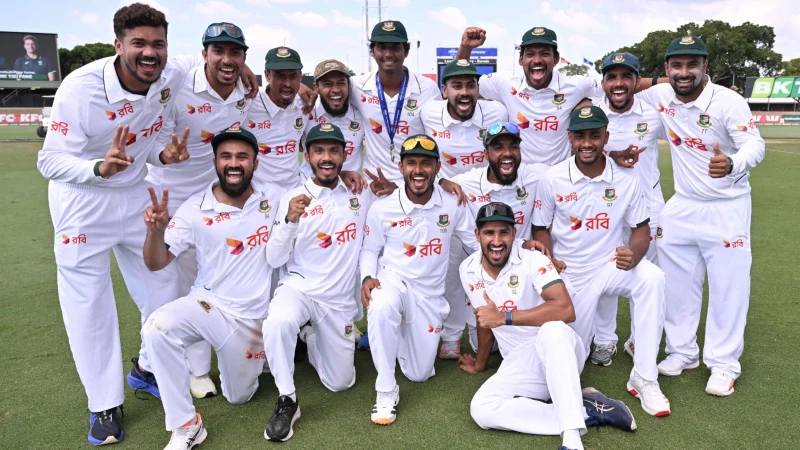
Any discerning Bangladeshi would be forgiven for wanting to scoop up a handful of this hallowed Darwin soil and bring it home. Selector Habibul Bashar Sumon, traveling with the squad, smiled in agreement when that wish was put to him. What Pakistan could not manage this century, what no Sri Lankan sorcery in modern cricket could conjure — after 23 long years of being shunned and overlooked in Australian territory, Najmul Hossain Shanto’s Bangladesh did exactly that on the strength of just a one-week invitation. They went to Australia and beat Australia at Test cricket, on Australian soil. Having shattered the arrogance of a superpower, the Tigers’ hunger for victory has today brought not just the Darwin stands but the entire cricketing world to a standstill.
Sukanta’s lines keep coming to mind: “Bravo, Bengal, this earth watches on in wonder: though burned to ashes, still it will not bow its head.” On Darwin’s green carpet today, the red-and-green’s representatives seemed to write precisely that kind of glorious tale of indomitable defiance.
Where does Australia sit, the crowned king of Test rankings lodged firmly at number one, and where does a scrappy Bangladesh languish, floundering at ninth from the bottom? In the cricketing ledgers of the pundits, this match’s result had already been written, one-sided, before the coin was even tossed. An unequal, mismatched, and — it seemed — foregone contest. And indeed, that is precisely what happened: Bangladesh won an unequal fight, first bowling Australia out for 198; it was mismatched, too — Bangladesh piled on more than four hundred runs (426), riding centuries from Tanzid Tamim and a 65-run innings from Mehedi Hasan Miraz; and, in the end, it was a foregone three-and-a-half-day contest, as Hasan Mahmud and Mehedi Hasan bowled Australia out for just 284 in the second innings as well. Some are calling this win an “upset.” But given how methodically Shanto’s side executed their plan across all eleven sessions of the Test, calling it an upset feels almost like an insult.
Before the Test even began, the Australian media had asked Pat Cummins whether it would be over in two days or three — there was a certain disdain toward the visitors in that question. Perhaps it was precisely that arrogance that fueled Shanto’s Bangladesh as they dismantled Travis Head and Steve Smith’s Australia in three and a half days, as easily as scattering puffed rice. As Hasan Mahmud’s swing and Miraz’s web of spin brought the kangaroos’ pride crashing down like a house of cards, the sky and air over Darwin bore witness to a new awakening. This was no miracle, no fluke — pushing cricket’s aristocratic kings onto the back foot for three and a half days straight was, in truth, the name of the Tigers’ concentrated fighting spirit, and one of the most revolutionary turns in cricket history. Nor can the magnitude of this win be diminished by any suggestion that this was Australia’s “A,” “B,” or “C” side. Travis Head, Labuschagne, Smith, Green, Carey, Cummins, Starc, Hazlewood, Lyon — this was, in effect, Australia’s Ashes-winning side.
Midway through the match, Australian pacer Josh Hazlewood made a rather helpless admission — that they didn’t even have video footage on many of Bangladesh’s cricketers, that the players were largely unfamiliar to them. When someone from the world’s top-ranked Test side says something like that, it raises questions about their professionalism — or else it reveals just how indifferent they had been toward Bangladesh. This was their first match of the new season, yet they had arrived in Darwin only two days beforehand. Some squad members gathered in Brisbane, but the camp wasn’t a long one. Perhaps they assumed, simply from the name “Bangladesh,” that there wasn’t much homework needed. It’s also possible they had prepared for cricketers like Mushfiqur and Taskin, only to find themselves facing a Test examination set by Hasan Mahmud, Tanzid Tamim, and Mehedi Hasan Miraz — men who had spent nearly two years mentally preparing specifically for this series. Hasan Mahmud had gone to Kent in England for a trial and earned his place in the county side; he put that experience of playing county cricket to good use in this match.
The unrestrained tears of winning the ICC Trophy in a fog-bound Kuala Lumpur in 1997 to claim a place on the world stage, or the unbelievable feat, born of youthful audacity, of knocking a mighty India out of the 2007 tournament in Trinidad — these hold an eternal place in the treasured emotional core of Bengali hearts. Exactly two years after that, in 2009, the epic of whitewashing the West Indies on their own Caribbean islands, or that thrilling Test win on home soil that shattered the pride of cricket’s very inventor, England — measure these carefully, and not one of them is worth a fraction less! Each of those wins was, given its own context and the challenges of that time, one of the finest advertisements in our cricketing history.
The famous 2022 Test win at Mount Maunganui, or the history wrested away from the heart of Rawalpindi in 2024 — this nine-wicket win in Darwin eclipses them all in an instant. To call it merely winning a cricket match would be an insult to the grammar of the sport itself; this is, in truth, the tale of a silent, ruthless humbling of an empire on twenty-two yards. For 23 long years, the Australians had built a wall of cricketing untouchability, refusing to let the red and green step into their yard — never inviting them to stadiums like Sydney or Melbourne, instead summoning them dismissively to a ground like Darwin. Shanto’s side has trampled that condescension underfoot to seize this win.
After this epic triumph in Darwin, the way the cricketing world looks at Bangladesh on the map has changed forever. From now on, everyone will view this red-and-green side with respect and profound regard. Those who, for so long, dismissed Bangladesh as merely a “conditions-exploiting” home team or a fleeting side capable of the occasional upset have had their old lenses shattered today. Marching into the lair of world cricket’s aristocratic elite and dismantling them in a trap of their own making, Shanto’s side has proven that Bangladesh is no longer some peripheral or pitiable side — but a new superpower of the twenty-two yards. The crown of honor the Tigers wore on Darwin’s green carpet today has brought Bangladesh supreme recognition and lasting distinction in the court of world cricket.
বাংলায় মূল প্রতিবেদন পড়ুন · Read the original Bengali report