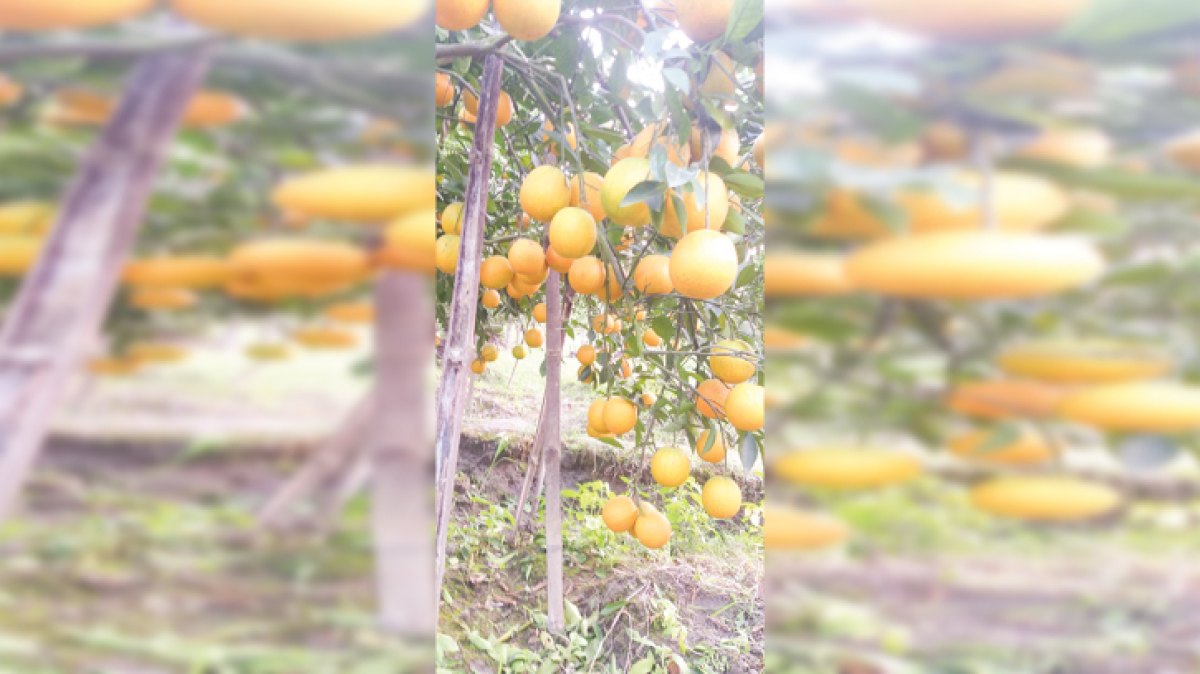
He began his venture with just 1,500 taka (500 taka) in capital, without major infrastructure or institutional assistance, relying only on self-belief, hard work, and a determination to try something new. Guided by that vision, Abdul Karim, an agricultural entrepreneur from Mujgunni village in Manirampur upazila of Jashore, transformed a modest seedling nursery into a thriving 25-bigha fruit orchard (25 bighas). Today, the plantation is filled with China orange, yellow malta, and plum trees, providing regular employment for 20 workers (20 people), most of whom are women.
Abdul Karim's journey is not merely an entrepreneur's success story; it serves as a practical model for how rural economies in Bangladesh can generate new opportunities through limited capital, perseverance, and long-term planning.
In 1997, Karim launched his nursery business with just 1,500 taka. Though he started small, his goals were ambitious. He navigated initial hardships, capital shortages, and uncertainty without giving up, expanding his nursery operations while experimenting with new fruit varieties. Nearly 12 years ago, he realized foreign fruit varieties could flourish in Bangladesh's soil and climate, leading him to pilot China orange cultivation despite widespread skepticism. After initial trials succeeded, he expanded commercially, and today his 25-bigha orchard produces China oranges, yellow malta, and plums alongside ongoing nursery sales.
According to Karim, the orchard and related nursery activities generate annual earnings of approximately 70 to 75 lakh taka (70-75 lakh). Annual operating expenses, including maintenance, labor wages, and inputs, total around 30 to 35 lakh taka (30-35 lakh). In addition to fruit sales, the nursery supplies saplings across Bangladesh.
The orchard's China oranges and yellow malta attract buyers locally and from distant districts. Orchard managers note laboratory tests confirmed the oranges contain 13 percent juice content. In local markets, oranges sell for around 250 taka per kg, while yellow malta fetches 140 to 150 taka per kg. Wholesalers from Jashore and other districts buy directly at the farm gate, bypassing intermediaries.
Another key dimension of Karim's enterprise is local job creation. The farm currently employs about 20 regular workers, most of them women, who handle pruning, harvesting, sorting, and tree care.
For local female workers, the orchard provides steady family income, enabling them to meet household expenses and actively contribute to the rural economy while supporting expanding fruit production.
The Mujgunni plantation has attracted visits from agriculture officials, administrative figures, journalists, and curious visitors. Manirampur Upazila Agriculture Officer Mahmuda Akter toured the orchard, praising its management and noting that foreign fruit varieties can expand in local conditions with proper technology, inputs, and government support. Hadiuzzaman, a certificate assistant at the Jashore Deputy Commissioner's office from Keshabpur, also commended the venture. Visitors from Jashore, Khulna, and Dhaka regularly visit to see heavy clusters of fruit and witness the possibilities of foreign fruit cultivation on domestic soil.
With Bangladesh relying heavily on imported fruit, cultivating adapted high-yielding varieties domestically can curb import dependence and raise rural incomes. Scaling commercial orchards requires research-backed farming, certified saplings, pest management, modern irrigation, and access to markets, alongside low-interest credit and technical training.
For Abdul Karim, his success represents decades of toil. Overcoming hurdles from a 1,500-taka start to a 25-bigha plantation, he remained committed to innovation, proving that diverse foreign varieties can thrive on Bangladeshi soil.
What began in 1997 with 1,500 taka has grown into a 25-bigha orchard, an active nursery, and employment for 20 people, illustrating how individual drive can reshape rural agriculture.