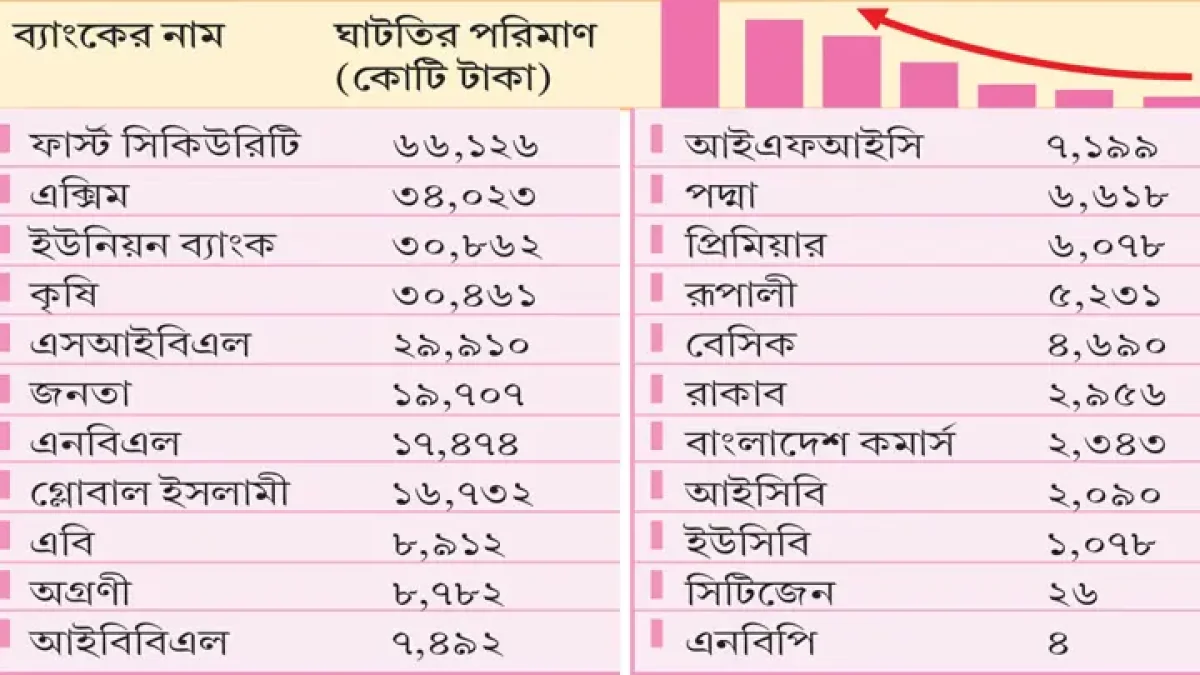
Capital shortfalls in the country’s banking sector continue to widen. According to the latest figures, the deficit has crossed Tk 3 lakh crore, breaking all previous records. Private-sector First Security Islami Bank recorded the largest shortfall at Tk 66,126 crore, while Janata Bank had the highest deficit among state-owned lenders at Tk 19,707 crore.
Bankers said an abnormal surge in defaulted loans has created the massive capital gap, further worsening the sector’s capital-to-risk-weighted assets ratio (CRAR).
According to Bangladesh Bank data, the combined capital shortfall of 22 banks stood at Tk 308,803 crore at the end of June, up from nearly Tk 294,000 crore across 21 banks in March. The remaining banks in the country have no capital deficit.
Bankers said loans disbursed through irregularities during the ousted Awami League government have now turned non-performing. Banks are unable to maintain required security reserves, or provisions, against these loans, eroding their capital and putting the stability of the entire financial sector at risk.
Banks previously controlled by S Alam during the Awami League administration are now facing heavy capital shortfalls. Similarly, IFIC Bank, formerly controlled by ex-prime minister’s adviser Salman F Rahman; Premier Bank, linked to former lawmaker HBM Iqbal; and United Commercial Bank (UCB), formerly controlled by ex-land minister Saifuzzaman Chowdhury Javed, have also fallen into deep capital deficits.
Four state-owned banks face Tk 38,000 crore shortfall
Four state-owned banks account for Tk 38,411 crore of the total capital shortfall. Janata Bank leads with Tk 19,707 crore, followed by Agrani Bank at Tk 8,782 crore, Rupali Bank at Tk 5,231 crore and BASIC Bank at Tk 4,690 crore.
Eight private banks show Tk 50,000 crore deficit
Eight conventional private banks recorded a combined capital shortfall of Tk 49,731 crore. National Bank topped the group with Tk 17,474 crore, followed by AB Bank at Tk 8,912 crore, IFIC Bank at Tk 7,199 crore, Padma Bank at Tk 6,618 crore, Premier Bank at Tk 6,078 crore, Bangladesh Commerce Bank at Tk 2,344 crore, United Commercial Bank (UCB) at Tk 1,078 crore and Citizens Bank at Tk 26 crore.
Premier Bank Managing Director Monjur Mofiz told Amar Desh that the bank’s non-performing loan ratio fell significantly in September compared with June. The ratio stood at 34.91 percent in June and dropped below 30 percent in September, easing provisioning pressure, he said. The bank’s capital position also improved over the same period, with its CRAR beginning to return to positive territory in September after being negative in June, while losses narrowed. Relocating the head office reduced operating costs and helped build positive customer sentiment, he added.
He said the current management committee is working step by step to improve the bank’s condition with 100 percent transparency and expressed hope for further notable gains in financial indicators next year.
UCB and IFIC Bank could not be reached for comment.
Seven Islamic banks post Tk 187,000 crore shortfall
Islamic banks account for the largest share of the banking sector’s capital deficit, with their combined shortfall reaching Tk 187,238 crore at the end of June.
Among shariah-based lenders, First Security Islami Bank posted the highest shortfall at Tk 66,126 crore, followed by EXIM Bank at Tk 34,023 crore, Union Bank at Tk 30,862 crore, Social Islami Bank at Tk 29,910 crore, Global Islami Bank at Tk 16,732 crore, Islami Bank Bangladesh at Tk 7,492 crore and ICB Islamic Bank at Tk 2,090 crore.
Two specialised banks face Tk 33,000 crore gap
Among specialised banks, Bangladesh Krishi Bank recorded a capital shortfall of Tk 30,461 crore, while Rajshahi Krishi Unnayan Bank’s deficit stood at Tk 2,957 crore.
In addition, foreign lender National Bank of Pakistan posted a capital shortfall of Tk 4 crore.
CRAR slips further into negative territory
Overall capital adequacy in the banking sector deteriorated further at the end of June, with the CRAR falling to negative 3.80 percent from negative 3.17 percent at the end of March. Under Bangladesh Bank regulations, banks must maintain a minimum capital adequacy ratio of 12.5 percent, raising serious concerns over the sector’s financial resilience.
Contacted for comment, Mutual Trust Bank Managing Director Syed Mahbubur Rahman told Amar Desh that rising defaulted loans force banks to set aside higher provisions, reducing profits. When provisioning cuts into profits or causes losses, a bank’s capital erodes, increasing the risk of new or widening capital shortfalls as bad loans grow, he said.
Bangladesh Institute of Bank Management (BIBM) Director General Ezazul Islam said the overall capital adequacy ratio has declined further, though the aggregate figure should not be used to judge every bank equally given wide disparities across lenders. Many well-run private banks maintain a CRAR of 10 to 12 percent, whereas severely negative capital ratios at weak lenders such as Padma Bank, Union Bank and Janata Bank have dragged down the sector-wide average, he said.
He said overcoming the crisis requires establishing good governance across the banking sector, restructuring and raising fresh capital, ending all forms of corruption, restricting profit distribution by banks that fail to meet central bank capital requirements, and strictly enforcing banking laws and regulations.
বাংলায় মূল প্রতিবেদন পড়ুন · Read the original Bengali report