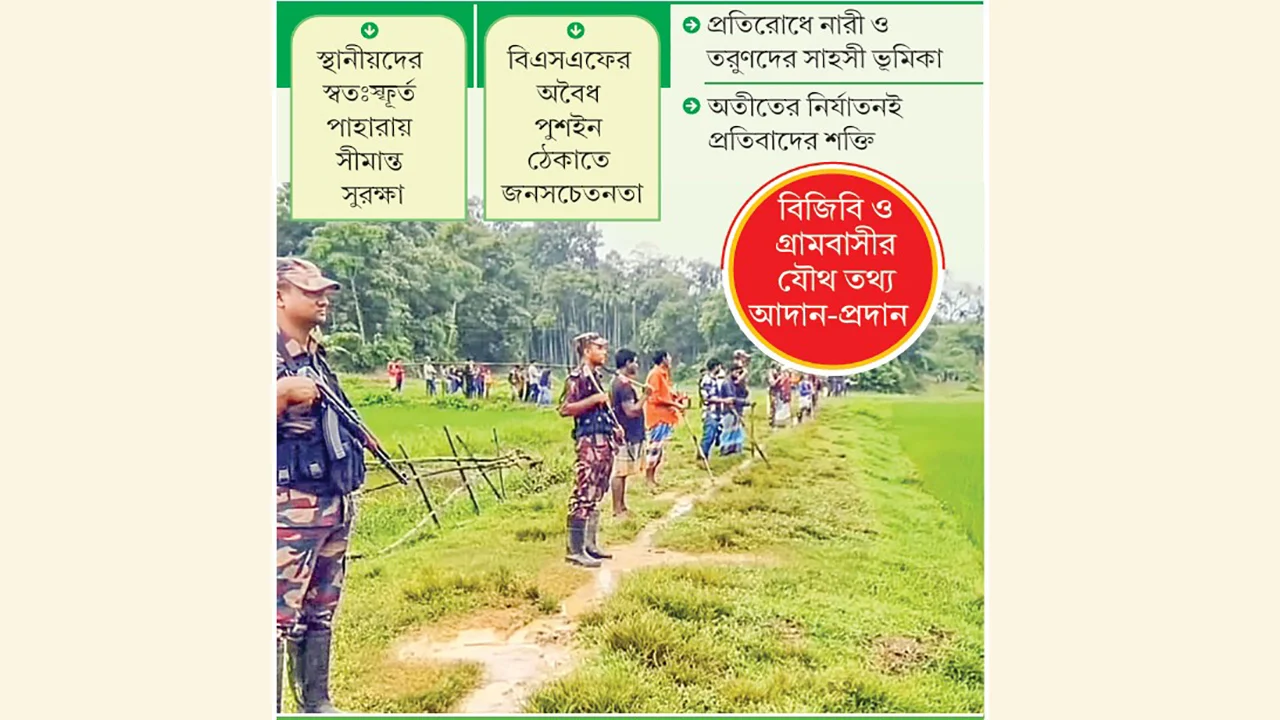
Along the barbed wire that divides two nations on the map, an undeclared, one-sided aggression has taken root. On one side stand India’s Border Security Force (BSF) armed with sophisticated weaponry. On the other, Bangladesh’s border residents have no boundary walls or heavy weapons.
Over the past decade and a half, the BSF has engaged in systematic human rights violations along Bangladesh’s borders — establishing illegal “pocket” encroachments at the zero line under cover of darkness and conducting a campaign of forced “push-ins.” Yet amid this geographic and infrastructural neglect, an unprecedented pattern of psychological and strategic resistance has emerged.
Despite severe limitations in rivers, canals, and paved roads for BGB patrols, border residents are no longer cowering at home in fear. Armed with microphones, flashlights, and whistles provided by the BGB, civilians form an impenetrable wall every night. Youth defy BSF gun barrels pointed in their direction to respond immediately to any aggression. Women have gone a step further than the men, building resistance that forces armed BSF personnel to retreat. “We must protect our own country ourselves” — this rallying cry has proven that even amid past state neglect, the collective strength of the people is Bangladesh’s most invincible weapon for defending its sovereignty.
An on-the-ground investigation from June 20 to 24 along the zero line in remote border areas of northern Bangladesh found that local youth and women, alongside the BGB, remain vigilant against any form of BSF provocation or infiltration. When necessary, they stay awake through the night to stand guard.
Several BGB company commanders, speaking on condition of anonymity, said the local population’s spontaneous participation is playing a significant role in preventing untoward incidents at the border.
Lieutenant Colonel Sirajul Islam, commanding officer of the 56th Battalion, said: “The BGB maintains a strict position against all BSF activities including push-ins. Ansar-VDP members and ordinary villagers are working alongside the BGB at the border. At night, they divide into multiple groups to join BGB patrols and provide intelligence support.”
Diplomatic sources said that in recent months, attempts to forcibly push groups of people — including women and children — into Bangladesh under cover of darkness from the West Bengal and Tripura borders have increased alarmingly. The BGB has lodged strong protests through repeated flag meetings against this unilateral BSF behavior. Simultaneously, maximum vigilance and a “zero tolerance” policy have been ordered at every sensitive border point to counter this new infiltration strategy.
On June 16, Human Rights Watch published a special report and statement noting that India is pushing ethnic Bengali residents (predominantly Muslim) from West Bengal and other states into Bangladesh without any legal process — a clear violation of international law.
Bangladesh’s Foreign Ministry has formally stated that attempting push-ins under cover of darkness without any legal process or bilateral communication is a clear violation of international border law and contrary to the friendly relations between the two countries. The ministry said it is unacceptable to claim people are Bangladeshi nationals and push them in without valid citizenship documentation. Under international norms, even if someone is genuinely a Bangladeshi citizen, India must follow the formal process of legal verification and flag meetings before any pushback.
Bangladesh shares a 4,096-kilometer border with India’s West Bengal, Assam, Meghalaya, Tripura, and Mizoram states, spanning 30 districts across five divisions.
Old wounds and present vigilance
On June 21, this reporting team reached the Khalisha Kotal border in Naodanga union of Phulbari upazila, Kurigram, amid heavy rainfall. Just across the line lie India’s Kishamat Karla and Kadamtali Bazar. Border resident Sirajul Islam still carries the memory of a painful incident from years ago. His two brothers — Sofirouddin, 28, and Ekramul, 22 — were killed by BSF gunfire over a minor dispute concerning a border pillar and bridge.
“The BSF took both bodies to the other side and returned them three days later. That wound is still fresh in our hearts. But the situation has changed now. We will farm our own land and will not retreat in fear,” Sirajul Islam said.
Similarly, at the Balatari Dhularkuti border, Mohammad Kaiyum Hossain Rubel’s younger brother permanently lost sight in one eye to BSF fire. On April 30, 2018, ninth-grade student Mohammad Rasel Mia was cutting grass with his father approximately 500 yards inside Bangladesh when he was chased by BSF personnel. Rasel jumped into a nearby river in fear for his life, and BSF fired rubber bullets from a shotgun at him. Forty-eight splinters struck his head and face. After prolonged treatment, his right eye was saved but his left eye lost its sight permanently.
Locals said these brutal past experiences have motivated border residents to stand alongside the BGB for their own protection.
Women standing guard through the night
On-the-ground reporting found that even those living closest to the barbed wire at the border’s edge demonstrate immense courage in speaking out against injustice from the other side. Whenever the BSF attempts forced push-ins under cover of darkness, local women and men create alert signals with flashlights and whistles alongside the BGB.
In Shariyaljote on the Tetulia border of Panchagarh — a distant corner from Kurigram — the same scene was observed. Resident Firoza Khatun said: “I am not afraid of anything at the border. When BSF comes to push people in, I immediately call the BGB and rouse the villagers.”
Mohammad Tajul Islam, a farmer near pillar 931 in the Krishnanagar Bokshi area, said: “The women in our area are more active than the men. When they see any unjust BSF activity, they come out of their homes, gather while shouting, and create resistance. The combined outcry of the women forces BSF to retreat.”
Youth as the border’s primary strength
Local youth are patrolling the border all night alongside the BGB to prevent any disturbance or infiltration attempt. There are precedents of entire villages uniting to chase back any party from the other side that advances toward their area.
Mohammad Shuvo Patowary, a Higher Secondary Certificate examinee from the Balatari Dhularkuti border area, said: “When push-in attempts occur, we monitor BSF movements and patrol with the BGB at night. When BGB members bring microphones, we youth take responsibility for operating them while everyone maintains alert positions.”
Shuvo said that several months ago, when BSF members entered Bangladeshi territory and attempted to assault local farmers, villagers and youth united instantly to mount resistance. Despite certain risk of death, the youth did not retreat in defense of their country.
Joint patrols by villagers and BGB
Visiting border areas across Kurigram, Naogaon, Joypurhat, Thakurgaon, Lalmonirhat, and Panchagarh in the northern region, this investigation found a state of round-the-clock vigilance. Locals share information with the BGB at every moment to prevent BSF push-ins.
Mohammad Milon Mia, a resident of the Altadighi border area in Dhamurhat upazila, Naogaon, said whenever they receive any news or rumor of illegal push-ins at the border, the entire community becomes alert and provides full support to the BGB.
Mohammad Monir Khan, a resident of the border area under Hatkhola BOP in Panchbibi upazila, Joypurhat, said: “Whenever India’s BSF comes to push people in, all of us civilians unite with the BGB to stop it.”
Former Member of Parliament from Kurigram-4, Mohammad Ruhul Amin, sharply criticized India’s push-in policy: “India is a powerful and large nation; we do not expect such behavior from them. Under international norms, if someone is a Bangladeshi citizen, they should be returned through a letter to the BGB and a flag meeting — through legitimate process. Secretly dumping people and creating border instability is unacceptable.”
However, even amid this courageous vigilance, the investigation revealed serious infrastructural deficiencies in the border areas. Locals expressed concern that there are no proper roads near the Bangladesh side of the border. This lack of developed roads makes it difficult for the BGB to conduct rapid patrols or reach border areas during nighttime or any emergency.
India’s border infrastructure is entirely different. There, paved roads run right up to the border with BSF camps alongside. If Bangladesh similarly had developed roads and BGB camps near the border, resistance against any aggression from the other side would be much easier.
Former MP Ruhul Amin confirmed this crisis: “The condition of border roads is very poor. If the roads are repaired, the BGB will be able to reach these areas quickly.”
Several BGB company commanders also acknowledged this limitation, saying that disconnected roads sometimes cause significant delays in reaching from one point to another. Patrols are conducted on bicycles over broken roads, which is extremely difficult and risky. In emergencies, bicycle chains break and must be left in bushes while personnel proceed on foot. Border road development is therefore urgently needed.
বাংলায় মূল প্রতিবেদন পড়ুন · Read the original Bengali report