China has long used the strategy known as "salami slicing" to expand its influence across the Pacific, advancing through small, incremental steps rather than direct military confrontation, analysts say.
"Salami slicing" is a geopolitical and military tactic in which a large territory is not seized all at once but brought under control gradually through a series of small, seemingly minor moves — much like cutting a salami into thin slices rather than consuming it whole. The approach allows a power to establish control over contested areas without triggering outright war or violations of international law severe enough to invite a forceful response.
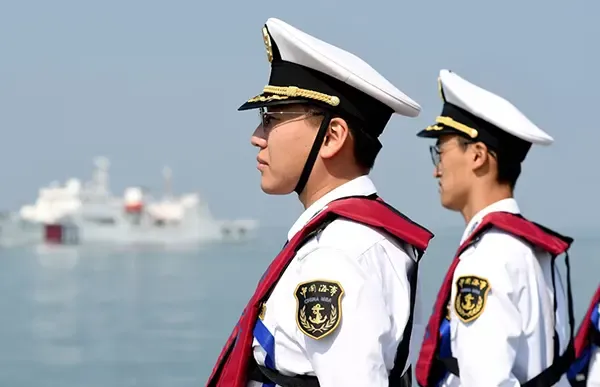
Within just a few weeks, Chinese vessels have conducted what Beijing describes as "law enforcement" operations at record distances from the Chinese mainland, and carried out what it called "research" operations inside a disputed lagoon more than 500 miles from China's coast. Analysts say this represents a major push to extend China's presence beyond the "First Island Chain" — the strategic boundary running through Japan, Taiwan and the Philippines that both Beijing and Washington regard as a critical dividing line in the western Pacific. The maritime activities intensified in the weeks following US President Donald Trump's visit to Beijing, which was described as cordial. During that visit, Chinese leader Xi Jinping made clear that Taiwan remains the main potential source of friction in the US-China relationship.
China has warned the United States against providing military assistance to Taiwan. Earlier this month, three civilian law-enforcement vessels belonging to China's Maritime Safety Administration crossed the channel between the Philippines and Taiwan and began patrol and mapping operations in waters east of Taiwan — the first time MSA vessels had crossed that line, observers said. The move amounted to a significant psychological challenge and warning for Taiwan's 23 million people.
Through semi-official social media accounts, China announced it had for the first time mapped the seabed off Taiwan's eastern coast and that these waters would henceforth be treated as China's "near-sea," subject to its full jurisdiction. Taiwan's President Lai Ching-te sharply condemned the operation, saying Beijing's real aim was imperial expansion and that its actions posed a threat to Taiwan and the wider Indo-Pacific region. A Taiwanese security official said China was using civilian ships to project an impression of real jurisdiction over Taiwan. Experts argue that such civilian and paramilitary vessels pose a greater long-term threat to the status quo than military ships precisely because they appear less threatening on the surface.
While commercial vessels were initially challenged by radio, China's next move could involve blocking ships headed to Taiwan or compelling them to call at Chinese ports — affecting, among others, liquefied natural gas tankers supplying the island. The US State Department has described China's behaviour as "deeply destabilising." Britain, France and Germany issued a joint statement expressing serious concern over freedom of navigation and the safety of international shipping in the region.
In the South China Sea, China is also expanding its presence around Scarborough Shoal, which lies within the Philippines' exclusive economic zone. Satellite images have captured artificial floating structures China has built there. Philippine Defence Secretary Gilberto Teodoro expressed deep concern, saying China had previously lied about building military bases on artificial islands and was once again engaging in deception under the guise of research. Washington has supplied the Philippines with four maritime drones worth $13 million to help counter the situation. Analysts warn that without effective international resistance, China will continue advancing — slice by slice — until it exerts control over the entire region.