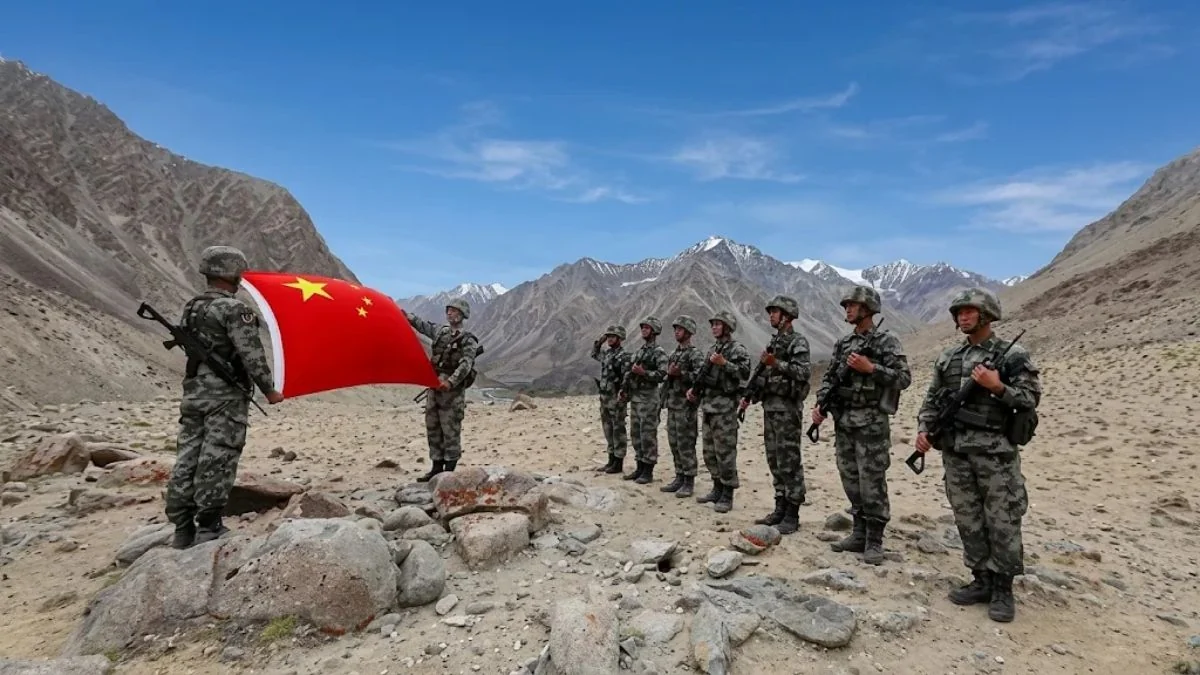
China’s military activity along the border of Arunachal Pradesh is renewing India’s security concerns. Besides deploying troops near the border, Beijing is expanding roads, railways, airbases and military installations across Tibet. As a result, the strategic question for India is not only how many troops are on the border, but how quickly reinforcements and equipment could be brought in if needed.
Military analysts see the combined arms brigade as one of the main strengths of China’s People’s Liberation Army. Alongside infantry, these brigades include artillery, armoured vehicles, air defence, intelligence, surveillance, engineering and logistics. The units can be organised in light, medium and heavy forms as needed, and a brigade usually has 4,500 to 5,000 soldiers.
China’s military set-up on the Arunachal border is arranged in several layers. Besides units close to the border, forces under the Tibet Military District can be used as reinforcements. If the situation becomes more complex, other units under the Western Theatre Command can also be sent. In other words, China can keep the ability to raise military pressure quickly without stationing all its troops on the border permanently.
According to the Indian Army’s annual assessment for 2025-26, China reduced its deployment on its northern border somewhat in 2025. But there were forces equivalent to 10 combined arms brigades along the Line of Actual Control and another 10 brigades’ worth in usual training areas. The figure covers the whole India-China border, not only Arunachal Pradesh. The same assessment described the Indian Army’s readiness as strong.
Another important part of China’s capability is Damxung airbase in Tibet, about 300 km from the Arunachal border, at an altitude of 4,000 metres or more. Its runway is about 5.2 km long. Commercial satellite images published in July 2026 reportedly showed four J-20 fighter jets there in June. It is not certain how many aircraft or which units are permanently based there.
Tibet’s road, rail and air links can give China an added advantage in moving troops and equipment quickly, which is especially important for sustained operations at high altitude. India, for its part, is improving roads, communications, surveillance and logistics in border areas. Keeping troops deployed for long periods in remote mountains is a major challenge for India, but its experience of the local terrain and its presence on the border are important advantages.
Military contact between the two countries on the border also matters for avoiding conflict. After tension in the Tasing area in September 2026, senior military officers of both sides were reported to have met in the Wacha-Damai area.
Overall, there is no sign that a major conflict in Arunachal is inevitable. But military infrastructure in Tibet, the capacity to mass troops quickly and the expansion of air power give China the opportunity to apply long-term pressure. India’s challenge is therefore not only guarding the border but sustaining fast and steady military readiness at a moment of crisis.
বাংলায় মূল প্রতিবেদন পড়ুন · Read the original Bengali report