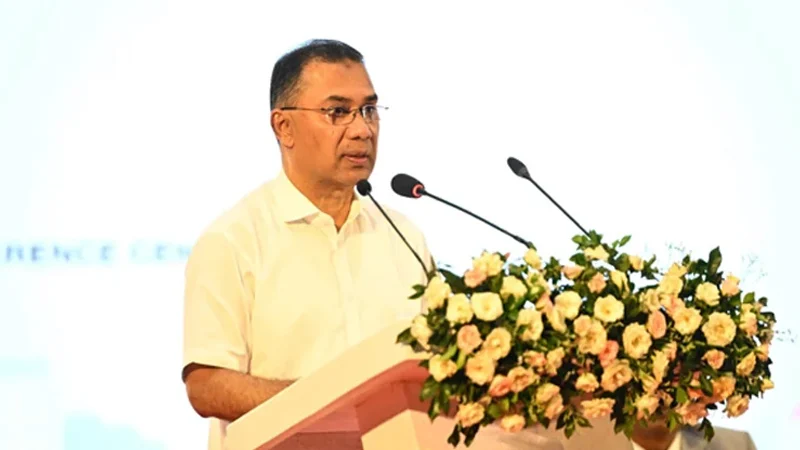
Prime Minister Tareque Rahman has said the time has come to rebuild a Bangladesh left fragile in the grip of fascist rule. More than a decade and a half of fascist exploitation and misrule had turned Bangladesh into a debt-dependent and import-dependent fragile state, he said, and this state — fragile across education, health, the environment and every field — must now be rebuilt. The SDGs had an undeniable role in this journey of national reconstruction.
As part of this, he said, the present government had taken steps to implement a five-year strategic economic framework to ensure people’s prosperity — a framework that aligned the country’s national development plan with the UN-declared Sustainable Development Goals (SDGs).
The prime minister made the remarks at a national conference on setting a five-year strategic framework for achieving the Sustainable Development Goals.
The conference was held on Monday afternoon at the Bangladesh-China Friendship Conference Centre in Sher-e-Bangla Nagar in the capital.
Tareque Rahman said that a look at the BNP’s public policy made clear that all the party’s plans and programmes had always been people-friendly.
For the development of the country and its people, he said, there had been the 19-point programme of the independence proclaimer and slain president Ziaur Rahman, former prime minister Khaleda Zia’s “Vision 2030,” and now the 31-point state-reform agenda — each historically not very different from the vision and mission of the Millennium Development Goals (MDGs) or today’s SDGs.
Just as Bangladesh had shown success in implementing the MDGs, the prime minister said, it was properly taking steps and implementing them for the SDGs. He said the present government’s public policy also matched the SDG principle of “leave no one behind.”
To ensure the interests of people of all classes and professions, he said, the present government’s policy was “Bangladesh for all.”
The prime minister said the government’s “five pillars of reform and development” — poverty alleviation, universal social protection, quality education and healthcare, gender equality, and climate resilience and good governance — reflected these core SDG priorities.
To graduate from the list of least-developed countries and consolidate progress in implementing the SDGs, he said, the present government had adopted a “three-R” strategy of recovery, rehabilitation and reconstruction, through which everything from short-term stability to long-term structural transformation would be implemented in a single coherent design.
Tareque Rahman said that, on the people’s mandate, from the day after it formed the government on 17 February the present government had been implementing several social-protection programmes — a family card to ensure women’s social and economic empowerment, a farmer card to protect farmers’ interests, and an e-health card to ease public health and medical services.
Through these, direct subsidies, farm inputs, financial support and healthcare were being delivered to marginal farmers, low-income families and vulnerable groups, he said. A sports card had also been introduced, and imams, muezzins and religious leaders of various faiths across the country had been brought under an honorarium.
In one way or another, the government’s support network was thus reaching people of every class and profession, the prime minister said.
He said the government had a well-considered roadmap and plan to gradually bring every possible citizen under the social-protection net and financial-support framework within the current term.
As part of the “SDG Village” programme, he said, three villages had been initially chosen as a pilot model for localising the SDGs — Mitingachhari in Kaptai upazila of Rangamati, Pankhali in Dakop upazila of Khulna, and Nafanagar in Bochaganj upazila of Dinajpur.
In these villages, he said, various programmes would be implemented experimentally at once — family cards, health cards, farmer cards, loans for small and medium enterprises, school uniforms, madrasa-based education, renewable energy, village tourism, One Village-One Product, tree planting, canal excavation and ecotourism — and their impact monitored.
Based on the success of this initiative, plans had been taken to expand the model to other villages across the country in future, he said, adding that he hoped the SDG Village would become an exemplary platform for presenting the present government’s election pledge to the world as an internationally recognised “development model.”
Saying the SDGs could not be implemented through any single ministry or division, Tareque Rahman said their successful implementation required the combined cooperation of government, the private sector, development partners, NGOs, civil society, the media and every citizen.
He said he hoped that at the three-day conference, every coordinating ministry and division would adopt realistic and timely action plans and steps by discussing their goal-based progress, challenges and future tasks.
Tareque Rahman said the government’s approach on a few fundamental matters in future action plans was clear: a democratic state with free elections, the rule of law and institutional accountability; a humane state where health, education and civil rights would be universal; and a welfare state where every citizen’s economic opportunity and fairness would be ensured.
He called on everyone to work with firm resolve to achieve the Sustainable Development Goals by 2030.
Present at the event were Local Government, Rural Development and Cooperatives Minister Mirza Fakhrul Islam Alamgir; Finance and Planning Minister Amir Khasru Mahmud Chowdhury; state minister for planning Jonayed Saki; planning division secretary S M Shakil Akhtar; and the prime minister’s adviser (of ministerial rank) for finance and planning, Dr Rashed Al Mahmud Titumir, among other senior officials.
বাংলায় মূল প্রতিবেদন পড়ুন · Read the original Bengali report