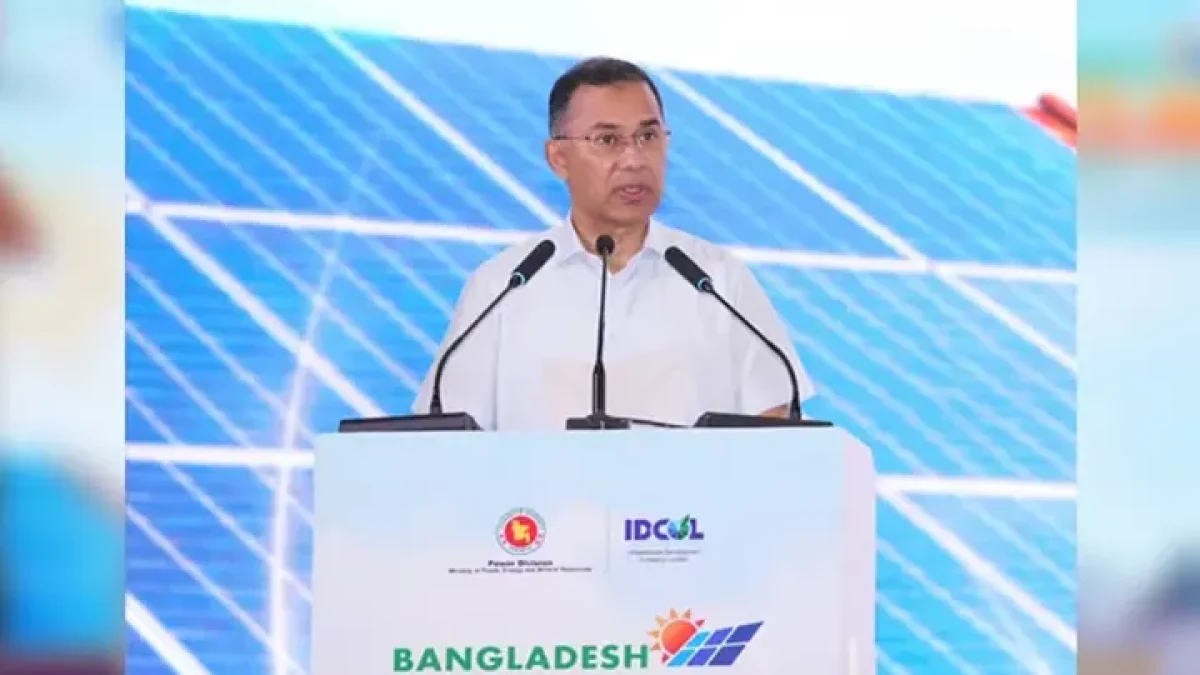
Prime Minister Tareque Rahman said Bangladesh could address its power crisis through affordable measures instead of what he described as looting in the name of quick-rental plants.
The government is aware of public hardship caused by energy and electricity problems and has taken steps to manage the crisis and secure long-term supply, he said.
Rahman spoke Tuesday morning at the opening of the two-day Bangladesh Solar Expo 2026 at the Bangladesh-China Friendship Conference Center in Dhaka.
Power, Energy and Mineral Resources Minister Iqbal Hasan Mahmud chaired the event, jointly organized by the Power Division, the ministry and Infrastructure Development Company Limited.
The government is working simultaneously to stabilize supply, review electricity-sector costs and contracts, expand domestic gas exploration, diversify fuel sources and accelerate solar deployment, Rahman said.
Bangladesh aims to produce 20 percent of total electricity demand from renewable sources by 2030 and 30 percent by 2040.
The prime minister called entrepreneurs the main drivers of the transition and said the government had initially allocated one thousand five hundred crore taka to make solar financing easier, with more funding to follow.
Renewable energy is no longer merely promising but an unavoidable reality for Bangladesh, he said.
Rahman said the current budget also allocates Tk 500 crore annually for startups so promising ideas are not lost for lack of money.
He blamed heavy import dependence for exposing Bangladesh to disruptions caused by global conflicts.
The government provided Tk 43,000 crore in electricity subsidies in the 2025-26 fiscal year to keep supply as stable as possible, he said.
It has increased diesel stocks, worked to secure coal for power plants, contacted alternative suppliers and allocated Tk 600 crore to procure fuel oil for generation.
Rahman said the priority was meeting future demand and ensuring uninterrupted supply rather than spending time debating previous governments’ failures.
The government enacted the Special Solar Power Installation Ordinance 2026 and introduced policy support, tax and customs benefits and financial incentives.
Tax and customs concessions are intended to lower equipment costs and encourage imports and domestic production of solar panels, inverters and batteries.
If plans proceed, Bangladesh expects to add three thousand to four thousand megawatts of solar power to the national grid before summer, he said.
The government wants unused roofs at offices, schools, colleges, hospitals, factories, businesses and homes to generate power.
By February 2027, it plans to buy surplus net-metered electricity at Tk 10.50 per unit and provide incentives.
Rahman said solar panels at his home had already supplied some surplus electricity to the grid.
He urged public and private sectors to work together, reduce equipment costs and ensure that installed systems receive regular maintenance and customer support.
Distribution companies should maintain contact with entrepreneurs and respond to their problems, he said.
Converting electric irrigation pumps to solar could reduce farming costs, protect the environment and save grid electricity.
Solar power could also support cold storage, agricultural preservation and new rural enterprises, while lowering energy costs for farmers.
Rahman said government must produce enough electricity, while citizens should use it efficiently by relying on daylight and switching off unnecessary lights, fans and devices.
He called on development partners to support smaller local entrepreneurs as well as large projects and said expatriate Bangladeshis had opportunities to invest.
The prime minister urged government, businesses, financial institutions, development partners and citizens to work together to turn sunlight into a national asset.
He presented awards to winners of the Spur: In Search of Sustainable Energy Innovation 2026 competition. Ministers, lawmakers, secretaries and senior officials attended.
Rahman said the expo should create entrepreneurs, investment, links between banks and businesses, training and jobs rather than ending as a two-day exhibition.
He called for practical solar expansion in every district and upazila and said collective action could make the national target achievable.
বাংলায় মূল প্রতিবেদন পড়ুন · Read the original Bengali report