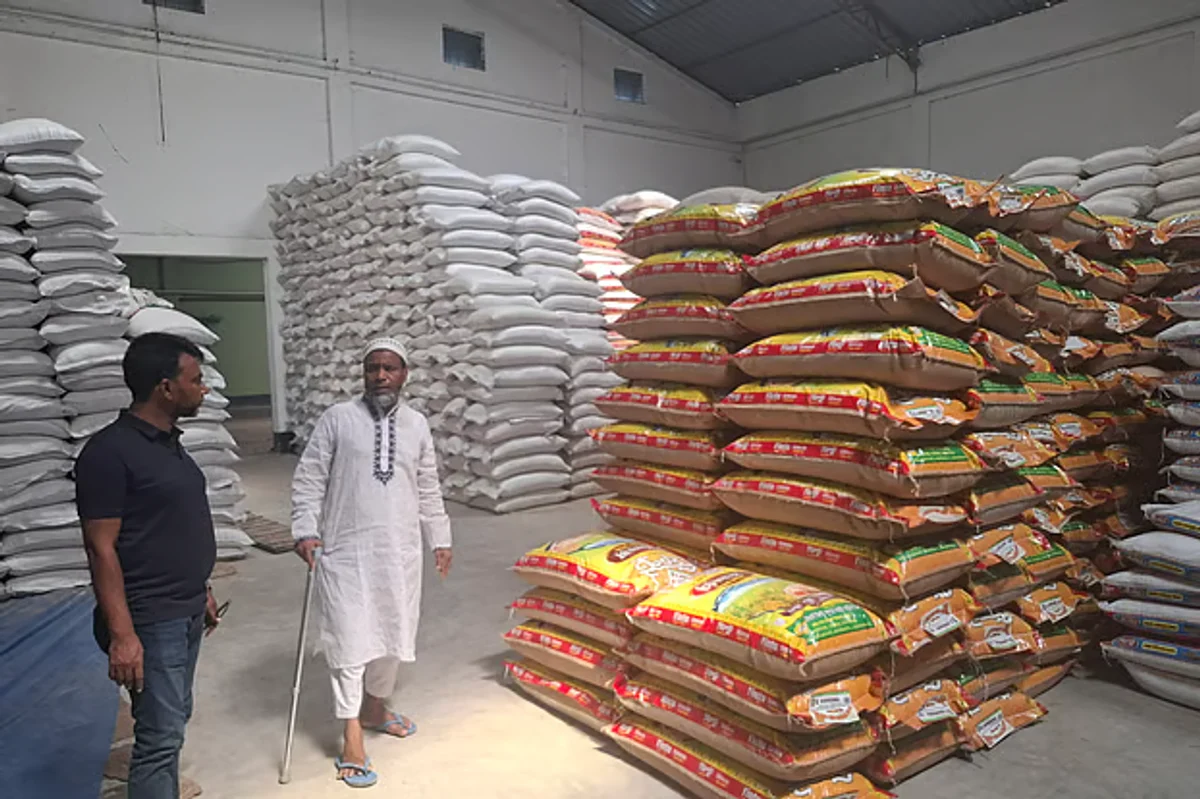
CHAPAINAWABGANJ — Tarikul Islam, from Alinagar village of Mokarampur in Chapainawabganj’s Gomastapur upazila, enrolled in school but could not get past the second grade. Stricken with polio in childhood, he lost the use of part of his body. A crutch has been his constant companion since.
But Tarikul did not give up despite the disability. Through hard work and drive he has become a successful entrepreneur, and a local role model. He is now managing director of Fintu Super Auto Rice Mill, with six general managers and 200 employees under him. He owns two auto rice mills.
Society calls this disabled businessman by his nickname, Fintu — also the name he gave his business. His mill is in Enayetpur village in Chapainawabganj. Daily output is 3,000 maunds. The rice from his mill is well known in the country’s south. Sold under the “Fintu Rice” brand, demand is so high that it fetches Tk 200 more per sack than other local rice. It sells especially well in Kushtia, Rajbari, Kishoreganj, Bhanga and Kanaipur in Faridpur; Tekerhat in Madaripur; Barishal; Jhenaidah; Kaliganj; Chuadanga and Alamdanga. Two truckloads go to Kushtia and Kishoreganj every day. One to three truckloads go to Narayanganj daily, three to five truckloads to Jhenaidah weekly, and shipments also go to Kaliganj, Chuadanga and Alamdanga.
In a recent conversation, 60-year-old Tarikul Islam shared the story of how he overcame childhood physical disability to become a successful entrepreneur. He had enrolled in the village primary school’s first grade, but failed the first-grade exam. “When I could not pass the exam, my father said I would not be able to study. After that I did not pursue education much further. The struggle for life began. I got involved in business in childhood, without knowing or understanding much,” he said.
Tarikul said even as a child he would take 10 kg of rice on the train from Chapainawabganj to Ishwardi in Pabna. He would sell the rice and return the same day. He would earn five to eight taka in profit a day. At the time, a plate of rice at a roadside eatery in Ishwardi sold for eight ana. Sales gradually grew. After Ishwardi he started selling rice in Kushtia. One day, while transporting rice illegally on a passenger train, he was charged with smuggling.
Speaking of his marriage, Tarikul grew briefly sombre. Composing himself, he said: “Right after the wedding, my father gave me two maunds of paddy and five tin sheets and separated me from the family. Then the real fight for life began. My mind was only on business. From that thought, I sold the two maunds of paddy my father had given and bought mangoes. But I lost 20 taka on the mango sale. After the loss I thought, with a new bride at home, telling her about the loss would upset her. So I forgot about it, bought some fish and went home laughing. After a single loss in the mango business, I was financially weakened. Seeing this, my close friend Ataur Rahman lent me 2,000 taka to do something. With that money I opened my first grocery shop. Because I had already decided I would do business no matter what.” Things ran like this for a few years. In 1991 he hit a capital crunch again. He had no home of his own. He took a 2,000-taka loan from Grameen Bank. He received 1,850 taka in cash. With 1,800 of that he bought a cow. Seven or eight months later, he sold the cow for 3,600 taka. He combined the 3,600 taka with 400 taka in shop savings — 4,000 taka in total — and started a parboiled-rice business.
Tarikul said rice traders never reveal where they sell. One day a trader gave him a contact: Probir Babu, a businessman at Kushtia’s Boro Bazar. He took rice and went to him. By then it was late afternoon. Probir Babu refused to buy the rice and sent him away. Tarikul went door to door at the Kushtia market. Eventually, one trader agreed to buy his rice. That was the start of his rice trade in Kushtia. Tarikul said that today, if 100 sacks of rice are sold in the Kushtia rice market, 90 of them are “Fintu Rice” — meaning Tarikul’s mill’s rice. “I do not sell any adulterated rice. That is why demand for my rice is high,” he said.
বাংলায় মূল প্রতিবেদন পড়ুন · Read the original Bengali report