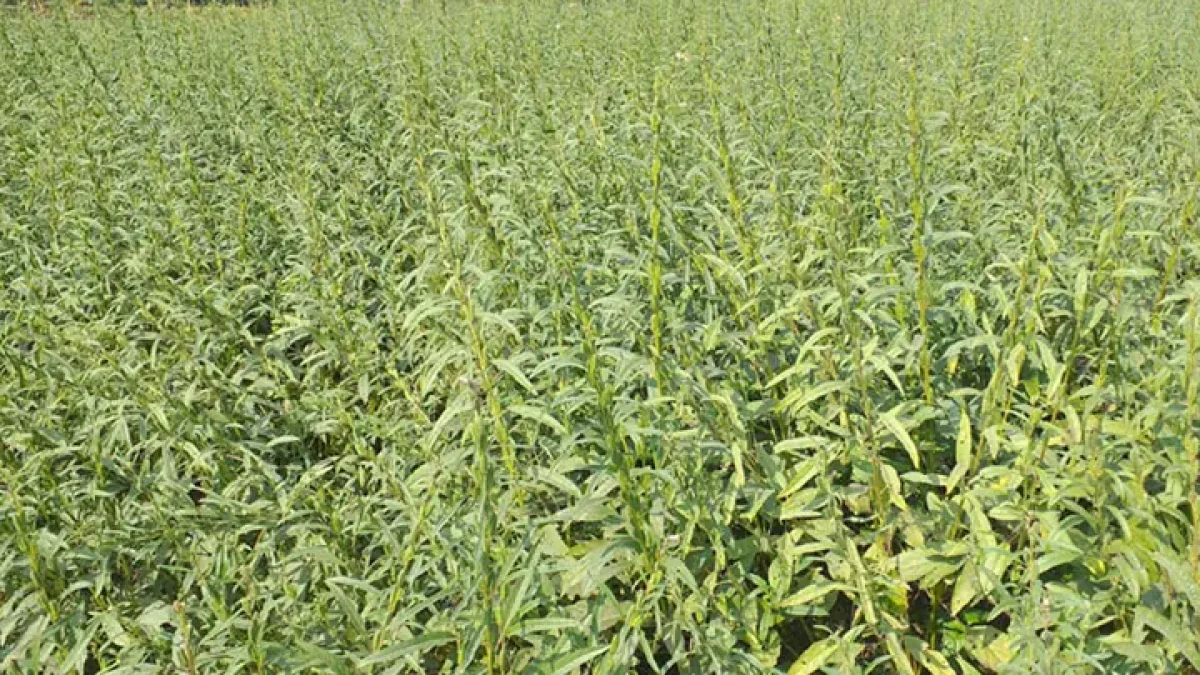
Farmers in Joypurhat's Panchbibi upazila are hoping for extra income by growing sesame on unused spaces such as fallow land, roadsides and field embankments. Low production costs, minimal upkeep and favourable market prices have steadily boosted their interest in sesame cultivation.
According to the upazila agriculture office, sesame has been cultivated on about 15 hectares across villages in Bagjana, Dharanji, Aymarasulpur and Balighata unions this season. The crop is usually grown around homesteads, along pond banks, beside roads and on field boundaries. Farmers hope for a bumper harvest if weather conditions remain favourable. Beyond serving as a source of edible oil, sesame is widely used in the food and cosmetics industries. Strong demand for sesame sweets such as khaja, laddu and moa, as well as biscuits and mashed sesame (bhorta), is fetching good prices not only in local markets but also in other districts.
According to farmers, cultivating sesame on one bigha of land costs only Tk 3,000 to Tk 4,000 for fertiliser and other inputs, while yielding three to four maunds. Depending on quality, sesame is currently selling for Tk 10,000 to Tk 12,000 per maund, offering a potential profit of Tk 25,000 to Tk 30,000 per bigha after expenses. The crop can be harvested within just 80 to 100 days, and dried sesame stalks also serve as fuel.
Anisur Rahman, a farmer from Damdama village in the upazila, said, "Sesame cultivation requires very little fertiliser or pesticide. Because cattle and goats do not eat sesame plants, there is no extra cost for guarding the crop. That is why, like every year, I have sown sesame on three bighas of uncultivated land." Aminul Islam of Dharanji village has planted sesame along the embankments around his one-bigha vegetable plot.
He said sesame plants act as a natural fence, keeping cattle and goats out of the field and saving the cost of building separate fencing. Imran Ali of Kachna village has sown sesame on 16 decimals of land hoping to meet family needs and earn extra income. Meanwhile, having no land of his own, Naresh Das of Chakshimulia village cultivated sesame along both sides of roughly half a kilometre of roadside and achieved a good yield.
Upazila Agriculture Officer Mallika Rani Sehanobish said regular advice is being provided on sesame farming to ensure proper use of fallow and unused land and create additional income opportunities for farmers.