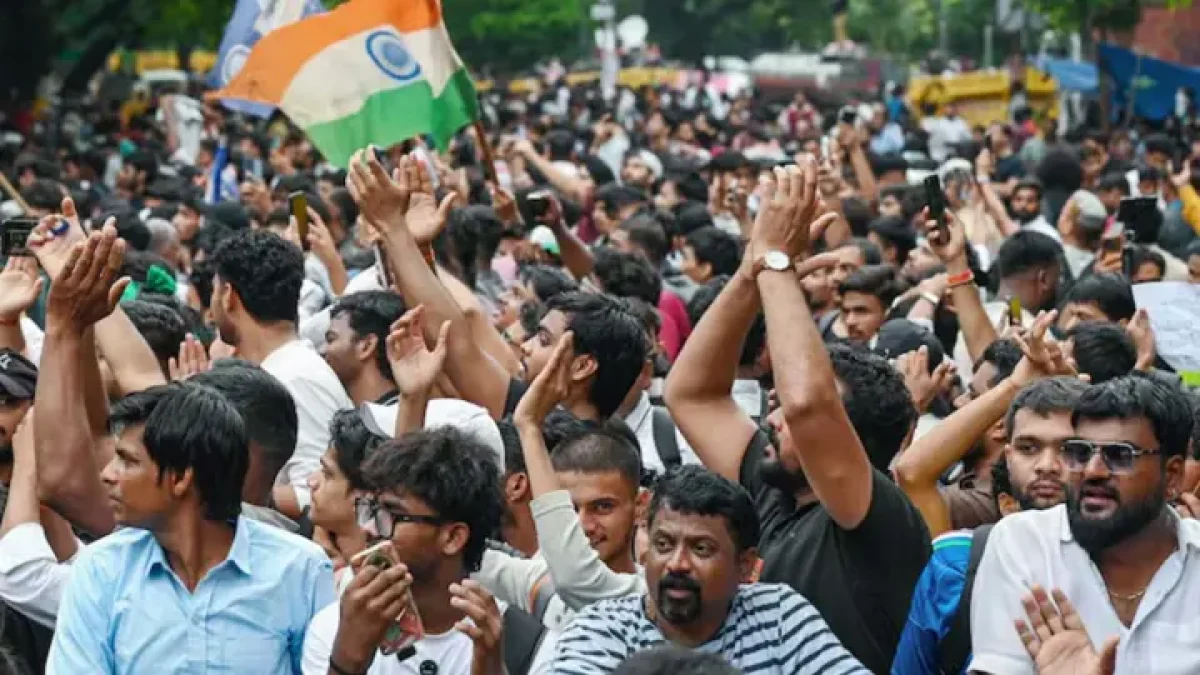
Political tension has spread afresh in India over the verification and revision of the voter rolls. Leaders and activists of opposition parties and various organisations are protesting across the country after 130 million names were dropped from the rolls in a check of the details of about 1 billion voters. They allege that large numbers of names were deliberately removed to give the BJP, led by Prime Minister Narendra Modi, an advantage in elections. The Election Commission and the ruling party reject the allegation.
The opposition has questioned the commission’s neutrality over the removal of so many names, and the demand for the removal of its head, Gyanesh Kumar, has grown louder.
Alongside the opposition parties, the youth-led Cockroach Janta Party (CJP) has called a large protest in the capital, New Delhi, on Saturday. Police say permission for the rally has not been given. The CJP says several leaders of the protest have already been detained.
Citing Election Commission figures, the BJP says about 130 million names were removed during the verification, more than the entire population of Japan. Of those removed, about 28 million had died, 63 million had moved elsewhere, 10 million were listed more than once and about 30 million could not be found.
The opposition parties allege that voters from Muslim and other minority communities were targeted. They say an attempt is being made to influence election results by deliberately removing voters thought unlikely to support the ruling BJP.
Questions over the commission’s neutrality
Amid the dispute, questions have also been raised about the commission’s internal workings. In late September it emerged that two members of the commission had repeatedly voiced concern about voter registration, the revision of the rolls and their digital management.
It is alleged that objections on these matters were put to Chief Election Commissioner Gyanesh Kumar at least 14 times in about 10 months without being given due weight. Opposition leaders accused the commission of bias, protests spread to various places and Kumar’s resignation was demanded.
The commission says differences of opinion in internal discussions are not unusual, that all its decisions were taken in accordance with the law, and it rejects the charge of working for any political party.
The BJP, for its part, accuses the opposition of trying to weaken people’s trust in democratic institutions by spreading confusion about a lawful electoral process.
Worry grows ahead of state elections
The dispute has sharpened at a time when elections are due in several important states early next year. At least seven states are likely to vote next year, among them BJP-ruled Uttar Pradesh, India’s most populous state and one of great importance in national politics.
About 13% of names have been dropped in Uttar Pradesh since verification of the rolls began there in October 2025. Those removed have to prove their identity and eligibility to be included again, and many voters complain of hardship in the process.
The opposition parties say the removal of names has already affected election results in some states, and that millions of people in Bihar and West Bengal in particular are at risk of losing their right to vote.
They fear that irregularities in removing names and long delays in settling appeals could affect future elections too, and warn that this method of revising the rolls could be used as a political weapon.
The BJP says Narendra Modi’s popularity, the government’s development initiatives and the country’s economic growth are the main reasons for its electoral success.
What happens when a name is dropped?
Under the Election Commission of India’s rules, a name may be removed from the rolls if the voter has died, is listed more than once, has moved permanently to another area or cannot be found. Officials are obliged to record the reason for the removal.
A person whose name is not on the draft roll may apply for inclusion before the final roll is published, and may appeal if the application is refused. There is also provision to challenge the decision even if the name is dropped from the final roll.
To vote in future elections, however, those removed must win their appeal or apply afresh for registration under the rules. The opposition parties say the process is so long and complicated that many voters find it hard to get back on the rolls, and that large numbers of people could in effect be deprived of the vote.
A major political dispute of the Modi years
The dispute over the voter rolls has become one of the biggest political challenges of Prime Minister Narendra Modi’s nearly 12 years in power. With next year’s state elections ahead, it is sharpening the conflict between the ruling BJP and the opposition.
At a rare press conference last year, Chief Election Commissioner Gyanesh Kumar called on the opposition parties to submit their allegations by affidavit. That did not end the dispute.
The youth-led CJP has meanwhile launched a new campaign. The party claimed that weeks of its protests in July forced the country’s education minister to resign. Political circles are watching to see how far its movement on the voter rolls will spread.
In India, the world’s largest democracy, the dispute has prompted fresh debate about the Election Commission’s credibility, the right to vote and the neutrality of the electoral system. How far it will affect the coming elections remains to be seen.
বাংলায় মূল প্রতিবেদন পড়ুন · Read the original Bengali report