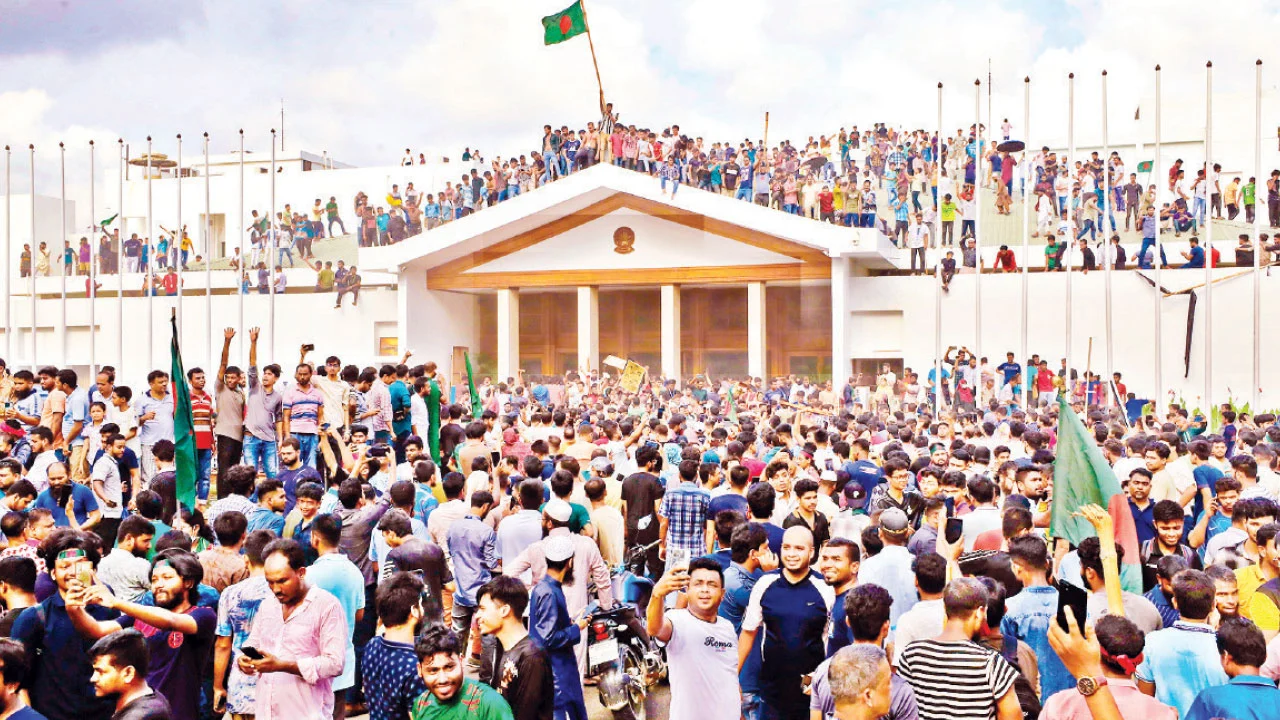
Only the calendar can say that July has ended. History does not say so. History knows that some months never end. Some blood may dry, but its stain never fades. Some names are not buried beneath the ground; they return in the air, in slogans on walls, in the voice of any young person standing against injustice. So July is not merely a month; it is a nation’s conscience, an ongoing question, an unfinished duty.
July was not merely a movement. It was a truth spoken directly into the eyes of the state — that before the collective awakening of the people, even the powerful are helpless, defeated. The streets bore witness to that truth, along with the sacrifice of countless wounded and dead. Young people like martyr Abu Sayed did not simply lose their lives; they taught a nation to ask a question — does the strength of the state exist over the people, or for the people?
The trouble is that power cannot easily accept questions. Power prefers obedience, loves applause, and views dissent with suspicion. Nearly every era of history has shown that those who stand tall are branded, at times, as unruly, at times as conspirators, at times as enemies of the state. The dictionary changes, the language changes, but the color of blood never changes.
Even today, when news of tension, violence, or division arrives from various educational institutions, an inevitable question arises — have we truly learned from July? If a university, meant to be a symbol of free thought, becomes a place where identity is judged instead of ideas, that is not merely one institution’s crisis; it is a cause for concern over the nation’s future.
The spirit of July cannot remain confined to memorial gatherings, processions, or ceremonial speeches. Hanging photographs of martyrs while forgetting their dreams, promising a charter while delaying its implementation, or leaving the expectations of martyrs’ families in prolonged waiting — none of this can be a source of pride for any nation. The dignity of sacrifice is preserved through concrete action, through justice, and through securing people’s rights.
There is one more thing we must keep in mind. History can be used, but history cannot be deceived. In the end, history does not remember who held power — it remembers who sacrificed truth for the sake of power, and who paid the price for truth. The blood of martyrs, therefore, cannot belong to any individual, party, or group. It is a moral commitment of the entire nation.
Power is temporary, but history is long-lived. Those in power today will not be there tomorrow; but their decisions, their sense of justice, or their silence will remain on history’s pages. History will one day ask — was the dignity of that blood upheld? Did the martyrs’ dreams move toward realization? Was respect shown toward merit, free expression, and justice?
July, therefore, is not the name of any celebration, nor the name of any political slogan. July is a moral standard, one that repeatedly places every power, every institution, and every citizen before themselves. The only way to pass that test is to place people above power, to not fear truth, and to carry the martyrs’ sacrifice not merely in memory, but in the practice of statecraft.
Because the martyrs did not want flowers. They wanted a Bangladesh where truth would stand taller than power, and country taller than party.
বাংলায় মূল প্রতিবেদন পড়ুন · Read the original Bengali report