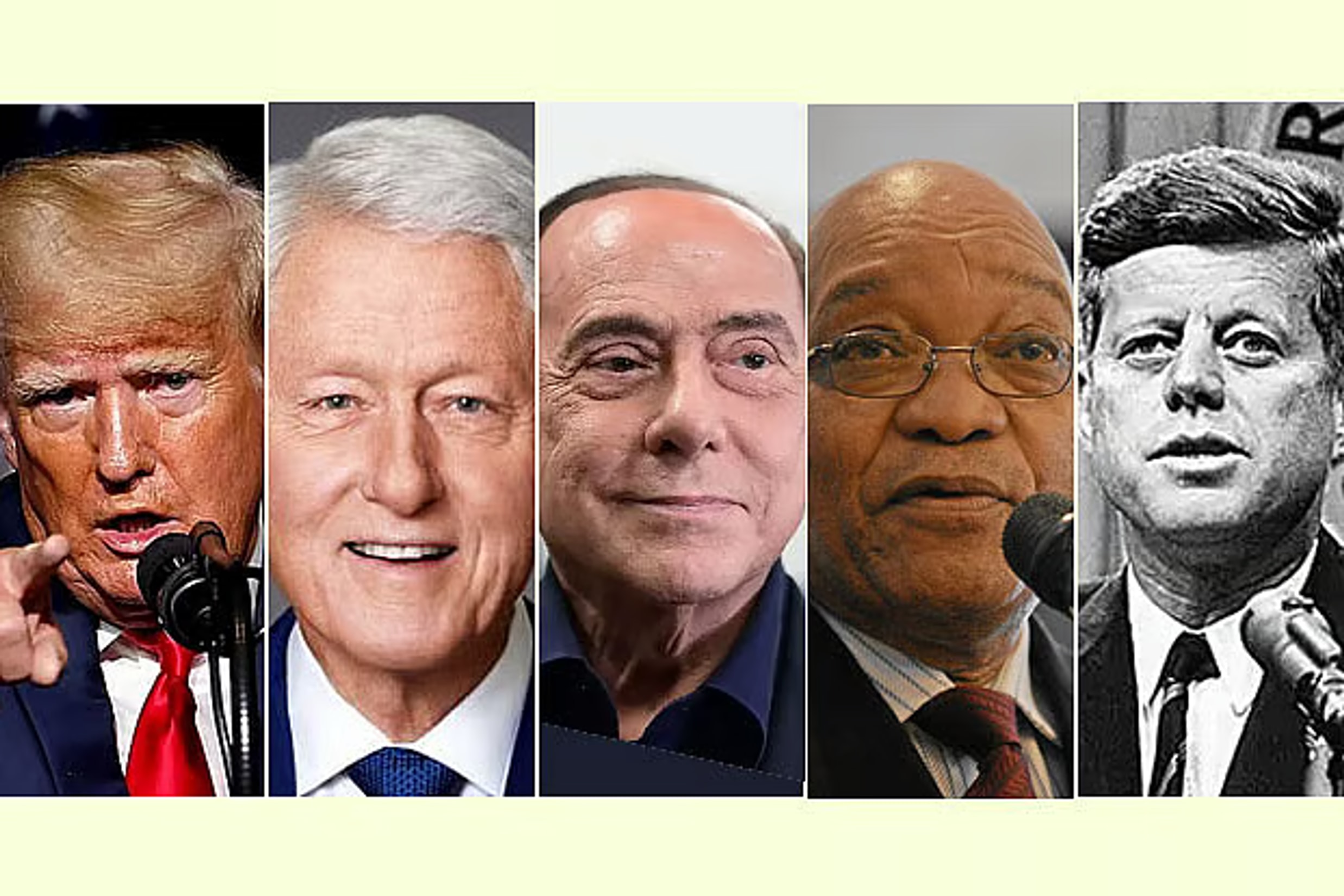
Among United States presidents, Donald Trump is the one who has repeatedly had to stand before a court over sex scandals and criminal offences.
Look back through history, however, and the list of heads of state who were caught in sex scandals or legal tangles at the very summit of power is a long one. Some lost power, some served harsh prison terms, and some survived politically even amid fierce controversy.
Below are the private-life scandals of several powerful heads of state, like Donald Trump, and their legal and political consequences.
Donald Trump (United States)
Whenever allegations of a sex scandal arise, a rush follows on Donald Trump’s side to prove him a gentleman. But the new FBI documents relating to the notorious sex offender Jeffrey Epstein that the US justice department has released recently make that saintly image hard to sustain.
In the documents an unnamed woman states that in the 1980s, when she was only 13 to 15 years old, Epstein introduced her to Trump, and that Trump then tried to force her into a sexual relationship. Although attempts were made to keep this 2019 deposition blacked out in the files, it did not stay hidden.
The White House has called it “false and exaggerated.” Trump’s supporters have pointed to a phone conversation from about 20 years ago in which Trump said he had known from the outset that Epstein was a “creep.” Trump is said to have thrown Epstein out in 2004 after he tried to poach an employee of the Mar-a-Lago club — although their closeness in the 1980s and 1990s tells another story.
Trump is the only US president to be found liable, and convicted, over a sex scandal and criminal offences. In 2023 a court ordered him to pay $5 million for sexually abusing the writer E. Jean Carroll.
He was also convicted on 34 criminal counts of falsifying business records to conceal hush money paid to the adult film star Stormy Daniels to keep her quiet before the 2016 election. In January 2025, however, New York Supreme Court Justice Juan Merchan granted him an “unconditional discharge” in that case, saying no sentence could be imposed because of the constitutional protections attaching to his taking office as president.
Bill Clinton (United States)
Bill Clinton’s name comes up first when the sex scandals of US heads of state are mentioned. In 1998 news of his relationship with Monica Lewinsky, a 22-year-old White House intern, spread like wildfire. But as a report in The Washington Post showed, the scandal originated in a sexual harassment suit filed in 1994 by Paula Jones, an Arkansas state employee.
According to the report, while giving evidence in Paula Jones’s case, Clinton denied under oath having had any “sexual relations” with Monica Lewinsky. But Clinton’s DNA matched exactly the stain on Lewinsky’s famous blue dress. Faced with the FBI’s incontrovertible forensic evidence and questioning by independent counsel Kenneth Starr, Clinton was finally forced to admit the relationship.
On the charge of lying under oath, the US House of Representatives impeached Clinton in December 1998. He kept his office through a Senate vote in February 1999. Judge Susan Webber Wright fined him for contempt of court and false testimony. In November 1998 Clinton settled Paula Jones’s suit out of court for $850,000.
Moshe Katsav (Israel)
The starkest example of going straight from the summit of power to prison over sex offences is Moshe Katsav, Israel’s eighth president. Katsav, who served as president from 2000 to 2007, first faced allegations of sexual assault in 2006.
BBC archives show that in 2006 Katsav himself complained to Attorney General Menachem Mazuz that a female employee was blackmailing him. But the picture changed completely once an investigation began. The employee alleged that Katsav had raped her twice in 1998. Two more women employees of the president’s office later brought sexual harassment allegations against him.
According to a report in the British daily The Guardian, Katsav was offered an easy plea bargain in 2007. Insisting he would prove himself entirely blameless, he rejected it and faced trial.
After long hearings, a panel of three judges at the Tel Aviv district court convicted Katsav in December 2010 of two counts of rape and of sexual assault. Calling his testimony full of lies, the court delivered a landmark ruling: when a woman says “no,” it means only “no.” He was sentenced to seven years in prison in 2011.
Silvio Berlusconi (Italy)
Italy’s four-time prime minister Silvio Berlusconi was known worldwide for his colourful, unrestrained and controversial private life. The biggest scandal against him is known as “Rubygate.”
According to the French news agency AFP, allegations arose in 2010 that Berlusconi held sex parties known as “bunga bunga” at his luxury yacht and villa, and that he paid a 17-year-old Moroccan girl — a minor, known in the case by the nickname “Ruby” — for sex. When she was arrested by Milan police on a theft allegation, Berlusconi himself telephoned the police station to have her released, falsely telling police she was a granddaughter of the then Egyptian president Hosni Mubarak.
In 2013 a lower court in Milan sentenced Berlusconi to seven years in prison for abuse of power and for paying a minor for sex. An appeal court overturned the verdict in 2014, saying police could produce no conclusive proof that Berlusconi knew she was under age.
Jacob Zuma (South Africa)
South Africa’s former president Jacob Zuma also faced a huge sex scandal early in his political life. In late 2005 the daughter of a family friend brought a rape case against him.
According to Associated Press reporting at the time, the complainant — publicly known by the pseudonym “Khwezi” — was an HIV-positive social worker. Her father had been a political comrade of Zuma’s, imprisoned with him on Robben Island for 10 years during the anti-apartheid struggle. Zuma was accused of raping her at his Johannesburg home; his defence was that the encounter was consensual.
In May 2006 a South African court acquitted Zuma. But testimony he gave during the hearing caused intense controversy worldwide. Zuma told the court he knew she was HIV-positive but had simply taken a shower afterwards to avoid infection — a remark that infuriated South Africa’s Aids activists.
Zuma became president of South Africa in 2009. The complainant, facing continued threats and abuse from his supporters, was forced to leave the country and died in exile in the Netherlands in 2016.
Fernando Lugo (Paraguay)
The scandal of Paraguay’s former president Fernando Lugo was at once religious and political. Lugo had been a highly popular Roman Catholic bishop, called “bishop of the poor” by poor Paraguayans. He left his church post in 2006 to enter politics and was elected president in 2008.
A report by the Qatari broadcaster Al Jazeera said a storm broke over Paraguayan politics only months after he took office, when a 26-year-old woman filed a paternity suit against Lugo over her child.
She said their physical relationship had begun when she was a 16-year-old and Lugo, as bishop, was staying at her foster mother’s house. Facing the claim, Lugo publicly admitted in April 2009 that he was the father of the woman’s two-year-old child. Two more women then said Lugo was the father of their children.
Such a scandal involving a Catholic bishop struck hard at Paraguay’s conservative society, and his moral standing collapsed entirely. Taking advantage of that weakness, Paraguay’s Senate removed Lugo from the presidency in June 2012 through a brief political impeachment.
The private lives of French presidents
French politics has a historic law and tradition of not publishing leaders’ private lives in the media. Under article 9 of the French civil code, protecting a citizen’s private life is a legal right. In the case of some heads of state, however, that private life reached the level of misuse of state funds.
An analysis in the French national daily Le Monde showed that former French president François Mitterrand kept entirely secret, for 20 years, the state expenditure he incurred for Mazarine Pingeot, the daughter born to Anne Pingeot, his partner of 30 years.
A special unit of the French elite security service was permanently assigned to guard Mazarine and her mother. More than that, to stop any journalist revealing Mazarine’s existence, Mitterrand ordered illegal wiretaps on many journalists and writers. The French public first learned the truth when Paris Match magazine published photographs of Mazarine in 1994.
In 2014 the French magazine Closer leaked photographs of a secret relationship of the then French president François Hollande. They showed Hollande in a helmet, riding an ordinary scooter to meet the actor Julie Gayet. After the leak his relationship with his official partner and France’s first lady, Valérie Trierweiler, broke down, causing enormous controversy in France.
John F Kennedy (United States)
The private life of John F Kennedy, one of the most charismatic presidents in US history, was wrapped in mystery and scandal. The American press maintained its traditional silence during his lifetime, but documents released after his death brought sensational details to light.
A Los Angeles Times report based on declassified US intelligence files said the most dangerous relationship in Kennedy’s life was with Judith Campbell Exner. The singer Frank Sinatra introduced her to Kennedy in 1960. But at the same time she was also the lover of the notorious Chicago mafia boss Sam Giancana and of the gangster Johnny Roselli.
According to declassified historical FBI files, when the bureau’s then director J Edgar Hoover examined her phone records he found she was calling both the mafia boss Giancana and the official White House number. Giving evidence to the US Senate’s Church Committee in 1975, she admitted she had acted as a personal courier between Kennedy and the mafia boss Giancana. To win Chicago’s votes in the 1960 election, Kennedy had sent money and important documents to the mafia through her. She was also an intermediary in the joint CIA-mafia plan to assassinate Cuba’s leader Fidel Castro.
বাংলায় মূল প্রতিবেদন পড়ুন · Read the original Bengali report