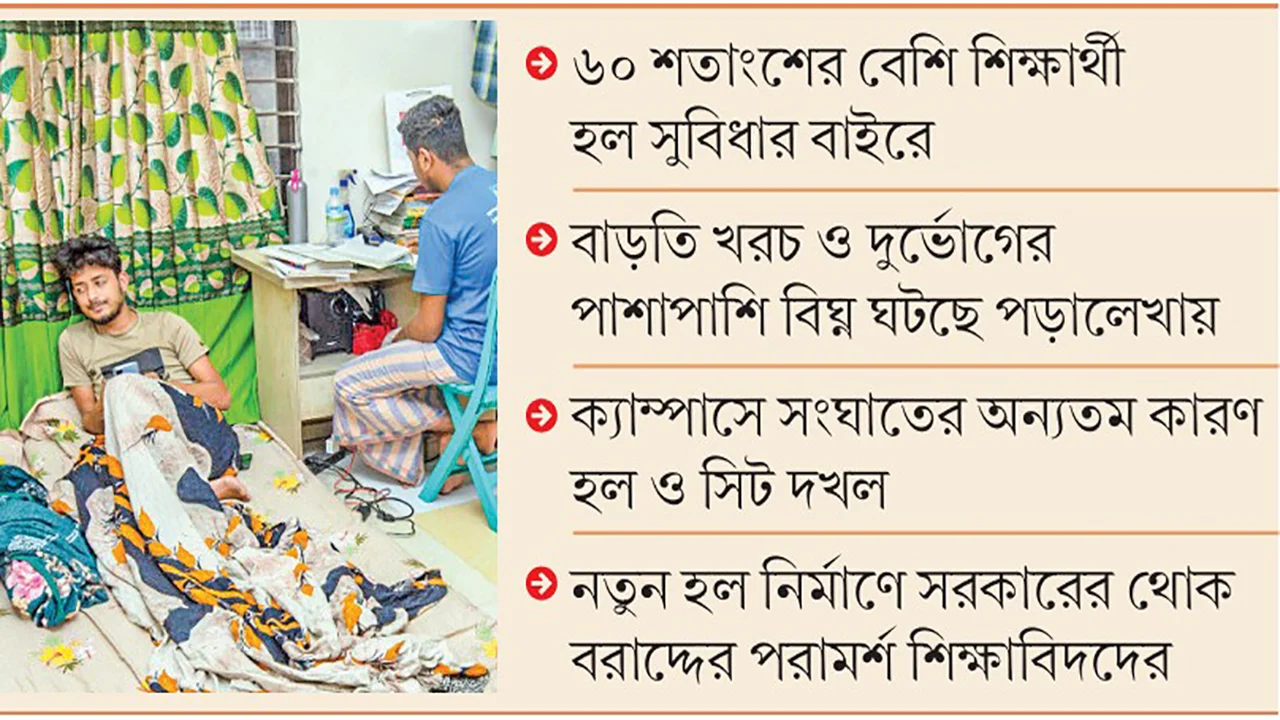
Housing shortage remains one of the most persistent problems facing the majority of students at the country’s public universities. With far fewer residential halls than needed, this problem has continued for years. Currently, fewer than 40 percent of students at various universities have access to hall accommodation. The remaining roughly 60 percent face severe housing shortages. While three universities offer full residential coverage, 10 offer none at all. Even where some accommodation exists elsewhere, most students must arrange mess housing, rented accommodation, or stay with relatives near their universities on their own.
This results in added expenses and significant time lost commuting, alongside disruptions to studies and various other hardships. The housing shortage also negatively affects campus politics, with conflicts sometimes arising over hall and seat control. Those familiar with the issue recommend building sufficient new halls alongside increasing seats in existing ones to address the crisis. They also demand that seats be allocated based on merit according to policy, with guaranteed housing security for those allocated seats.
According to the University Grants Commission’s (UGC) most recently published 2023 annual report, the country’s 50 public universities have 162 male and 100 female residential halls, providing housing to 39.65 percent of students. Full residential coverage exists at Bangladesh Agricultural University, Patuakhali Science and Technology University, and Kishoreganj University.
Meanwhile, no residential facilities exist at all at Bangladesh Medical University, Chattogram Medical University, Rajshahi Medical University, Rabindra University, Sylhet Medical University, Chandpur Science and Technology University, Khulna Medical University, Kurigram University, Sunamganj Science and Technology University, and Pirojpur Science and Technology University.
Meanwhile, only nominal residential facilities exist at Bangladesh University of Professionals (4.44 percent), Pabna Science and Technology University (4.94 percent), and Jagannath University’s single female hall (7.34 percent). The remaining universities have residential facilities for varying numbers of students.
According to sources, because residential capacity falls short of demand at public universities, securing a hall seat is one of the biggest aspirations for students. Although rules require seats to be allocated based on merit, this went unenforced during the previous fascist government’s tenure. Even students who received seat allocations according to the rules often could not stay in them due to occupation by activists of the ruling student organization. Meanwhile, those affiliated with the occupying group’s politics often retained residential facilities without allocation, even continuing to live in halls after finishing their studies. Those with illegal residential access were often involved in various conflicts and creating disorder in halls and on campus, with university authorities largely appearing indifferent to the situation.
Following the [July] 2024 revolution, as the fascist student organization Chhatra League was expelled from all campuses and its activities later banned, the situation began to shift somewhat. During the interim government period, legitimate seat holders were guaranteed the opportunity to stay in university halls. In particular, student union elections created opportunities for both residential and non-residential students to secure their rights at the relevant universities. However, with the terms of these student unions nearing their end and fears of the ruling party’s student wing, Chhatra Dal, expanding its influence, many remain uncertain about whether the current environment will be maintained. Even so, leaders of Islami Chhatra Shibir, currently leading many of these student unions, are emphasizing ensuring seat allocation based on merit according to hall policy at their respective universities.
Asked about the student housing crisis and seat allocation process, Dhaka University Vice-Chancellor Professor Dr Obaidul Islam said: “The seats available in our university’s halls are very inadequate. Students coming from across the country face difficulties in their very first year after admission. In particular, female student enrollment is growing here, yet the number of female halls remains low (19 male and five female halls). Given this situation, we have taken up a project to build several new halls for students. We are also taking steps to increase seats in existing halls.”
On the housing crisis across various universities, he said: “If the government provides block allocations through the University Grants Commission (UGC) for building residential halls, this crisis could be resolved quickly.”
The academic also said maintaining peaceful conditions in residential halls is essential to ensuring a proper academic environment on campus. He said any conflict or clash centered around halls must be addressed politically, requiring political parties to work together. No one holding differing views should be forced out. He said he is working overall to maintain a peaceful environment at Dhaka University, including ensuring seat distribution according to policy.
According to sources, Dhaka University’s 16 male and seven female halls currently provide residential facilities to a total of 43.97 percent of students, making securing a hall seat a matter of major importance for students there.
It is understood that students at Chattogram University face the most severe hardship due to the housing shortage. The university’s five female and 10 male halls/dormitories provide residential facilities to only 21.87 percent of students, forcing students living outside to endure long commutes, added expenses, and various hardships.
On this matter, Chattogram University Central Students’ Union (CUCSU) General Secretary Sayed Bin Habib said: “To address the housing crisis, we have taken various initiatives to increase housing by 10 percent, as per our election manifesto. Accordingly, housing is being arranged for roughly 300 students through 90 spots in teachers’ quarters, 30 in Suhrawardy Hall, and renovation of Shamsunnahar Hall, among other measures. Additionally, a budget of 6.9 billion taka for constructing a 10-story hall is in the process of coming from the ministry. Another major project involving the construction of 10 halls (five for women and five for men) is expected to be approved. Once completed, this will resolve the housing crisis in the long term.”
He further said that instead of the ousted Chhatra League’s occupation-based approach, seats in halls are now being allocated based on merit, adding: “We want this kind of environment to be maintained. If anyone thinks of occupying seats the way Chhatra League did, it will be resisted,” he warned.
At Islamic University (IU), established with the goal of full residential coverage, only 26.14 percent of students currently receive housing facilities. As a result, while many hope to secure a hall seat, that fortune eludes most. Those familiar with the matter believe residential halls need to be expanded.
On the hall situation, IU Journalists’ Association President Niyamatullah Munim said: “During the ousted Awami League government’s tenure, residential halls were under Chhatra League’s control. Meritorious students received seat allocations at the time, but couldn’t stay in them without the group’s approval. However, the situation has normalized since the interim government period. Everyone hopes this environment continues.”
Rajshahi University, one of the country’s oldest and largest higher education institutions, provides residential facilities to 46.71 percent of students across 12 male and six female halls. While seat allocation in halls has followed normal procedures since August 5, new concerns have recently emerged. On June 29, Chhatra Shibir held a human chain protest alleging illegal seat occupation by Chhatra Dal in the halls, presenting a three-point demand including ensuring full residential coverage. Chhatra Dal has denied the seat-occupation allegations. It is understood that the two student organizations have recently agreed to coexist in the halls and on campus.
Meanwhile, Jagannath University (JnU), located in Dhaka’s Sadarghat area, currently has roughly 20,000 students. But even 20 years after its establishment, the university has built only one hall, for female students.
JnU Central Students’ Union (JnUCSU) General Secretary Abdul Alim said: “The housing problem at JnU has become a permanent curse. University administrations and budgets come and go, but the problem is never solved.” He said the female residential hall is currently housing more students than its capacity, while male students, with no hall at all, face extreme hardship.
The student union leader further said: “Currently, the military is carrying out construction on two male halls, named Pani Bhaban and Dr Habibur Rahman Hall. This is scheduled to be completed by December, providing housing for 1,600 students. Beyond this, 200 million taka had been allocated for building a temporary tin-shed hall on seven acres of university land, which could be completed within four months. We have been demanding this work be assigned through the military. This would provide housing for 1,700 students.”
“But Chhatra Dal wants a 10-story building constructed there instead, which would house only 600-700 students. This would also take much longer to complete.” Abdul Alim said the university administration has given assurances on these matters, but uncertainty remains over whether they will actually be implemented.
Similarly, among the country’s major public universities, residential facilities stand at 53.03 percent at BUET, 33.57 percent at Shahjalal University of Science and Technology, 33.40 percent at Khulna University, 47.50 percent at HSTU, 34.70 percent at Mawlana Bhashani Science and Technology University, 33.92 percent at KUET, 47.21 percent at DUET, 37.01 percent at Noakhali Science and Technology University, 20.84 percent at Comilla University, and 39.40 percent at National Poet Kazi Nazrul Islam University.
However, universities with higher residential coverage include Jahangirnagar at 98.91 percent, Sher-e-Bangla Agricultural University at 98.15 percent, CUET at 70.78 percent, Chattogram Veterinary and Animal Sciences University at 85.37 percent, and Sylhet Agricultural University at 96.22 percent. According to the UGC report, the remaining universities have residential coverage ranging from roughly 13 to 50 percent.
বাংলায় মূল প্রতিবেদন পড়ুন · Read the original Bengali report