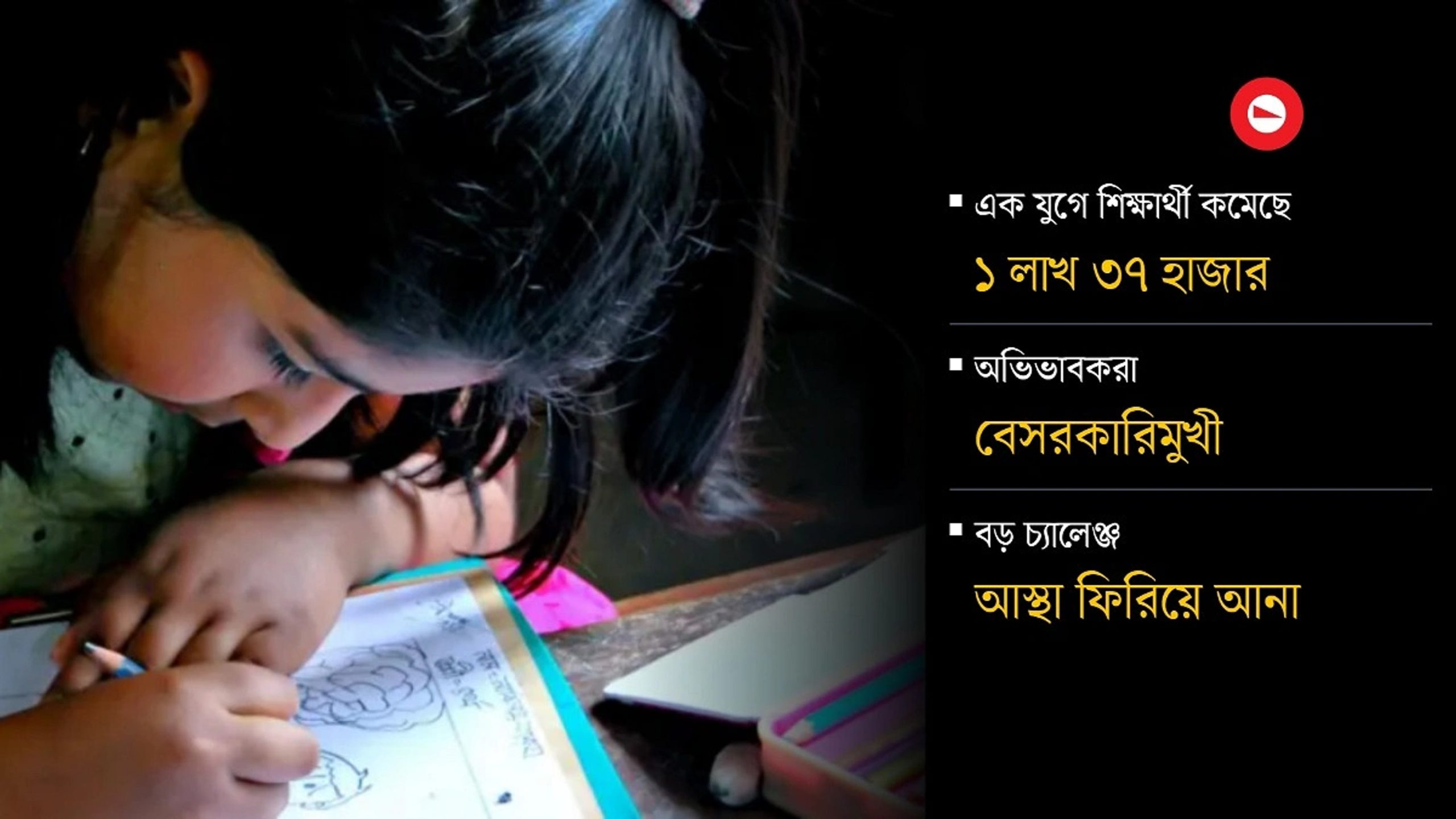
Despite free books, stipends, fee-free schooling and other benefits, government primary schools are losing pupils. In Rajshahi division alone, government primary schools have lost about 1 lakh 37 thousand pupils over the past dozen years. Over the same period, pupil numbers have risen at kindergartens and private primary schools. Analysts say the shift is an important signal of a change in people’s confidence in, and expectations of, government primary education.
Government investment in primary education is rising every year. In the current financial year, 35,403 crore taka has been allocated to primary and mass education. The money goes on pay and allowances for government primary school teachers and staff, school management, infrastructure development, teacher training, free textbooks, stipends and various educational support programmes.
Even with this vast state investment, the fall in pupil numbers at government primary schools has given those involved in education pause for thought. A large share of parents say they now give more weight not simply to free education but to the quality of their child’s learning, regular teaching, examinations, teacher-parent contact and individual attention. So despite the extra cost, they are sending their children to private institutions.
According to the Directorate of Primary Education, government primary schools in Rajshahi division had 13 lakh 9 thousand 75 pupils in 2014. By 2026 the number had fallen to 11 lakh 83 thousand 992.
Over the same period, pupil numbers at kindergartens and other private primary institutions rose. These institutions had 4 lakh 36 thousand 966 pupils in 2014. By 2026 the number had risen to 5 lakh 4 thousand 30.
According to the latest Population and Housing Census 2022, the population of Rajshahi division is 2 crore 3 lakh 53 thousand 116. In the 2011 census the figure was 1 crore 84 lakh 84 thousand 858 — an increase of about 18 lakh 68 thousand in a decade.
Parents say regular classes, homework, examinations, English teaching, contact with teachers and the ability to monitor their child’s progress have become important to them.
Saju, a parent who sends his son to Shaheen School in Rajshahi, said: “I cannot even think of sending my child to a primary school. There is no trace of modern education there. To build a pupil up, including making them proficient in English, and to give them quality teaching, there is no alternative to a good private school.”
Visits to various government primary schools in Rajshahi also found the picture of falling numbers. Only 10 pupils enrolled in class one this year at Katakhali Government Primary School in Paba upazila. According to the school authorities, many pupils left the government school for kindergartens that have grown up nearby.
Akshi Government Primary School in the same upazila has also lost pupils. In five years the school’s roll has fallen from 550 to about 350. Over the same period several kindergartens have grown up around the school.
Education officials have not yet reached any firm conclusion on why pupil numbers are falling at government schools. In their view demographic change, parents’ socioeconomic circumstances, the spread of private educational institutions and several other factors may be at work. Data-based research is needed to establish the real reason.
Nur Akhtar Jannatul Ferdous, assistant director at the office of the divisional deputy director of primary education in Rajshahi, said: “It is not possible to say in a word why pupil numbers have fallen. Research is needed on this. Once research is done, details can be given.”
Professor Dr. Akhtar Banu, director of the Institute of Education and Research at Rajshahi University, said: “Parents choose a school considering their child’s future. They enrol their child where they have more confidence. So the biggest challenge before government schools is to win back people’s confidence.”
বাংলায় মূল প্রতিবেদন পড়ুন · Read the original Bengali report