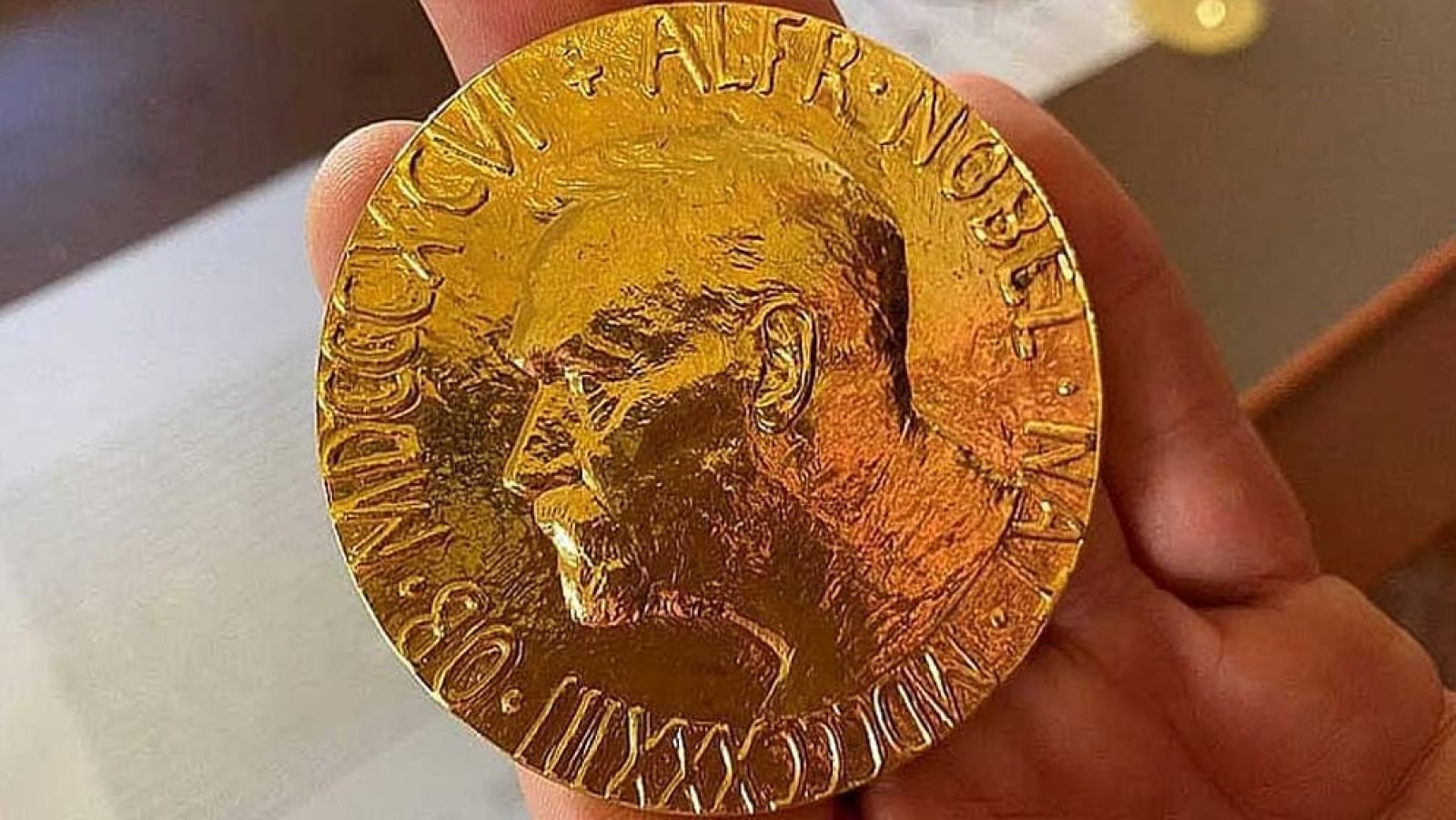
Amid wars, conflicts, humanitarian disasters and a crisis of international cooperation, the Nobel peace prize for 2026 will be announced on Friday. The announcement is due from Oslo, the Norwegian capital, at 3pm Bangladesh time. Jørgen Watne Frydnes, chair of the Norwegian Nobel Committee, will name the winner.
According to a Reuters report, 287 nominations were submitted for this year’s prize: 208 individuals and 79 organisations. The committee does not publish an official list of nominees; under its rules nomination papers are kept secret for 50 years. The names that surface before the announcement therefore depend largely on what nominators, experts and the media make public.
In the final days the list of possible candidates ranges from organisations giving humanitarian aid in war-torn countries to international courts, a journalists’ rights group, a religious leader and even the International Space Station.
In Reuters’ analysis, the names being discussed this year include Pope Leo, the International Criminal Court (ICC), the International Court of Justice (ICJ) and Francesca Albanese, the UN special rapporteur on the Palestinian territories.
The report says Pope Leo has been speaking for an end to wars, for dialogue and for the peaceful settlement of disputes. Experts think his calls for peace at a time of conflict in the Middle East and international instability have brought him into the discussion.
The ICC and the ICJ are also being discussed for their role in strengthening international law and the multilateral system. Some analysts point to the possibility of recognising the two courts because international cooperation and the peaceful resolution of conflict are among the prize’s core purposes.
Albanese is also mentioned for her stand on Gaza and Palestine, though some international observers think her candidacy could be highly politically sensitive.
Trump’s name is also discussed
One of the most talked-about names is US President Donald Trump. Leaders of several countries have said publicly that they nominated him, though the committee does not confirm such nominations.
Several experts who spoke to Reuters thought his chances of winning were very slim. They suggested that the controversy around Trump and last year’s prize could affect this year’s decision too.
The matter drew more attention when the 2025 laureate, Venezuela’s María Corina Machado, later presented her Nobel medal to Trump. There is also discussion of whether the committee could take a decision this time that would put the prize at the centre of a new political controversy.
The Emergency Response Rooms of war-torn Sudan have also emerged as a possible candidate. Since the civil war began there in 2023, this network built by local volunteers has provided food, medical care, safe evacuation and other emergency help in many areas. With international aid falling, such local initiatives have taken on special importance.
They are also on the 2026 list of Håkon Gjerløw, director of the Peace Research Institute Oslo (PRIO).
Ukraine’s Mykola Kuleba
Ukrainian children’s rights campaigner Mykola Kuleba and his organisation Save Ukraine are also being discussed. The organisation has worked to rescue Ukrainian children taken to Russia during the war and reunite them with their families.
PRIO’s list includes Kuleba together with Save the Children, the international organisation working for children. PRIO says such a prize could send a message about the importance of peace and human security by putting the protection and rights of children in wartime to the fore.
Attacks on and killings of journalists around the world have also entered the discussion, with the Committee to Protect Journalists (CPJ) a possible candidate.
According to PRIO, 132 journalists and media workers were killed in 2025, one of the worst years since records began. The CPJ’s name has come up against the background of growing pressure on journalists’ safety in war zones and on independent journalism.
One of the most unexpected names this year is the International Space Station (ISS). According to an AP report, the station, run jointly for many years by scientists from the United States, Russia, Europe, Japan, Canada and other countries, is seen as a rare example of international cooperation beyond the Earth.
The ISS is also on Gjerløw’s list. His argument is that while geopolitical divisions have grown on Earth, the project has long set an example of cooperation between countries in space.
Why this year’s prize matters
The prize comes at a time of several major conflicts. War and humanitarian crises continue in Ukraine, Sudan, the Middle East and elsewhere, and debate is growing about the effectiveness of international institutions, multilateral cooperation and international law.
Kristian Berg Harpviken, secretary of the Norwegian Nobel Committee, told Reuters recently that the committee is watching the changing international order closely. With that change, he said, come trends that threaten the values the peace prize stands for.
He hinted that the work of those building new forms of cooperation and structures of peace may be among the things the committee considers, but gave no indication of a likely winner or any particular candidate.
A late favourite, or a surprise?
The peace prize is hard to predict to the last moment. In the past it has gone to many people and organisations who were little discussed beforehand. So the possibility that the committee will choose someone outside these names cannot be ruled out.
The committee itself says the names that have surfaced cannot be treated as an official list of candidates. Which of the 287 nominations it has chosen will be known only at Friday’s announcement.
বাংলায় মূল প্রতিবেদন পড়ুন · Read the original Bengali report