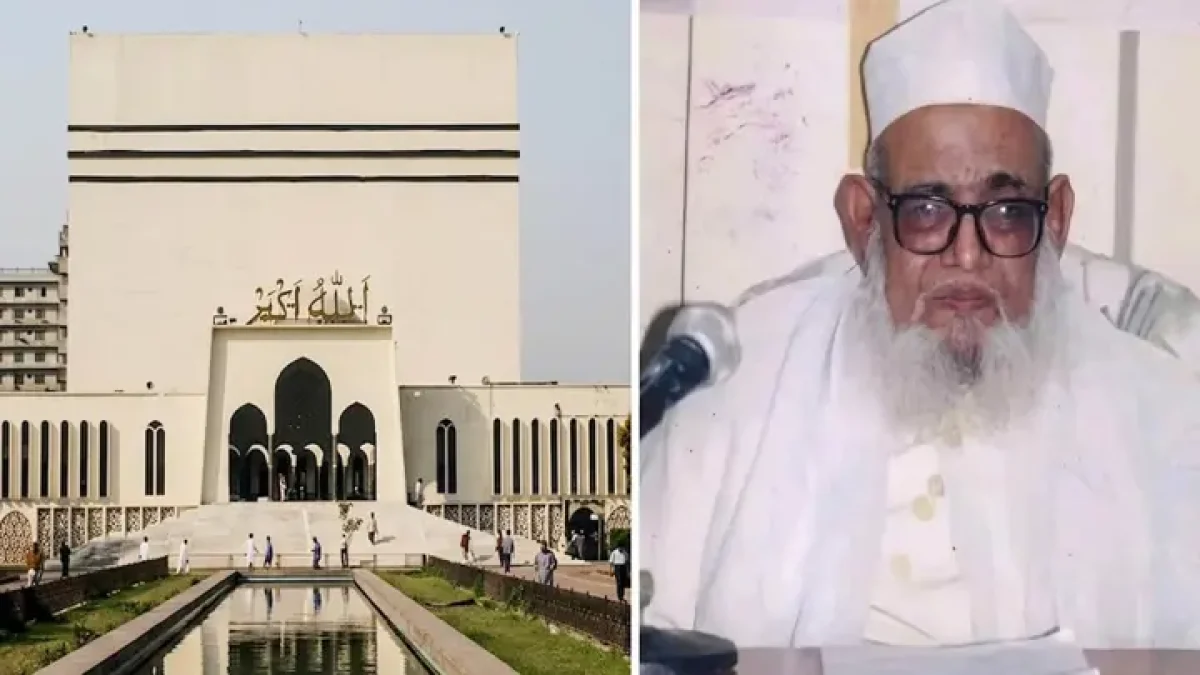
It is 19 years since the death of Maulana Ubaidul Haq Jalalabadi, a distinguished scholar, educationist and writer of Bangladesh’s Islamic community and for many years khatib of the national mosque, Baitul Mukarram. He died on 6 October 2007, 23 Ramadan 1428 in the Hijri calendar.
Over a varied career in scholarship, teaching, the office of khatib, Islamic research, writing and religious leadership, Maulana Ubaidul Haq left a particular mark on the country’s Islamic community.
Higher studies at Deoband
Maulana Ubaidul Haq was born on 2 May 1928 at Barothakuri in Zakiganj upazila, Sylhet. His father, Zahurul Haq, known as Urkiz Ali, had been a student of Darul Uloom Deoband and was a khalifa of Allama Ashraf Ali Thanwi.
After his early schooling in his own village and at local institutions, he went to Darul Uloom Deoband in India for higher studies. There he studied under renowned scholars of the subcontinent, among them Husain Ahmad Madani, Ibrahim Balyawi, Izaz Ali Amrohi and Qari Muhammad Tayyib.
He achieved outstanding results in the Dawra-e-Hadith examination at Darul Uloom Deoband.
Teaching and the office of khatib
After completing his studies, Maulana Ubaidul Haq began his working life in 1949 as a teacher at Jamia Hussainia Ashraful Uloom at Bara Katra in Dhaka. He later taught at a madrasa in Shahjahanpur and at Darul Uloom Karachi. For a time in this period he was also involved in the political activities of Jamiat Ulema-e-Islam and the Nizam-e-Islam Party.
He later joined the Government Madrasah-e-Alia in Dhaka, where he served as head maulana from 1980 to 1985.
In 1984 he took up the post of khatib of Baitul Mukarram, Bangladesh’s national mosque. He held it until his death.
His teaching did not stop when he retired from Dhaka Alia. He served as muhtamim of Madrasa-e-Islamia Islampur and as shaykh al-hadith of Madrasa-e-Faizul Uloom Azimpur. He was also shaykh al-hadith at Al Jamia Al Islamia Patiya and at Jamia Qasimul Uloom Dargah-e-Hazrat Shahjalal. Many renowned scholars of the subcontinent were among his students.
Islamic research and religious work
Alongside teaching and his duties as khatib, Maulana Ubaidul Haq played an active part in Islamic research and religious unity in Bangladesh. The work of the Islamic Research Council, which grew out of his thinking, later influenced the development of the Islamic Foundation Bangladesh.
He also played an important part in establishing Islamic banking and insurance in the country. He was chairman of the Shariah council of Islami Bank and of the joint Shariah committee formed by several Islamic banks, and took the initiative to set up a national Shariah council.
He served for many years as president of the International Majlis-e-Tahaffuz-e-Khatm-e-Nabuwwat Bangladesh. He took a public stand against various activities he held to be contrary to Islam and the Shariah. His statements and actions on religious values and social order were widely discussed at the time.
Writing and translation
Maulana Ubaidul Haq Jalalabadi was also a writer and translator. He added “Jalalabadi” to his name from Jalalabad, the old name of Sylhet, the land of his birth. He left works in Bangla, Urdu and Arabic.
His notable books include Tarikh-e-Islam, Sirat-e-Mustafa, As-Siqaya Sharh Sharh al-Wiqaya, Nashr al-Fawaid Khulasa Sharh al-Aqaid, Azhar al-Azhar, Tahsil al-Kafiya and Shia Sunni Ikhtilaf. Another notable work is the collected text of a series of talks, Quran-e-Hakim aur Hamari Zindagi, broadcast from the Dhaka station of Radio Pakistan.
Tarikh-e-Islam is in two volumes. It covers a long span of history, from pre-Islamic Arabia through the coming of Islam to the Muslim rule that followed. His Sirat-e-Mustafa sets out the life of the Messenger of God (peace be upon him) together with the purpose of reading the sirah and various fundamentals of Islam.
Awards and honours
Maulana Ubaidul Haq received a number of awards and honours in his lifetime in recognition of his scholarly and religious service. He took first place more than once in Arabic oratory competitions, and received a gold medal from Saudi Arabia’s Majlis ash-Shura.
In 2004 the National Sirat Committee Bangladesh awarded him a gold medal as the Islamic personality of the year. In 2005 the Quran Shikkha Society honoured him for his special contribution to the teaching of the Quran and hadith.
Death and burial
Maulana Ubaidul Haq Jalalabadi died on 6 October 2007, in the month of Ramadan. His funeral prayer was held at the National Eidgah and was attended by the highest officials of the state, religious scholars, political leaders and people from all walks of life. He was buried at Azimpur graveyard.
Nineteen years after his death, his contribution to teaching, to the office of khatib, to Islamic research, to writing and to religious leadership is still remembered in Bangladesh’s Islamic community.
বাংলায় মূল প্রতিবেদন পড়ুন · Read the original Bengali report