Hearing his name brings joy to mind before any statistics. He is remembered not for goals, titles or records, but for the beauty of his play. Former Brazil player Ronaldinho is one of those names.
His smile with the ball at his feet, his dribbling that made fools of opponents, his passes that turned the impossible into the possible, and his ability to turn football into entertainment for spectators set him apart from everyone else. For more than two decades, the same question has gone round and round in football lovers’ minds — who is Ronaldinho, really?
In search of that answer comes the new documentary “Ronaldinho: The One and Only.” Released on Netflix this past April ahead of the World Cup, the three-part documentary is not just the story of a footballer; it is the tale of a poor Brazilian boy’s conquest of the world — a man with a smile always on his face, but whose life held struggle, tragedy, controversy and unbelievable success.
The little boy from Porto Alegre
Ronaldinho was born in 1980 in Porto Alegre, a city in southern Brazil. His full name is Ronaldo de Assis Moreira. Football was in his family’s blood. His father, Joao, was an amateur footballer and a worker at a shipbuilding yard. His elder brother, Roberto, dreamed of becoming a professional footballer.
But Ronaldinho’s childhood was not a happy one. He lost his father when he was only eight years old. Financial hardship fell upon the family. In the documentary, family members recall that time. It shows that football was little Ronaldinho’s only refuge.
From street football to the world stage
Ronaldinho grew up playing football in Brazil’s alleys, beaches and small grounds. The documentary reveals how his extraordinary talent caught everyone’s eye at a young age. The story of scoring 23 goals in a single match at age 13 has come up for discussion again. Very soon, he came to the attention of the Brazilian club Gremio. From there began his professional football journey.
Old video footage in the documentary shows that the young Ronaldinho’s style of play was different from others’ even then. He did not just want to score goals; he wanted to delight the spectators.
A scene from “Ronaldinho: The One and Only.” Netflix
European conquest
Ronaldinho entered European football by joining France’s PSG. But his true rise came at Barcelona in Spain.
One of the documentary’s most emotional sections is the Barcelona chapter. The club was then in crisis. The fans were dejected. Ronaldinho arrived and changed not just the team but the entire club’s mentality.
In 2005 he won the Ballon d’Or. Around the same time, he turned Barcelona back into one of Europe’s top clubs. From former teammates’ accounts in the documentary, it emerges that Ronaldinho’s presence was infectious. Just as he smiled on the pitch, he spread joy in training too.
Ronaldinho in Messi’s life
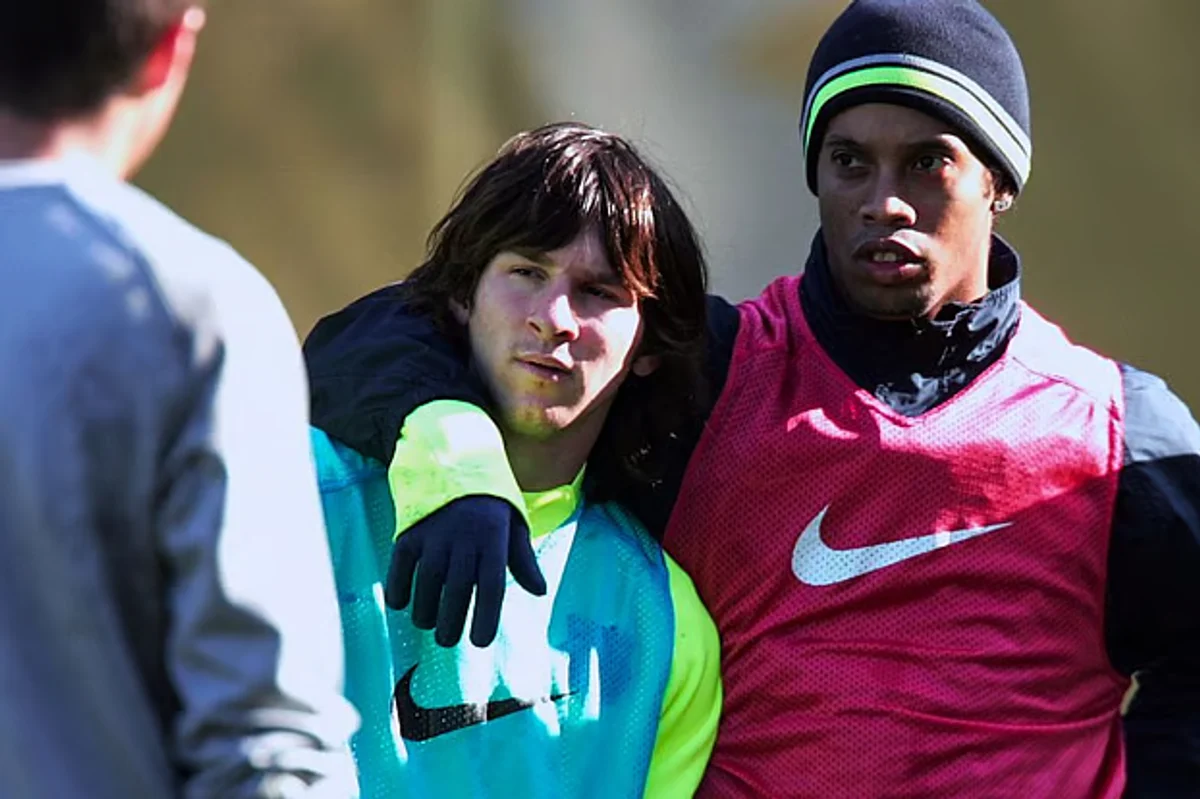
One of the documentary’s most appealing parts is Ronaldinho’s bond with Lionel Messi. Everyone knows today’s Messi. But in 2004 he was a shy teenager. It was Ronaldinho who first took him in within the dressing room. When Messi made his debut for Barcelona’s senior side, Ronaldinho was the team’s biggest star. Ronaldinho also assisted Messi’s first goal. The documentary shows how he took the young Messi under his wing and gave him confidence in the dressing room. In the view of many analysts, Ronaldinho’s role in Messi’s rise in Barcelona’s history was extremely important. In the documentary, Messi too shares memories of that time.
Ronaldo’s shadow in the story too
Another interesting fact is brought up in the documentary. In 2003, Manchester United came very close to signing Ronaldinho. In the end he chose Barcelona. As a result, a winger’s spot was left vacant at United. It was through that opportunity that an 18-year-old came to the club — Cristiano Ronaldo.
The hero of the 2002 World Cup
Brazil’s fifth World Cup triumph also receives special importance in the documentary. The attack built around Rivaldo, Ronaldo and Ronaldinho in 2002 was one of the most fearsome trios in football history. His famous free-kick against England, in particular, remains one of the most talked-about moments in World Cup history. Was it a shot or a cross? The answer is still not fully settled. But the goal took Brazil to the semifinals. The team went on to win the World Cup.
Poster of “Ronaldinho: The One and Only.” Netflix
Not only success, but controversy too
The documentary does not shy away from the controversial chapters of Ronaldinho’s life either. Fitness problems toward the end of his career, an undisciplined lifestyle and various off-field criticisms come up. In particular, his 2020 arrest in Paraguay for using a fake passport is discussed in the documentary.
The makers try to show how worldwide fame can, at times, make a person’s private life so complicated.
Why is he so loved?
Ronaldinho’s career statistics are remarkable. He has won the World Cup, won the Champions League, won the Ballon d’Or. But the documentary brings up an important point — people do not remember him only for trophies. Because he played football with joy. In an era when football was increasingly trapped within tactics, economics and business, Ronaldinho reminded spectators that football is, above all, a game of joy. The documentary shows how he not only won matches but changed the very way football was played. His no-look pass, his elastico dribble, his impossible free-kicks and the skills with which he humbled opponents remain alive in the memories of football lovers from the pre-YouTube era.
The documentary’s biggest success is that it does not try to make Ronaldinho a god. Rather, it shows him as a human being. Here there is the rise of a legend, but also wrong decisions. Here there is the flash of success, but also the darkness of failure. As a result, the viewer does not just watch a football star; they come to know a human being.
বাংলায় মূল প্রতিবেদন পড়ুন · Read the original Bengali report