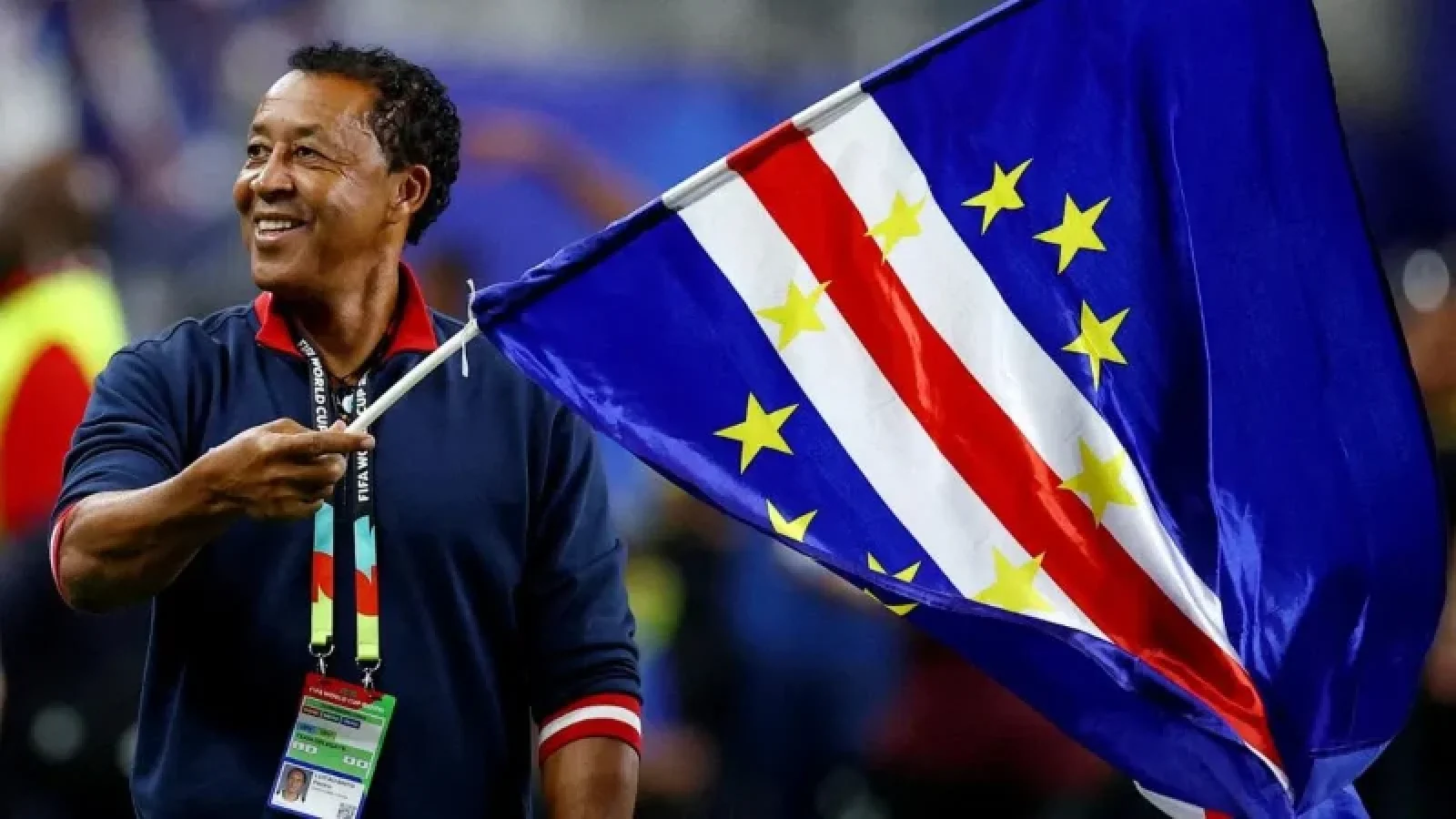
In the village of Povoacao Velha on Boa Vista island, there was only one television in the whole village. On World Cup nights, villagers would crowd in front of it. Standing at the back, a small boy watched, spellbound, the football magic of Diego Maradona and Lothar Matthaus. Back home, his mother would make him a ball out of socks. With that sock-ball his football journey began.
Many years later, that same boy wore the Cape Verde national team’s captain’s armband for 11 straight years. The football world now knows him as “Bubista,” though his real name is Pedro Leitao Brito. Because he was born on Boa Vista island, his childhood nickname “Bubista” has become his identity. And on Saturday morning, standing in the Houston dugout, that 56-year-old man wrote the greatest history of his country’s football. Under his guidance, the small African island nation of Cape Verde reached a World Cup knockout stage for the first time.
Cape Verde had to cross many rough roads to reach the World Cup. After failing seven times in a row, the African Blue Sharks qualified for the World Cup for the first time this time — and surprised everyone on their first chance. From a group with two former world champions, Spain and Uruguay, the team reached the last 32 as unbeaten runners-up. From the outside it looks like a fairy tale, but behind it lie nearly two decades of planning, patience and hard work.
One of the biggest foundations of Cape Verde’s success is centre-back Logan Costa. The Villarreal defender was out for nearly 10 months after suffering an ACL injury last July, and played just 13 minutes in La Liga on 17 May before the World Cup. Questions had been raised over the decision to include such a player. But Bubista did not lose faith, and it paid off: neither Spain, Uruguay nor Saudi Arabia could easily break the Costa-led defensive wall. Cape Verde’s biggest strength throughout the group stage was their organised defence.
Cape Verde’s population is just 5.5 lakh. But the number of expatriate Cape Verdeans is even greater than the people at home, and Bubista has strung those scattered people together. Midfielder Jamiro Monteiro, for instance, was born in Rotterdam in the Netherlands. Growing up in a migrant family, he learned his football on neighbourhood streets, later making his way to the national team via the Netherlands and the United States’ Major League Soccer. In World Cup qualifying, he secured Cape Verde’s World Cup ticket by playing his 50th international against Eswatini.
Kevin Pina’s story is no less surprising. He was spotted by former captain Carlos Morais while playing on the streets of Brockton, Massachusetts, in the United States, and from there began his professional football journey. He now plays for Krasnodar in Russia. His free-kick goal against Uruguay at the World Cup remains one of the tournament’s finest moments.
Helio Varela, who came on as a substitute to score the equaliser against Uruguay, plays for an Israeli club. Few may have known his name before the match, but one goal earned him a place in Cape Verde’s football history.
Defender Pico Lopes’s story is even more amusing. Born in Dublin, Ireland, the footballer at first thought the message from the Cape Verde coach, in Portuguese on LinkedIn, was spam — only later realising it was the national team’s call. Had he ignored that message, he might never have become part of history.
And goalkeeper Vozinha is now a hero across the whole country. Making seven saves alone against Spain, he became man of the match, and could not hold back his tears after the final whistle — because at that moment he most remembered his late grandparents, with whom his football journey first began.
The 36-year-old captain, Ryan Mendes, is the team’s most experienced face. Playing 96 internationals over the past 16 years, he has witnessed every rise and fall of Cape Verde. And 25-year-old Deylon Livramento opened the road to the World Cup by scoring important goals against Cameroon and Eswatini in qualifying. Few remembered those goals before the World Cup began, but the foundation of history was laid there.
For Cape Verde, the World Cup is not just a dream but an investment in the future. Just for playing the World Cup group stage, Cape Verde will receive $10.5 million from FIFA. The federation plans to spend all of it on developing the country’s football infrastructure and finding Cape Verdean talent scattered across the world. The generation of 14-year-old academy footballers like Yuri Marley Fernandes no longer has to imagine: they have grown up watching a national team that played a quarter-final at the Africa Cup of Nations and reached the World Cup ahead of sides like Cameroon. For them, the world stage is no longer an impossible dream.
Before the Saudi Arabia match, Bubista had said: “Everyone has the right to dream. There is no such thing as impossible.” This man, who began playing with a sock-ball, knows well just how much blood and sweat it takes to win the respect of world football.
On 4 July, the reigning world champions Argentina stand before them in the knockout stage, with Lionel Messi on the other side. That small boy from Povoacao Velha grew up watching even bigger magic on a borrowed television. Now it is his turn to write his own story on the biggest stage of the World Cup.
বাংলায় মূল প্রতিবেদন পড়ুন · Read the original Bengali report