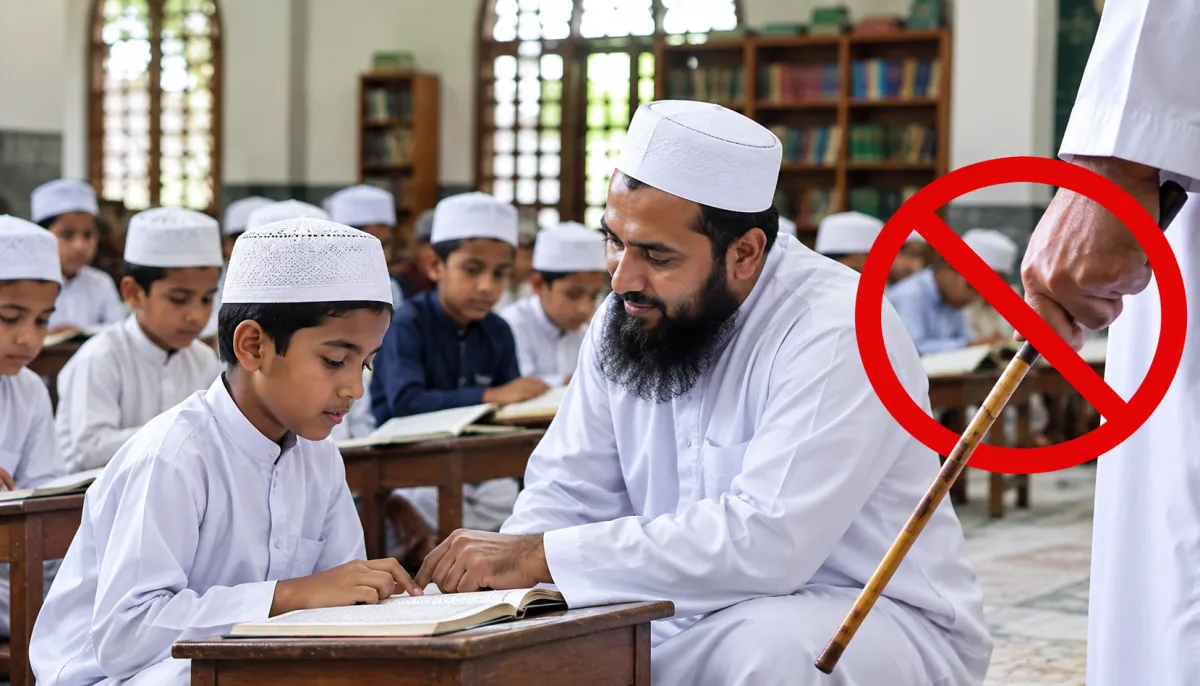
Al-Haiatul Ulya Lil-Jamiatil Qawmia Bangladesh has completely banned the corporal punishment of students at qawmi madrasas. It has also ordered every madrasa affiliated to the country’s six qawmi madrasa boards to form or reconstitute a student protection committee and put it into effect immediately.
The instructions were issued on Saturday (September 19) on the orders of Al-Haiatul Ulya’s chairman, Allama Mahmudul Hasan. They were given against the background of recent reports and allegations in various media and on social media about the abuse of students at qawmi madrasas and the immoral conduct of certain individuals.
The instructions say the sole purpose of discipline must be the correction and welfare of the student. It may not be retaliatory in any circumstances. Teachers are told not to punish a student while angry, and to take measures step by step. First a gentle warning, then a mild rebuke if needed, and then the scope for anger or a reprimand. If it is absolutely necessary, the final step is to call in the guardian, inform them in writing and take the necessary measures with the guardian.
The instructions make clear, however, that a student may not be beaten as punishment in any circumstances. Striking with a stick, a cane or any other implement, striking the face, the head or sensitive parts of the body, and any punishment that breaks bones, draws blood or leaves marks are all banned.
Teachers are also instructed to avoid any kind of psychologically abusive behaviour, including public humiliation, abuse, rebuke, harsh language and addressing students by hateful nicknames. Teachers who break these instructions will be held to account under sharia and the existing rules.
Al-Haiatul Ulya said its policy is to ensure a proper investigation and lawful trial where a person is genuinely involved in a crime or immoral act, and to give no shelter to an offender. But the instructions also said it is not reasonable to call the whole qawmi madrasa education system, its students and its teachers into question on the basis of isolated incidents, or to place the blame for the crime of a particular individual on a madrasa, a board or the wider body of scholars and students.
Investigation within seven days
Every madrasa is instructed to form or reconstitute a student protection committee and keep it active. Students, teachers and staff must be able to bring complaints of misconduct, abuse or harassment to the committee.
The instructions require an investigation to be completed and a report given within seven days of a complaint. In serious cases, the accused is to be temporarily kept away from duty while the investigation continues.
Madrasas were warned that if it is proved that a madrasa has no protection committee, that the committee is inactive, or that no action was taken after a complaint was received, that will be treated as grounds for suspending or cancelling the madrasa’s affiliation.
Islahi sessions and guardian meetings
The instructions call for regular islahi majlis sessions for teachers and students at every madrasa. Compulsory tarbiyati majlis sessions are to be arranged for newly appointed teachers, and more guardian meetings held.
Emphasis was also placed on strengthening contact and trust between madrasa authorities and guardians, and on bringing any problem to the authorities’ attention quickly.
Monitoring cell and hotline
Each board is instructed to form a separate madrasa monitoring cell to oversee madrasa activity, and to open a separate hotline for receiving complaints.
Once a complaint is received, the board, the madrasa authorities and the protection committee are to arrange an immediate, impartial investigation together. Care is also to be taken in checking the character and credibility of candidates when appointing teachers and staff.
At the same time, the boards are to arrange legal remedies through their panels of lawyers for innocent teachers, muhtamims or institutions who are the victims of false accusation, baseless reports or media trial. The instructions said Al-Haiatul Ulya’s central hotline number, 01700-763178 (WhatsApp), can be used where necessary.
The instructions, signed by Al-Haiatul Ulya’s chairman Allama Mahmudul Hasan, ask the country’s six qawmi madrasa boards and their affiliated madrasas to take the necessary steps without delay.
They add that the instructions were drawn up on the basis of decisions taken at the 69th meeting of the standing committee, held on September 12 under the chairmanship of Allama Mahmudul Hasan, and at the meeting of the relevant subcommittee held earlier on July 29. The instructions say that in preparing them, the writings on teaching and training of the scholars of Deoband, including Maulana Ashraf Ali Thanvi and Shaykhul Hadith Maulana Muhammad Zakariya Kandhlawi, and the fatwas of well-known religious institutions were followed.
বাংলায় মূল প্রতিবেদন পড়ুন · Read the original Bengali report