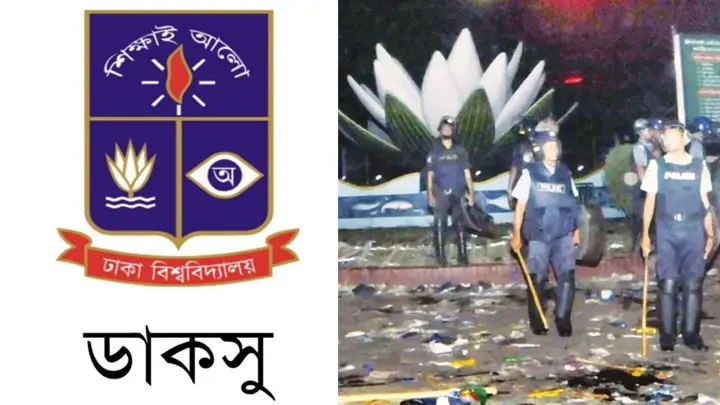
From the massacre carried out at Shapla Chattar in the capital on May 5, 2013, to the July-August 2024 student-public mass uprising, important historical chapters of Bangladesh’s anti-Awami fascism struggle have found a place in the archive of the Dhaka University Central Students’ Union (DUCSU). The archive prominently displays photographs of the brutal crackdown at Shapla Chattar and of students’ resistance. Scholars from the country’s Qawmi madrasa community have welcomed and praised this timely and courageous DUCSU initiative.
On May 5, 2013, the then Awami League government’s brutal crackdown on alims, madrasa students and ordinary people gathered at Shapla Chattar in Motijheel essentially laid the foundation for the anti-fascist resistance that followed. Continuing that sacrifice and anger from Shapla Chattar, the quota-reform movement of July-August 2024 grew into an all-out, unprecedented anti-fascist mass uprising. Through this struggle spanning more than a decade, authoritarian rule finally collapsed.
According to available information, at least 61 people were killed or went missing in the 2013 Shapla massacre, while more than 1,400 people lost their lives to the bullets of the authoritarian regime in the July-August 2024 mass uprising. Scholar leaders said the country’s future leadership grows out of Dhaka University’s campus, and that with the accurate history of Shapla Chattar preserved in DUCSU’s archive, the younger generation will be able to learn the true facts of this dark chapter of national history and its sacrifices. They also called for the ulama’s sacrifice and contribution to national history and state reconstruction to be formally recognised by the state, rather than the effort being limited to a photo exhibition.
Thanking DUCSU leaders, Hefazat-e-Islam Bangladesh’s deputy ameer and Khelafat Majlis’s deputy ameer, Maulana Ahmad Ali Kasemi, said DUCSU leaders had placed various images of Hefazat-e-Islam’s movement in Dhaka University’s archive. “We welcome this,” he said, “because the massacre carried out against Hefazat in 2013 is history that all the people of Bangladesh need to know. And Dhaka University’s students will one day hold various important positions in the country. I think those who placed these in the archive have done very good work, and I thank them for it.”
Muhim Mahfuz, a researcher with the Shapla section of the July Mass Uprising Memorial Museum, said adding Shapla mass-movement memorabilia to DUCSU’s archive is a significant step toward viewing Bangladesh’s history in full. “I want to thank the organisers for this,” he said, “because I see Shapla as the first phase of Bangladesh’s anti-fascist mass movement and the starting point of the July Revolution of 2024.” He said the social and cultural awakening among Bangladesh’s people that began with the 2013 Shapla movement continued through the years that followed and reached its successful conclusion with the fall of the authoritarian regime. “The history of July cannot be complete without the history of Shapla,” he added. “Giving Shapla its rightful place in history gives the new generation an important key to understanding the historical background of the July Revolution. I hope future DUCSU leaders maintain this continuity and work to enrich it further.”
National Ulama Alliance convener Maulana Ashraf Uddin Mahdi extended sincere thanks and gratitude to DUCSU authorities on behalf of the alliance for bringing this important chapter of history before the new generation, calling the preservation of the ulama community’s contribution and of photographs from the May 5, 2013 Shapla Chattar events, in a place as significant as DUCSU, undoubtedly important. He said that night at Shapla Chattar is a painful chapter in Bangladesh’s history, and that the photographs displayed in DUCSU’s archive bring back the memory of that night’s conflict, the helplessness of the injured, and the horrific situation at the scene. He said evidence-based investigation and ensuring justice are essential to presenting the events of that night to the new generation as accurate history.
Shapla Memorial Council general secretary Muhammad Kamal Uddin said that, on behalf of the council, they extend sincere greetings and gratitude to DUCSU for displaying photographs of the 2013 Shapla massacre in its archive. He said they were also pleased and grateful that the council’s published “Shahidnama” (record of martyrs) has been preserved in the archive, and that they hope DUCSU will organise further important discussions, exhibitions, and literary and cultural events around preserving the memory and history of the Shapla massacre in the days ahead. “Our hope is that this effort to preserve history and memory around Shapla grows even further,” he said.
National Ulama Mashayekh Aimmah Parishad joint general secretary Mufti Shamsuddoha Ashrafi said the 2013 Hefazat movement was a historic mass movement for the protection of the country, its values, its patriotism, its civilisation, culture and etiquette. He said it stood against fascism, against autocracy and against the rise of irreligion, and was fundamentally a movement for the protection of the country and the nation, so it must be considered a major part of the country’s history. Thanking DUCSU authorities, he said he believes they have fulfilled their responsibility through this initiative, and hopes that in future, beyond the archive itself, those concerned will remember and evaluate Hefazat’s role whenever the opportunity for nation-building arises, and that those who gave their lives for the country through Hefazat will be given due honour.
Jamiat Ulama-e-Islam Bangladesh’s publicity secretary, Mufti Imranul Bari Sirajee, said: “Hefazat-e-Islam Bangladesh is not a political organisation; it is a non-political, religious organisation of Muslim monotheist people in Bangladesh and around the world. Hefazat-e-Islam has always worked in the interest of Islam, the country and humanity. Hefazat-e-Islam Bangladesh played an important role in the 2024 movement and the 2013 Shapla Chattar history, as well as in various other movements and struggles in the country. There is no way to write the history of any movement or struggle in Bangladesh while leaving out Hefazat-e-Islam.” He added: “We commend those who will properly evaluate Hefazat-e-Islam’s role — they certainly deserve thanks. Hefazat-e-Islam has always worked for the country and for Islam, and will continue to do so. Hefazat-e-Islam Bangladesh will continue its activities for the welfare of Islam, the country and humanity.”