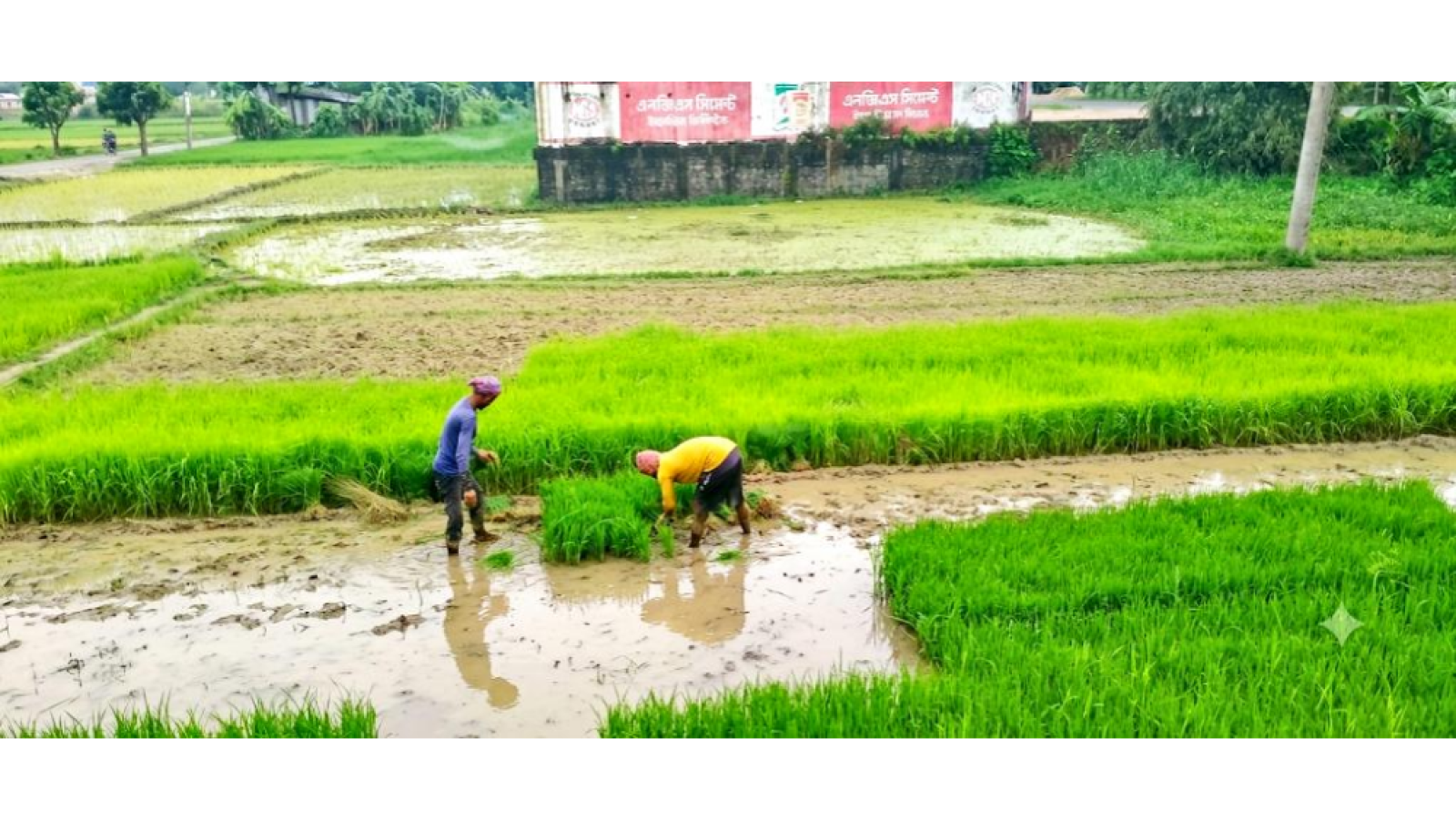
Farmers in Hathazari, Chattogram, are worried as production costs for transplanted Aman rice cultivation have risen sharply this season. Costs have increased across nearly every stage — land preparation, seedling transplantation, fertilizer, pesticide, irrigation and agricultural labor wages. In some areas, a labor shortage means farmers must pay higher wages just to secure workers. As a result, farmers are concerned about whether they will get a fair price for their paddy relative to their production costs.
Farmers across the upazila say costs have risen this year compared to last year, from land preparation through to harvest. Power-tiller plowing, seedling transplantation, irrigation and agricultural labor wages in particular have placed extra pressure on farmers, alongside rising costs for fertilizer, seed and pesticide.
Md Azgar Ali, a farmer in the Chariya area, said every stage of Aman cultivation on a single “kani” of land — land preparation, seedling transplantation, fertilizer application, weeding, pesticide, irrigation and harvesting — now costs more. Because of the labor shortage, workers aren’t available when needed, forcing farmers to pay higher wages to secure them. Even with a good harvest, he said, profits are likely to shrink once production costs are deducted.
Abdul Karim, a farmer in the Mirzapur area, said: “This time, the cost of everything is higher — land preparation, seedling transplantation, fertilizer, pesticide and labor wages. If the price of paddy doesn’t match production costs, it will be difficult for farmers to turn a profit.”
Md Selim, a farmer in Dholoi union, said: “The biggest costs in Aman cultivation are land preparation and labor wages. On top of that, fertilizer and pesticide costs have also gone up. If we don’t get a good price for the paddy, we’ll struggle just to recover our production costs.”
Several farmers complained that when they need to buy fertilizer and other agricultural inputs, they are sometimes charged more than the fixed price, in some areas. This further drives up production costs. They have called for regular monitoring of the fertilizer and agricultural-input market and action against irregularities.
A visit to several markets in the upazila found that fertilizer priced at 30 taka per kilogram was being sold for 33 taka per kilogram in some places — 3 taka more per kilogram than the set price. However, this was not the case at every shop.
According to the Hathazari Upazila Agriculture Office, the target for transplanted Aman cultivation in the upazila this season is 8,955 hectares. Farmers are being given necessary advice and technical support. Regular field-level guidance is being provided to protect crops from disease and pest attacks.
Upazila Agriculture Officer Mezbah Uddin Ahmed said: “The target for transplanted Aman cultivation in Hathazari this season is 8,955 hectares. There is no shortage of fertilizer or seed in the upazila. Supply of fertilizer and seed remains normal. Action will be taken against anyone selling fertilizer above the set price.”
He added that farmers are being encouraged to use fertilizer in moderation and to use improved seed varieties and modern agricultural technology to reduce production costs. Monitoring is under way to check whether fertilizer and agricultural inputs are being sold at the set price.
Farmers say that, with production costs rising this Aman season, ensuring a fair price for paddy is essential. They say a reasonable price in line with production costs would bring them some relief, and have called for stronger market monitoring to ensure fertilizer, seed and agricultural inputs are sold at the fixed price.
বাংলায় মূল প্রতিবেদন পড়ুন · Read the original Bengali report