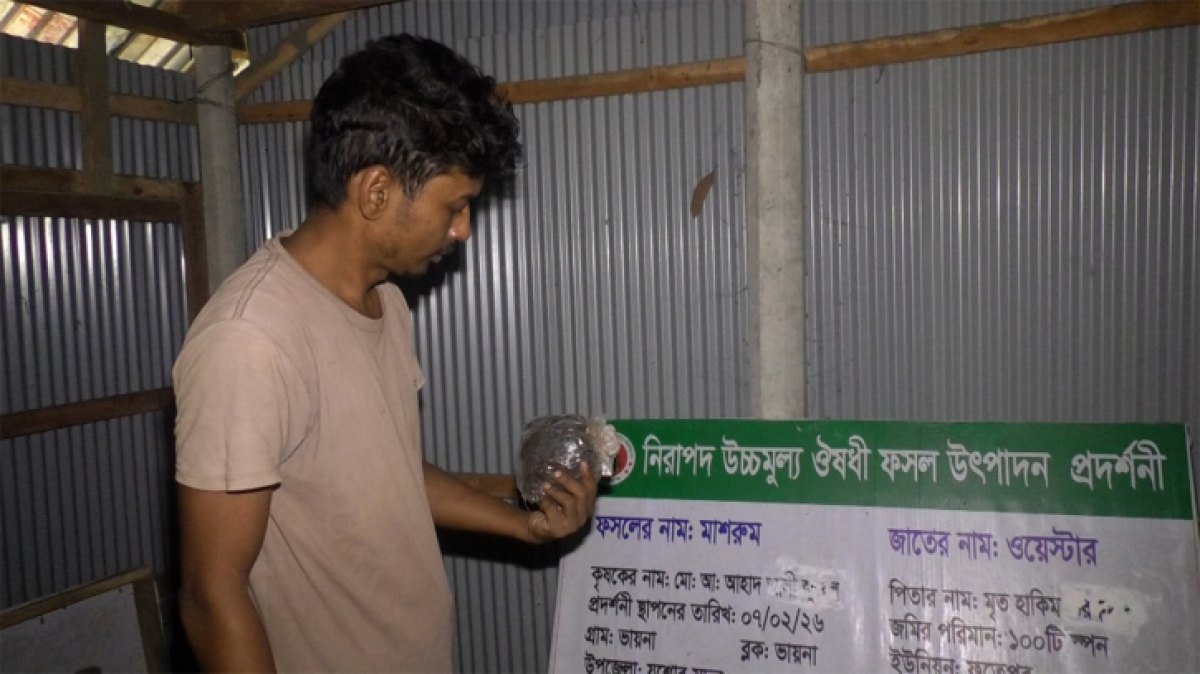
Farmers allege that although the records show thousands of taka spent on fertiliser, seedlings and other inputs, they did not receive even a quarter of the allocation. They took up mushroom and banana farming hoping to profit from the support given to demonstration plots, and have instead been left with losses. The farmers say they are in this position because they did not get the inputs and technical help due to them under the Sustainable Agricultural Extension Project. Yet one of the project’s main aims is to cut production costs and turn farming into a profitable, commercial sector.
The farmers say they took on demonstration plots under the project expecting that, with seedlings, fertiliser and the inputs they needed, their production costs would fall and they would make money. But without the promised inputs they have suffered losses instead. They allege that only a token amount of inputs was supplied and nobody followed up on the farming afterwards. For lack of supervision and technical help, their combined loss on the two demonstration plots is about Tk 3.5 lakh.
Abdul Ahad is an entrepreneur from Fatehpur village in Fatehpur union of Jashore Sadar upazila. After completing honours and master’s degrees in chemistry, he went into farming instead of chasing a job. To encourage the young agricultural entrepreneur, in February this year he was given a mushroom-farming demonstration plot under the field-level technology extension programme of the Sustainable Agricultural Extension Project in the Jashore Region. Under the rules, he was to receive 100 mushroom spawn packs, Tk 1,500 to build racks, and a small hand-held spray machine.
“The agriculture officers deceived us,” Abdul Ahad said angrily. “We got none of the facilities we were supposed to get. They did their duty by handing over the mushroom spawn, and after that nobody ever checked on us. In the end the farming failed and I suffered a big loss.”
A review of the project’s expenditure statement, however, shows a total of Tk 11,200 spent against Ahad’s mushroom demonstration plot. This includes Tk 3,000 for 100 spawn packs, Tk 4,200 for building racks with bamboo poles, Tk 1,000 for 10 sprayers, Tk 1,000 for a signboard and register, and another Tk 2,000 for labour and other items.
Ahad said that after the spawn was delivered, no agriculture officer visited his farm or checked on it regularly. Without the technical help and supervision he needed, his mushroom farming eventually failed. He says it cost him about Tk 60,000.
Under the same project, Mohsin Kabir and several other farmers took on a banana-farming demonstration plot in Chanchra union of Jashore Sadar upazila. Mohsin leased land and took up farming alongside a private-sector job. Alleging poor project support and negligence by field-level agriculture officers, the farmers say their combined loss on banana farming alone is about Tk 3 lakh.
According to project documents, a total of Tk 20,000 was shown as spent last March on this banana demonstration plot under the high-value fruit production programme. This includes Tk 1,200 for 120 banana saplings, Tk 1,050 for 50 kg of DAP fertiliser, Tk 600 for 30 kg of MOP fertiliser, Tk 75 for 5 kg of gypsum, Tk 1,250 for 5 kg of zinc, Tk 400 for 5 kg of boron and Tk 1,500 for 100 kg of vermicompost or organic fertiliser. The accounts also show Tk 2,025 for posts or pillars, Tk 5,000 for bagging the bananas, Tk 3,000 for organic pesticides and pest management, Tk 800 for a signboard and Tk 1,500 for transport.
But Mohsin Kabir says he was given inputs worth only Tk 5,000 to 6,000 in fertiliser and banana saplings. He received none of the other inputs on the list. The biggest problem was poor-quality saplings. He alleges that most of the banana saplings supplied were diseased. The plants died before they could grow. He was forced to cut down the remaining saplings as well.
“I leased land and started farming with high hopes,” Mohsin said, his voice breaking. “But within seven months I was badly hit. Most of the saplings we were given died. If the saplings themselves are faulty, how is a farmer supposed to farm? Apart from fertiliser and a few saplings, I got no help. I called the agriculture officers many times but could never find them in the field.” He added: “If marginal farmers like us are hurt like this, how will ordinary people be encouraged to farm? Without proper oversight of government projects, nobody can stop these losses for farmers.”
The allegations of a gap between the project’s allocations and the inputs actually supplied have raised questions about how it was carried out and how transparent it was. The farmers want an investigation into how much of the allocation was spent on the demonstration farms, why the actual inputs did not reach them, and what role the officers responsible for field-level supervision played.
Jashore Sadar upazila agriculture officer Razia Sultana said: “I was not in charge when the mushroom project in Fatehpur was carried out. But since the matter has come up, I will look into it and talk to the affected farmers.”
Zahidul Islam Biswas, deputy director (acting) of the Department of Agricultural Extension’s Jashore office, said: “I joined here only a month ago. I am not fully aware of this matter. But we will look into the allegations, and if there has been any irregularity, strict action will certainly be taken.”
He added: “Farmers are supposed to receive all the inputs and facilities allocated under the mushroom project. Also, any part of the allocated money left unspent is supposed to be deposited in the state treasury. Even so, the whole matter will be investigated and the necessary steps taken quickly.”
বাংলায় মূল প্রতিবেদন পড়ুন · Read the original Bengali report