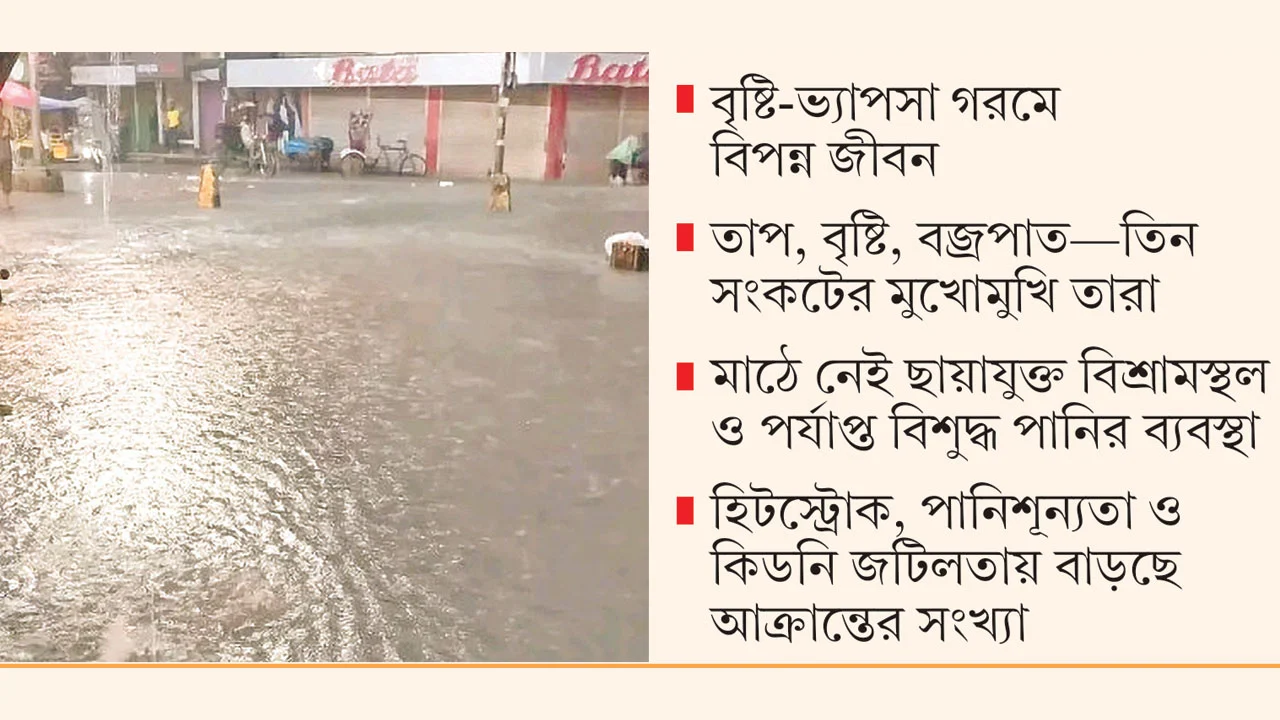
Rain has been falling on and off in Mymensingh for several days, moderate in places and heavy in others. Last Wednesday the Bangladesh Meteorological Department (BMD) recorded 174 millimeters of rainfall in Mymensingh, among the highest in the country. After the rain, excess humidity in the air, muggy heat and long-running weak airflow have further increased the health risks for farmers, construction workers, brick-kiln workers, rickshaw pullers and day laborers who work in the open air.
Experts say this is no longer a matter of normal seasonal weather; climate change has created a new kind of weather pattern in the Mymensingh region. High daytime temperatures, excessive humidity at night, afternoon thunderstorms and then muggy heat again, this changed cycle is becoming a major challenge for public health, agricultural production and the labor market.
The BMD’s July 8 forecast said there was a possibility of light to moderate rain, thundershowers and, in places, heavy to very heavy rainfall in the Mymensingh division over the next five days. It said daytime temperatures would fall slightly while nighttime temperatures would remain almost unchanged, and that the tendency for rain could ease somewhat after five days.
The July-September seasonal forecast, meanwhile, said the Mymensingh division could receive 420 to 450 millimeters of rainfall in that period, with day and night temperatures likely to remain above normal. It also mentioned the risk of three to five days of mild to moderate heatwave and 10 to 15 days of thunderstorms in July.
An analysis of weather data for May, June and July showed that for three consecutive months the wind speed in Mymensingh was limited to just three to four knots on most days. Over the same period, temperatures fluctuated between 32 and 36 degrees Celsius, and relative humidity in the air often reached 70 to 100 percent.
Dr. Pradip Kumar Saha, director of the Mymensingh divisional health services department, told Amar Desh that air temperatures were now higher than before. With weak airflow and high humidity added to this, sweat cannot dry easily, so the body’s normal heat regulation is disrupted and it feels much hotter than the actual temperature, he said. This significantly increases the risk of heat exhaustion, dehydration, heatstroke, kidney complications and reduced work capacity, and the number of heatstroke patients has risen in recent years compared with before.
He also said that, in this new reality of climate change, doctors and health workers from upazila health complexes to district-level government and private hospitals must be made more skilled and better trained to tackle heat-related illness, and that the health ministry must take a more effective and proactive role in ensuring the necessary training, medical equipment and preparedness.
Talking to farmers in Mymensingh Sadar, Gouripur, Nandail, Fulbaria and Trishal upazilas, it emerged that they have to work in the fields even in the rain, but that working for long periods in the muggy heat shortly after the rain stops becomes difficult. Many workers reported problems such as dizziness, weakness, extreme fatigue and breathing difficulty, and because most farmland has no trees or shaded resting places nearby, they cannot rest as needed.
The same picture is seen among construction and brick-kiln workers. Construction worker Md. Zubair complained that most workplaces lack adequate clean drinking water, shaded rest areas or scheduled breaks. At brick kilns, meanwhile, the heat of the furnace combined with the muggy heat outside puts double strain on the body.
Abdul Majed, a former director of the Department of Agricultural Extension, said the normal weather cycle had changed because of climate change, with early rain now and sudden severe heatwaves. During the current Aman rice planting season, farm workers have to work in the fields for long hours, he said, but because most fields have no trees or shade nearby they do not get the chance to rest at intervals, raising the risk of heatstroke and various heat-related illnesses in the excessive heat.
He also said summer temperatures in the Mymensingh region had risen steadily over the past two decades. Winters have shortened, irrigation demand for Boro rice has risen, and the timing of Aman planting has changed. New diseases and pest attacks are rising on maize and vegetables, and early floods in the haor of Netrokona and Kishoreganj and in border areas are creating a new risk for agricultural production.
According to meteorologists, the tendency for lightning in Mymensingh is also worrying. Moist air coming from the Brahmaputra basin, relatively cool air descending from the north, and the region’s vast open farmland make it easy for thunderclouds to form there.
Professor Dr. Murad Ahmed Faruk of the Institute of Environmental Science and Disaster Management at Bangladesh Agricultural University said the weather picture now seen in Mymensingh was not temporary but part of the long-term impact of climate change. If the current trend continues, he said, average temperatures will rise further over the next 10 to 20 years, labor productivity will fall, drought and water crises will increase, agricultural production will be disrupted and food security will come under threat. The impact of excessive pesticide use, reaching water bodies, could also have a negative effect on fish production and food quality, he added.
According to the Mymensingh weather observatory office, a lightning protection system has already been installed in Mymensingh to reduce the risk of lightning. But those concerned say the pace of the necessary maintenance, expansion and coordinated efforts to ensure the system’s effectiveness is still not satisfactory, so the expected benefits are not fully being felt in lightning-prone areas.
Professor Dr. Mohammad Khorshed Alam, head of the medicine department at Mymensingh Medical College Hospital, told Amar Desh that temperatures were rising every year because of global warming and climate change, with a direct impact on people’s health. Farmers, construction workers, brick-kiln workers, rickshaw pullers and people who work long hours in the open air are most at risk, he said.
He also said that it was not temperature alone; because of excessive humidity and weak airflow, the body cannot cool normally, greatly increasing the risk of heatstroke. Heatstroke is a medical emergency and can even lead to death if treatment is not received in time, he said, so during excessive heat it is essential to drink enough water, avoid working long hours in the harsh midday sun unnecessarily, rest regularly in shaded places and take anyone showing symptoms of heatstroke to hospital quickly.
বাংলায় মূল প্রতিবেদন পড়ুন · Read the original Bengali report