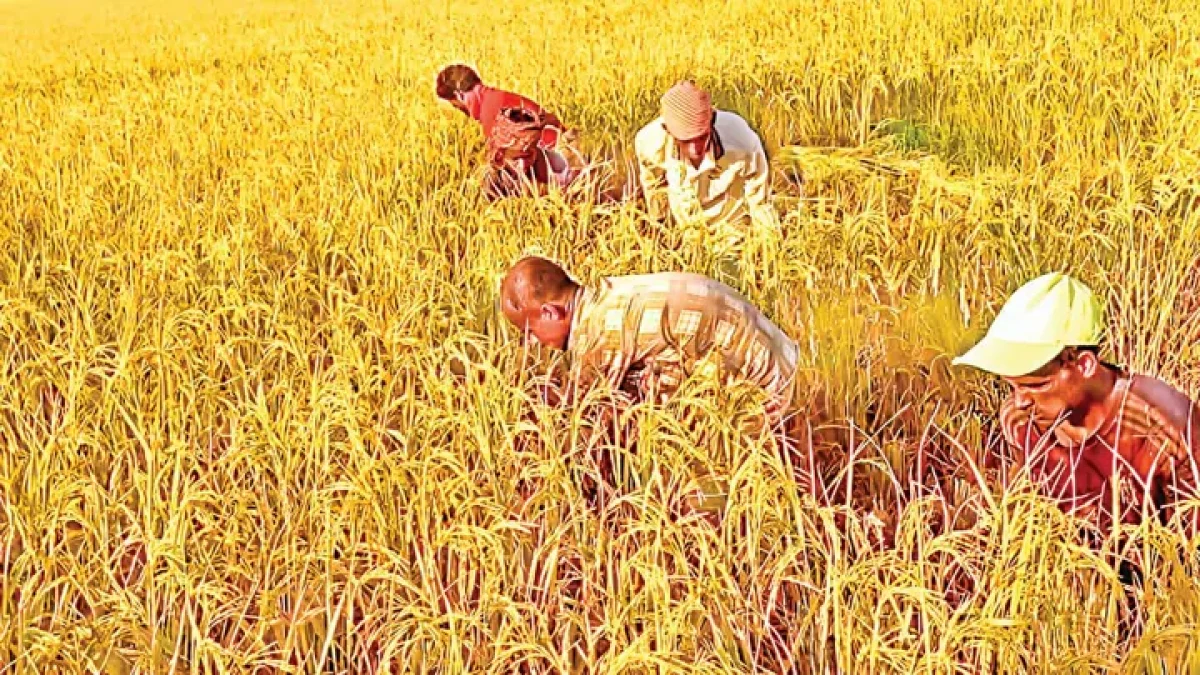
Farmers in Chattogram’s Rangunia upazila are expecting a bumper Aman paddy harvest on 3,500 hectares in Gumai Beel, known as the country’s second-largest wetland, after favorable weather spared crops from the flood damage seen in previous years. Good yields across Gumai Beel and other wetlands in the upazila have lifted farmers’ spirits, though many worry about high production costs and low paddy prices.
Field visits showed paddy ripening across Gumai Beel, Noagaon Beel, Toloibhanga Beel, Pomra, Betagi, Parua, Dakshin Rajanagar, Rajanagar, Kodala, Shilak, and Padua Beel. With the scent of ripe paddy drifting across nearby villages, farmers have hired laborers from local markets to harvest and bring in the crop before any rain arrives, and harvesting has already begun in several areas.
Agriculture officials said the paddy currently being harvested consists of early-maturing varieties.
According to the upazila agriculture office, Aman paddy was cultivated on 15,457 hectares across Rangunia this season, of which 1,550 hectares have already been harvested. High-yielding varieties are producing 5.6 to 6.2 tons per hectare depending on the variety, while hybrid varieties are yielding 6.5 to 8.7 tons per hectare. Intermittent rainfall, favorable weather, and low pest and disease incidence are expected to help the upazila meet its production target. In Gumai Beel alone, 50 hectares of the 3,500 hectares planted have been harvested so far.
Farmers said that while the weather and rainfall were favorable, expensive fertilizers, high labor wages, and costly irrigation fuel pushed cultivation costs above 27,000 taka per kani. With yields averaging 120 to 130 aari per kani—at 10 kg per aari—current market prices will bring in no more than 20,000 taka per kani, they said. Growers urged the government to prioritize genuine farmers in public paddy procurement, ensure fair prices, and monitor the market.
Rahim Uddin, a Gumai Beel farmer from Pathanpara Chowdhury Gutta, said the overall condition of Aman paddy is strong this season. Timely use of fertilizer and pesticides kept disease and pest attacks negligible, he said, adding that he cultivated Aman on six kani of land and hopes to turn a good profit.
Uttam Kumar Shil, sub-assistant agriculture officer for Mariamnagar union, said pest and disease outbreaks were minimal this year. Regular field visits and timely advice to farmers have set the stage for a bumper Aman harvest, he said.
Upazila Agriculture Officer Md Belal said yields in Gumai Beel are expected to exceed projections, crediting field-level monitoring by the agriculture office, timely and natural pest control measures, farmers’ hard work, and favorable weather.
বাংলায় মূল প্রতিবেদন পড়ুন · Read the original Bengali report