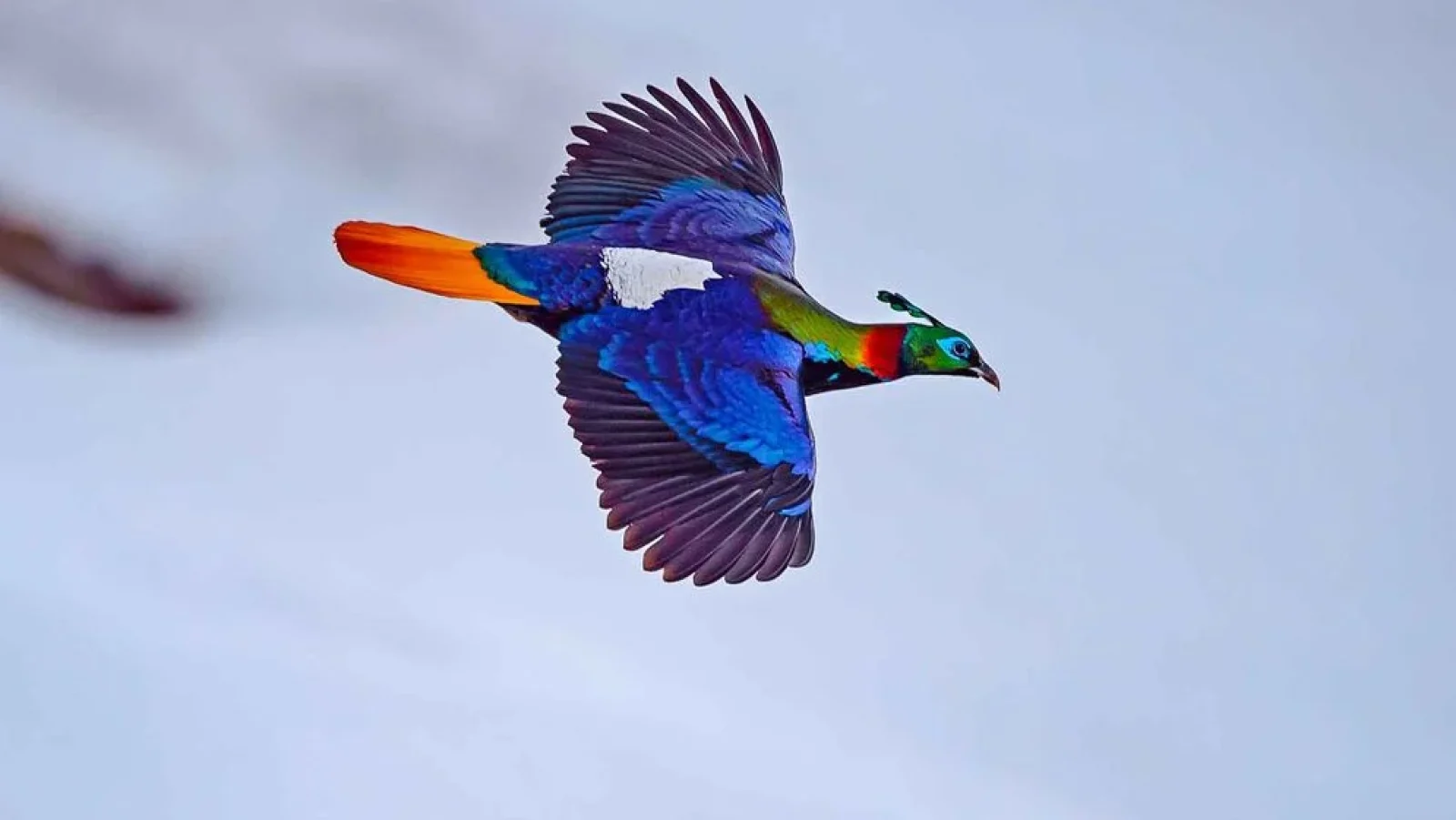
The blue-green hills of the Himalayas, snow-covered peaks and silent forests are the home of a bird of extraordinary beauty: the Himalayan monal. The male’s body shines with metallic green, blue, copper, purple and orange. But this symbol of Himalayan beauty is now having to adapt to man-made noise and environmental change.
According to a BBC report, two separate five-year studies by researchers in the Indian state of Uttarakhand have produced striking findings. They show that tourism, infrastructure building and the growing presence of people are shrinking the monal’s habitat. More than that, the bird is slightly altering its call to get round the noise of vehicles and tourists.
The monal usually ranges in the alpine meadows above the Himalayan forests, moving between lower hill areas and higher ground with the seasons. But researchers say that as people take over these natural habitats, the monal is being pushed steadily higher up the mountains.
Researchers modelled future changes in the monal’s potential habitat in the Himalayan areas of Uttarakhand and Himachal Pradesh. Considering different climate change scenarios, they found that habitat suitable for the bird could become more shrunken and fragmented in the coming decades.
Researcher Rajiv Lochan said melting snow is allowing plants to grow higher up the mountains, opening those areas to the monal. At the same time the bird is losing natural habitat lower down to human encroachment. It is thus being pushed upwards from both directions. Groups of birds may become trapped in small isolated areas, reducing the chance of breeding between groups and raising the risk of local decline in the long term.
Not only its address, but its voice
The second study brought out another striking effect of people on the monal. Researchers recorded monal calls in two valleys of the Kedarnath Musk Deer Sanctuary in Uttarakhand: Chopta, busy with tourists, and the comparatively quiet Madmaheshwar.
More than 700 calls were recorded in the two areas over a year from April 2023. The researchers then analysed the calls’ frequency and length and the level of surrounding noise.
The results showed that monals in the noisy area produce sounds of higher frequency than those in quieter surroundings. Calls in busy Chopta were also shorter.
The researchers think the monal is slightly changing how it uses its voice so that its call carries over the lower-frequency noise of vehicles and tourists on foot.
Lochan cautioned that this does not mean a permanent or evolutionary change in the monal’s voice; it shows the bird’s behavioural flexibility in adapting to different sound environments.
A bird’s call is not just sound; it is used for breeding, choosing a mate, warning rivals and signalling position. A major change in the sound environment could therefore affect the bird’s life cycle.
Anjal Prakash, a professor of public policy at FLAME University and a contributor to IPCC reports, said that when a bird has to raise its call to compete with tourists’ vehicles, or climb higher because meadows have shrunk under human occupation, it shows the deep effect of human pressure on Himalayan life.
Environment and climate researcher Vishal Singh asked: if a comparatively adaptable bird like the monal has to change both its “voice” and its “address”, what is happening to more sensitive species?
A warning for the Himalayas
The monal is not only a symbol of beauty; to researchers it is an important indicator of the health of the north-western Himalayan ecosystem, because its habitat is comparatively limited and it depends on areas at different altitudes through the seasons.
Alongside climate change, the research identifies unregulated tourism, urbanisation and the spread of infrastructure as major threats. In the past decade new roads and infrastructure have opened many remote Himalayan areas to tourists, bringing more people, more vehicles and more pressure on wildlife.
The researchers also say there is not yet enough information to reach final conclusions about the ecological effects of the change in the monal’s call. Wider research is needed.
বাংলায় মূল প্রতিবেদন পড়ুন · Read the original Bengali report