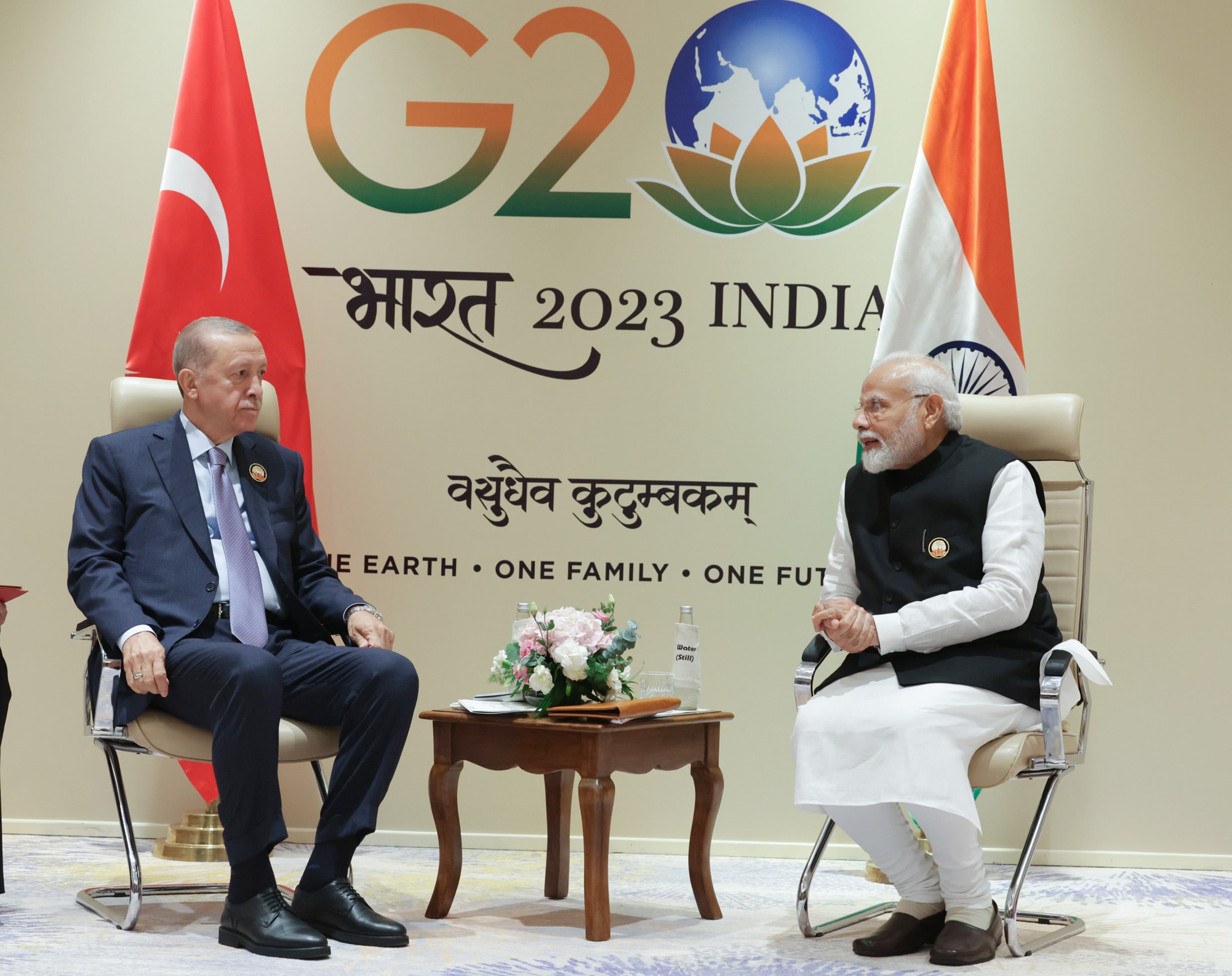
Relations between India and Turkey cannot be understood by looking only at Kashmir, Pakistan or President Recep Tayyip Erdogan’s recent positions. History, geography, economics, Turkey’s own foreign policy ambitions and a changing international order all play a part. That is the argument of a recently published book on Turkish foreign policy under the AKP and its implications for India by Mudassir Quamar, an associate professor at the Centre for West Asian Studies of Jawaharlal Nehru University.
The ties are older than the modern states. In 1912, during the First Balkan War, a medical mission led by Dr MA Ansari went from India to treat wounded Ottoman soldiers, and after the First World War a large part of Indian Muslim society, and Mahatma Gandhi, opposed British policy towards Turkey.
That early sympathy gave way after 1947. During the Cold War Pakistan and Turkey, a Nato member, both stood in the Western camp, and Pakistan became an ever larger factor between Ankara and New Delhi. On Kashmir, India regards the matter as internal, while Turkey has favoured international discussion and has at times backed Pakistan’s position.
The strain became more open in 2019, when Erdogan criticised India’s withdrawal of Jammu and Kashmir’s special status, and sharper still after the India-Pakistan conflict of April and May 2025. Turkey’s defence cooperation with Pakistan, including drones, warships and aviation technology, is for India a direct security question.
Yet trade, investment, tourism and business contact between the two countries have grown, and diplomatic doors have not closed. Turkey also matters to India for its place where the Black Sea, the Caucasus, the Middle East, the Balkans and Europe meet. The two countries differ deeply, but neither is in a position to ignore the other.
বাংলায় মূল প্রতিবেদন পড়ুন · Read the original Bengali report