China respects Bangladesh's sovereignty and its right to choose a development path suited to its own circumstances, acting Chinese Ambassador Liu Yuyin has said.
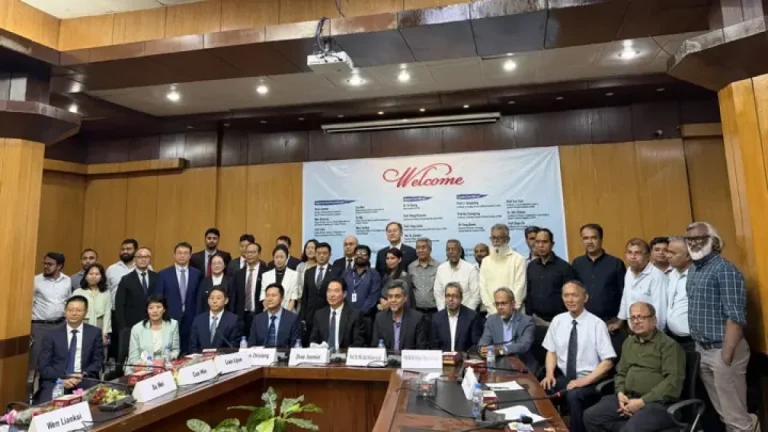
He also said Beijing remained committed to non-interference in Bangladesh's internal affairs. Liu spoke Monday morning, November 23, at a Dhaka hotel during the launch of a blue paper marking a decade of China's Belt and Road Initiative (BRI) in Bangladesh.
Sovereignty and strategic cooperation
Liu said China firmly supported Bangladesh's independence, sovereignty and territorial integrity. Bangladesh's people had the right to choose their own development course, he said.
He said Bangladesh remained committed to the one-China policy and opposed any form of Taiwanese independence. Mutual support on core interests built confidence for long-term planning in project financing, security and policy coordination, he said.
Strategic coordination between national leaders could help ongoing projects continue through political changes, Liu added.
Six proposed investment priorities
Professor Imtiaz Ahmed, executive director of the Centre for Alternatives and lead researcher of the blue paper, presented the keynote address. He urged future BRI investment to emphasize project quality, technology transfer and local capacity.
He proposed six priority areas: infrastructure and multimodal connectivity; healthcare and pharmaceuticals; education and skills; advanced technology and artificial intelligence; renewable energy; and garments and industrialization.
Ahmed discussed prospects for high-speed rail, Bangladesh-China-Myanmar connectivity and jointly developed Bengali large-language and voice models. He also emphasized retraining women garment workers to adapt to automation and AI.
Calls for local production
Textiles and Jute Secretary Ayesha Akter urged Chinese investors to move beyond supplying raw materials and invest in producing textiles, yarn, fabric and export goods in Bangladesh. Local production could create jobs and reduce the trade deficit, she said.
Power Division Secretary Mirana Mahrukh called for Chinese investment in renewable energy and highlighted joint production of battery storage systems, solar panels, inverters, smart meters and electric-vehicle charging infrastructure.
Chinese Enterprises Association in Bangladesh President Han Kun said the BRI offered opportunities for long-term partnerships beyond infrastructure, including energy, digital networks, health, education and industrialization.
Bangladesh-China Chamber of Commerce and Industry President Mohammad Khorshed Alam called for stronger relations through joint investment and technology transfer, including greater cooperation in capital markets and industry.