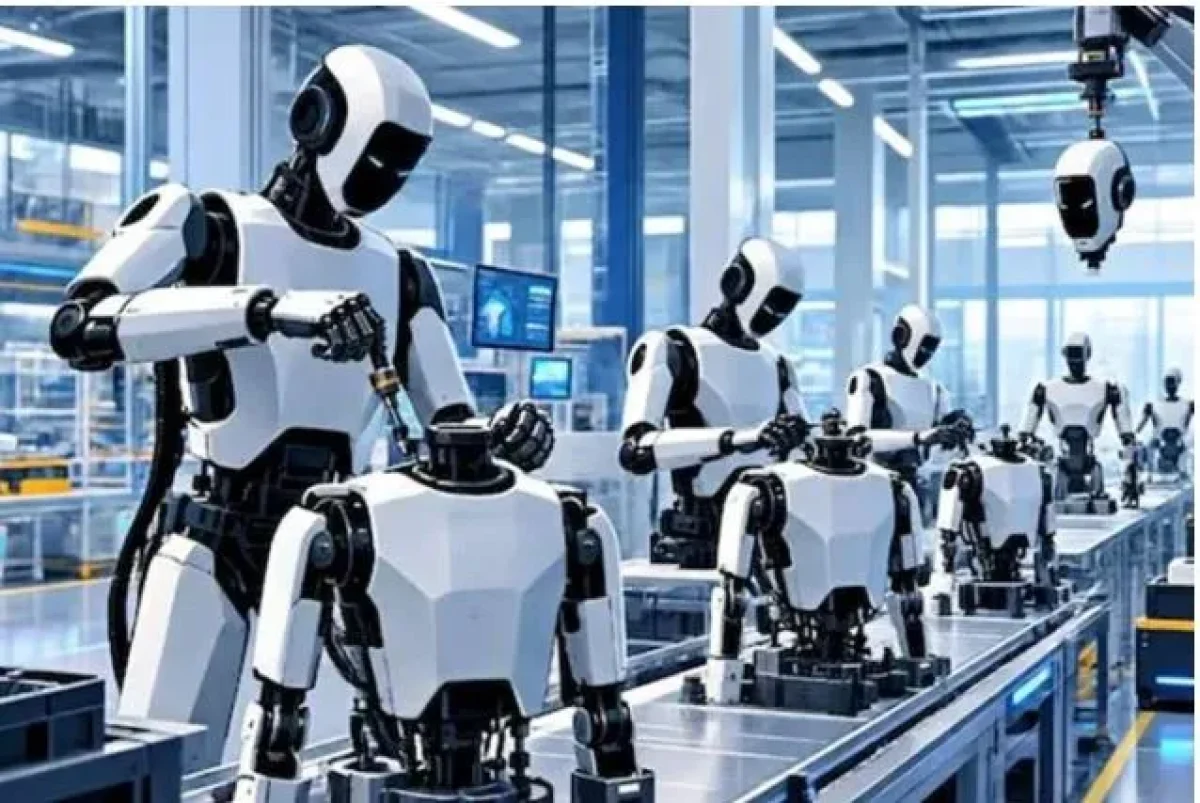
Robots were once thought of as machines to make people’s work easier. Their use was confined to lifting heavy things in factories, moving goods or doing dangerous jobs. With the rapid advance of technology that picture is changing. Robots are now not only working for people; they are also being put to work making other robots.
The robot maker UBTech Robotics has opened such a factory in China. At the plant in the city of Liuzhou, in the Guangxi Zhuang Autonomous Region, humanoid robots are being built with the help of robots and automated machinery. Most striking is its production capacity: a humanoid robot fit for industrial use can be turned out every 10 minutes. The factory covers 14,000 square metres and is 13.8 metres high.
It mainly produces UBTech’s Walker S and Cruzr series of humanoid robots for industrial use. Its annual capacity is 10,000 robots.
Robots doing the work of making robots
The factory’s most notable feature is that robots are not only produced here; they also work at various stages of production. One robot, that is, has a direct part in making another.
UBTech says its Cruzr Y1 and Cruzr S2 humanoid robots are being used to unload materials, stack them in set places, deliver them to the production line and move them from one part of the factory to another. Some robots are thus carrying the parts and materials that are later used to build other robots.
The whole job does not depend on humanoid robots alone. Final assembly uses collaborative robotic arms, driverless logistics vehicles, power-assisted manipulators and rotating worktables. By using these technologies together, several kinds of robot are made on the same production line, so a separate line does not have to be built for each model.
The “smart brain” behind it all
A digital management platform has been built to run the factory’s whole production system. UBTech calls it the “Smart Brain”. It was developed by UBTech with Siemens Digital Industries Software.
The system coordinates the various stages of the factory: which robot is to be built when, where the necessary parts are to be taken, what work is to be done at which stage, and the quality checks on the finished robots.
Each robot is given its own serial number in production, so that from the moment it enters the factory it is possible to follow where it is at each stage, what work has been done and what its production data are. If a problem arises in production it can be identified quickly and dealt with.
Fewer people, more automation
Another notable aspect of the factory is that comparatively little direct human supervision is needed. A large part of production runs automatically through a combination of automated machinery, robotic systems and digital management.
Robots and machines work not only on the production line; they also move materials from place to place, deliver parts and store finished products. Production, transport, testing and storage in the factory are thus tied into one automated system.
A “health check” before leaving the factory
No humanoid robot is sent to market as soon as it is built. Each has to go through several tests.
According to UBTech, each humanoid robot is tested for more than four hours. Its various mechanical and functional capabilities are checked, and so is its outward condition, with a 360-degree visual inspection of the whole robot to see whether there is any defect or problem anywhere. The purpose of such long testing is to make sure each robot meets the set standard before it leaves the factory.
112 robots in 65 square metres
Automated technology is also used in storing the robots once they are built. UBTech says its automated warehouse can hold 112 humanoid robots in only 65 square metres.
Automated guided vehicles, driverless forklifts and other logistics machines are used to move robots and parts from place to place between the production, testing and storage areas as needed. Dependence on people is thus falling even for taking finished robots to the warehouse or bringing materials to the production line.
China’s robot output is growing fast
The timing of the factory’s opening is also significant. China is now stressing greater use and production of robots in industry, and is moving robot technology from the experimental stage towards wide use in real industrial production.
According to China’s National Bureau of Statistics, 98,677 industrial robots were produced in the country in July this year, 30.2% more than in the same month a year earlier.
In the first seven months of this year China produced 635,056 industrial robots, 28.5% more than in the same period a year earlier. New factories are opening and automation in production is increasing.
The capacity to build a robot every 10 minutes may be startling today. But if this technological progress continues, factories like this could become the new normal of industrial production in the days ahead.
বাংলায় মূল প্রতিবেদন পড়ুন · Read the original Bengali report