After doctors diagnosed five arterial blockages in his heart, schoolteacher Md Kazim Uddin faced uncertain days fearing for his life. Following a cardiac event on 27 December 2019, he had three coronary stents implanted. Beside physical illness, he felt shattered emotionally. During that critical period, medical advice changed the trajectory of his life when a doctor recommended gardening flowers and fruit trees. What started with a handful of saplings has expanded across nearly five acres into an extraordinary orchard of domestic and foreign fruits.
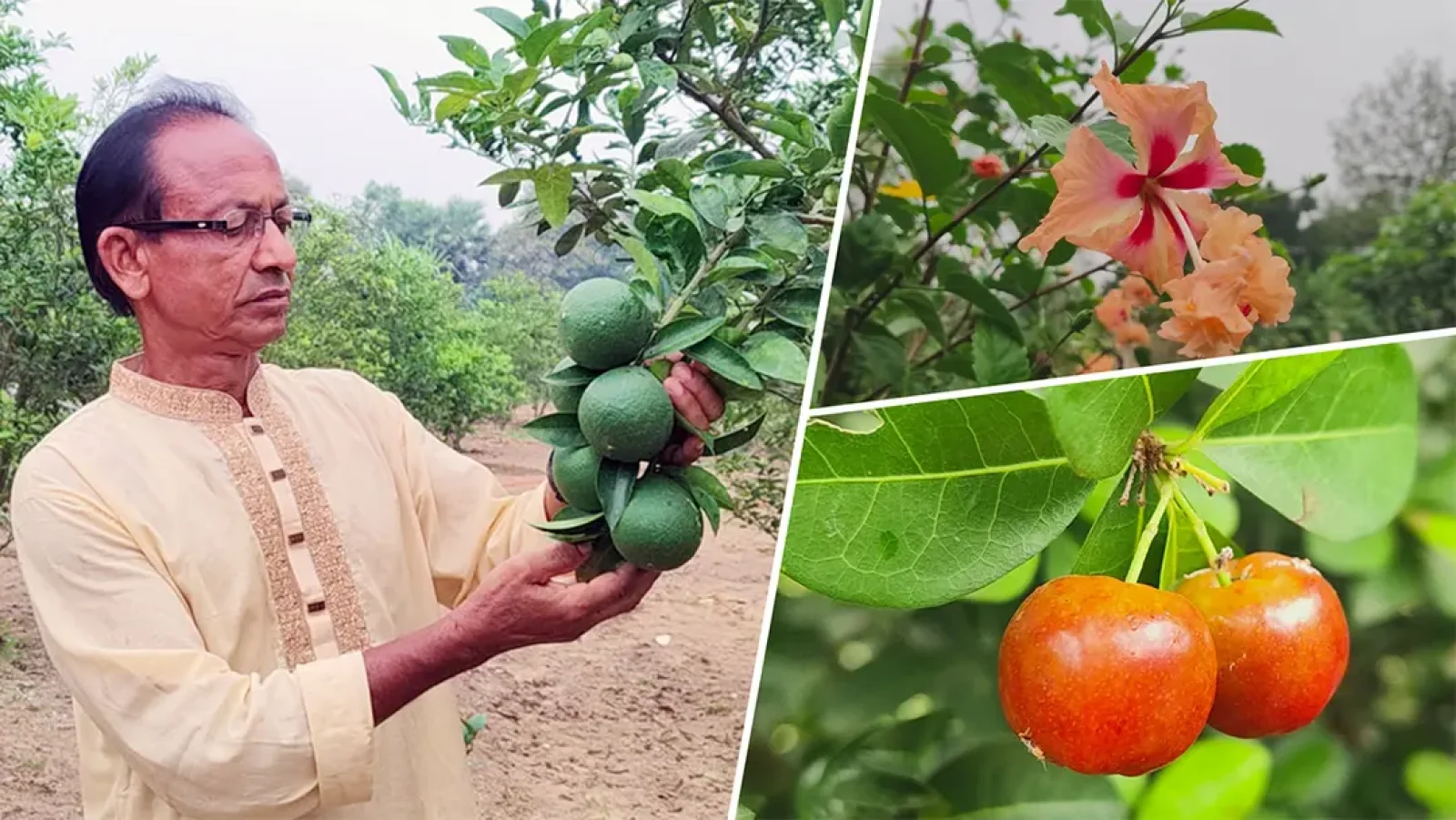
Kazim Uddin lives in Pahar Anantapur village of Rangamatia union, roughly 20 kilometres from the Fulbaria upazila headquarters in Mymensingh. The residence is known locally as Master Bari. Kazim is an assistant teacher at Babuganj Girls High School, and he named the orchard established around his home the Master Bari Mixed Fruit Garden.
Across nearly five acres, his garden hosts 2,500 to 3,000 trees of more than 200 varieties across roughly 35 fruit types from home and abroad. These include malta, lemon, jackfruit, mango, grapes, and various rare species. Begun as a therapeutic hobby, the orchard has become an integral part of his life while yielding commercial success.
Kazim Uddin recalled that after his cardiac illness in 2019, doctors identified five blockages, stenting three. The fear of death weighed on him constantly until Dr Abdus Sattar Bhuiyan, a cardiologist at Mymensingh Medical College Hospital, suggested cultivating flowers and fruit trees, advising that moderate physical work in a garden would lift his spirits.
Following that guidance, Kazim planted a few fruit saplings on fallow yard land. Nurturing the trees helped him regain mental composure and improve his health. As his passion grew, the orchard expanded steadily.
Starting in 2021, he began commercial cultivation of Vietnamese and BARI-1 malta, along with Colombo and seedless lemons. Across 15 decimals, he planted Vietnamese and BARI-4 jackfruit, while devoting remaining land to diverse native and exotic fruit trees.
A visit to the orchard on 19 November showed lush fruit trees spanning hillocks and slopes. Clusters of malta hung from branches, while lemons and papayas thrived. The mango section features more than 20 varieties, including Amrapali, Haribhanga, Katimon, and BARI-4, alongside over 30 grape varieties collected from across Bangladesh.
Malta is his largest commercial crop, with around 300 producing trees. A mature malta tree yields 120 to 130 kg of fruit annually, which sells locally for 40 to 50 taka per kg.
Detailing expenses and revenues, Kazim said maintaining 300 malta trees costs approximately 25,000 to 30,000 taka annually for organic fertilizer and pest management, while generating around 4 to 5 lakh taka from fruit sales. He meets most organic fertilizer needs using dung from his own cattle.
Kazim noted that when he began, neighbors scoffed at his endeavor, but seeing his success, local farmers now embrace fruit farming. Amid his teaching schedule, he spends every spare moment tending his trees, viewing the garden as a sanctuary of peace.
Kazim Uddin said that when he enters the orchard, the trees feel like companions speaking to him, bringing comfort. He urges others to plant trees, noting they protect ecological balance, provide oxygen, and beautify surroundings.
The orchard has attracted researchers, agriculturalists, and students from Bangladesh Agricultural University. Recently, a delegation from the university and the Food and Agriculture Organization of the United Nations (FAO) inspected the orchard while studying agricultural marketing.
Fulbaria Upazila Agriculture Officer Sukanta Dhar described Kazim as an exceptional grower who turned a personal hobby into an invaluable repository of 35 fruit types, preserving rare indigenous varieties essential for future agricultural research in Bangladesh.