Bangladesh has no system for training teachers before they are recruited; they are given the chance to train only after joining the job.
As a result, 41% of secondary-level teachers have still not received basic teacher training. The problem is not limited to secondary schools: large numbers of teachers at madrasas and at higher secondary level are also teaching without training. In all, about 2.5 lakh teachers who draw government pay and allowances are teaching without foundation training.
Monday (5 October) is World Teachers’ Day 2026. This year’s theme centres on standing with teachers and a 60-year commitment to protecting the profession, raising its status and shaping the future. The government has taken up various programmes to mark the day, including selecting the best teachers.
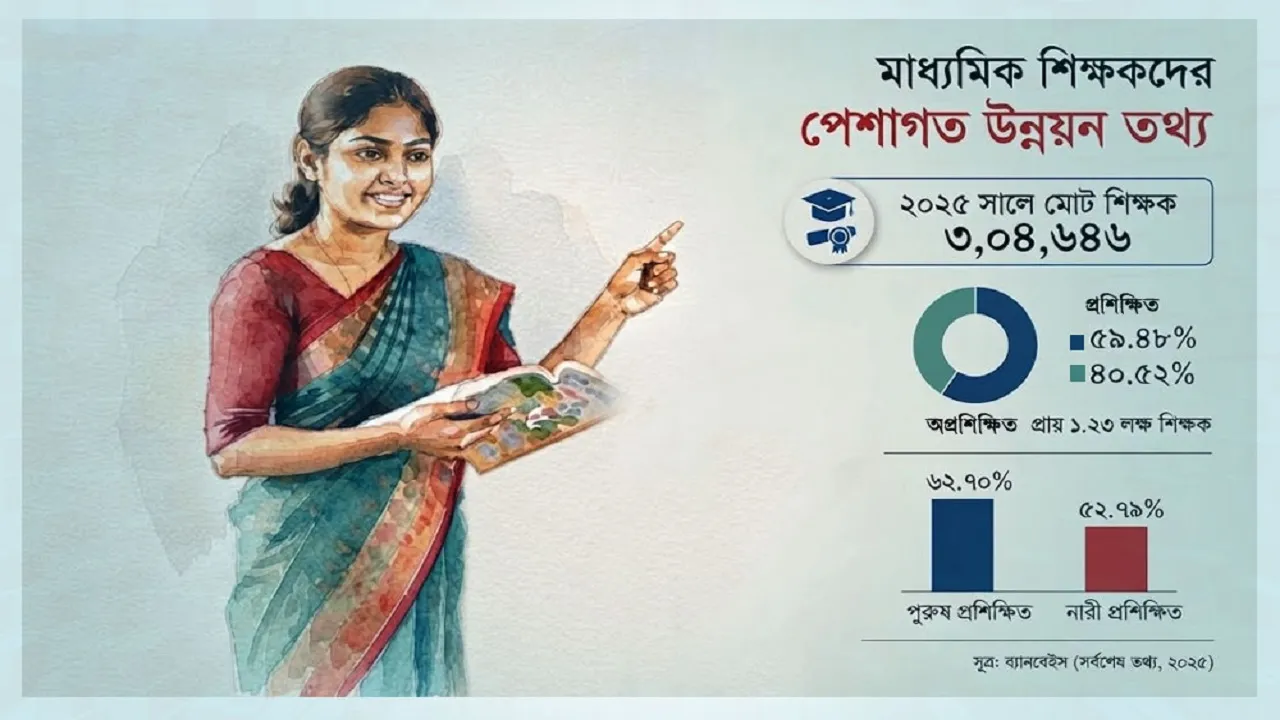
According to the latest data from the Bangladesh Bureau of Educational Information and Statistics (BANBEIS), there were 304,646 teachers at secondary level in 2025, of whom 59.48% were trained. That leaves 40.52%, or about 1.23 lakh teachers, without training. Among male teachers 62.70% are trained, and among female teachers 52.79%.
The situation is more fragile in madrasa education. According to 2025 data from the Directorate of Madrasa Education, the country has 138,675 madrasa teachers, of whom only 10% to 12% are trained. The rate was 9.19% in 2024.
Sources at the Directorate of Secondary and Higher Education (DSHE) said MPO-listed institutions at higher secondary level have 110,151 teachers, about 20% of whom have no training.
Experts say professional training before entering teaching is compulsory in most countries. Because Bangladesh does it the other way round, recruiting first and training later, many teachers go on teaching for years without training, which leaves a gap in the teaching skills needed in the classroom.
Rasheda K Choudhury, executive director of the Campaign for Popular Education (CAMPE), said that if training were arranged before recruitment, candidates would take the initiative to get trained themselves. The government must ensure training for those who have none, and also make sure the knowledge gained in training is being applied in the classroom, she said.
Meanwhile, an initiative has been taken to train 367,490 people under the Learning Acceleration in Secondary Education (LAISE) project. That training, however, is not a foundation course.
বাংলায় মূল প্রতিবেদন পড়ুন · Read the original Bengali report