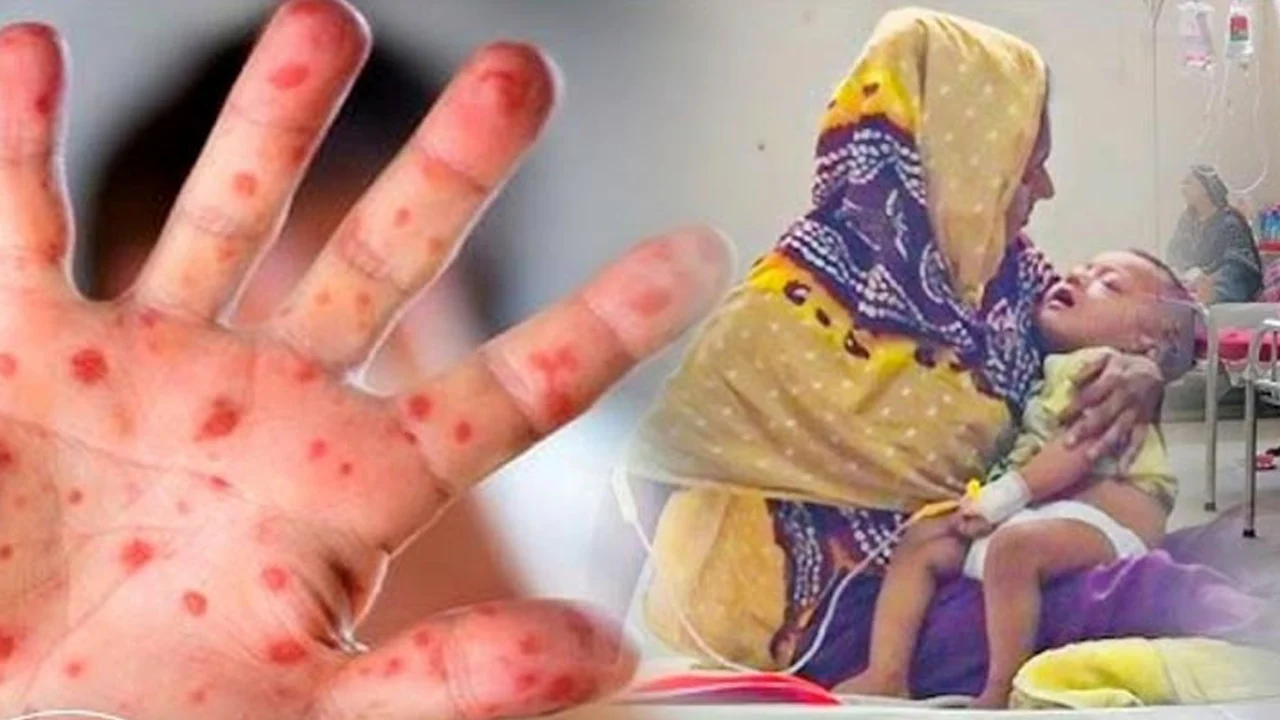
More than three months after measles spread among children in epidemic form in Bangladesh, the government has still not been able to bring the situation under control. As a result, the numbers of those infected and dead are rising daily.
According to official figures, infections from measles and symptoms of the disease have already crossed 85,000. At least 652 children have died. Public health experts blame the government’s mismanagement for so many deaths.
Dr. Be-Nazir Ahmed, former chief scientific officer of the Institute of Epidemiology, Disease Control and Research (IEDCR), said: “So many deaths happened because of the government’s mismanagement. If management had been done well, there would not have been so many deaths.”
He said that not declaring measles an epidemic and not imposing a nationwide health emergency, even after it had spread widely, was “a big wrong decision” by the government.
However, Junior Health Minister Dr. M.A. Muhith denied the allegation that deaths from measles had risen due to mismanagement. He also claimed that comparatively fewer children had died of measles because the government took timely measures.
Junior Minister Dr. Muhith said: “The measles outbreak began just 15 days after we took charge of the state. If we had not acted quickly, thousands of children would have died.”
What is the situation in hospitals now?
For the past month, the couple Salma Begum and Abdul Gani have been rushing from one hospital to another to save the lives of their children. Even so, they could not save their first child, Ibrahim. Suspected to have measles, the two-and-a-half-year-old died three weeks ago.
The child’s mother, Salma Begum, said: “At first he had a fever and a cold. Later he was having difficulty breathing. We first took him to a clinic. When the breathing difficulty did not ease, we took him to Dhaka Medical. Even so, we could not save my eldest son.”
Before that grief could pass, another son has shown symptoms of measles. To save the eight-month-old, who is suffering from high fever, cold and breathing difficulty, the parents are now spending day and night at the Bangladesh Shishu (Children’s) Hospital in the Sher-e-Bangla area of Dhaka.
Salma Begum said: “The older child died a while ago, and after Eid this child too has developed measles, cold, fever, breathing difficulty. It has been about a week now since we admitted him to this hospital.” The child’s father is a day laborer and is meeting the cost of his son’s treatment through borrowing, she said.
The child’s father, Abdul Gani, said: “Whatever money I had is all gone. Now I am treating my son by borrowing money from relatives. How long I can keep it up, I cannot say. Please pray that Allah heals my son.”
On a bed right in front of theirs, Saima Khan was playing with her daughter. The mother, who had come from Faridpur, described the situation she had been through over the past week. She said: “My child could not breathe, was having severe breathing difficulty. That is why, right after bringing her to the hospital, she was taken to the ICU. Meanwhile, children on the surrounding beds were dying, being put on life support. Seeing these things, a lot of fear was working in my mind. At one point I did not even feel that she would recover.”
But after three days in intensive care, the condition of Saima Khan’s daughter improved considerably.
“My child is now eating well by Allah’s grace, laughing and playing. As a mother, I cannot express how much peace it brings to see this,” Saima Khan said, becoming emotional.
Visits to the Bangladesh Shishu Hospital, Dhaka Medical College Hospital, Mugda Medical College Hospital and several other hospitals in Dhaka showed the measles wards almost filled to capacity everywhere.
The pressure of patients had been much higher and had begun to ease somewhat since last week, said Dr. Md. Atiqul Islam, a pediatrician at the Bangladesh Shishu Hospital and Institute.
How far is the government responsible?
In the three months since the outbreak in March this year, the number of children infected with measles or suspected measles has already reached close to 100,000. The death toll has risen past 650. Of these, about 36 have died at the Bangladesh Shishu Hospital, most of whom had come from outside Dhaka, the authorities said.
Doctors say they could not be saved because treatment could not be started in time.
Dr. Islam, in charge of the measles ward at the Bangladesh Shishu Hospital, said: “Some people are coming in panic from outside Dhaka. Those who had measles earlier have now developed complications, especially pneumonia. So, out of panic and fear, many are bringing their children to Dhaka for better treatment. Some of these patients deteriorate, and later, when their condition does not improve, they die.”
For the past few weeks there has been much discussion and debate in various quarters over how measles, almost eliminated from Bangladesh, returned, and who is responsible.
The BNP government has claimed that the previous Awami League and interim governments are responsible for the current measles situation.
Health Minister Sardar Md. Sakhawat Hossain recently told reporters: “The previous two governments are responsible for this measles infection. An MR vaccine campaign was supposed to be conducted every four years. But after December 2020 they did not do it. Its impact has fallen on us.”
The health ministry has already begun an investigation into how far each of the two previous governments is responsible for the measles outbreak.
At the same time, the government has informally requested the World Health Organization (WHO) to carry out an “independent investigation” into how and why the measles situation reached this stage.
But even if it had no role in the outbreak, the current government bears responsibility for failing to bring measles under control even three months after it spread, and for the resulting loss of life, public health experts believe.
In particular, they believe deaths rose because no emergency was declared over measles and good treatment could not be ensured at the district level.
Public health expert Dr. Be-Nazir Ahmed said: “From the very beginning we were saying it needed to be declared an epidemic, or a health emergency declared. Had that been done, an all-out response could have been mounted from every front. And if war had been declared against measles from every front at once, it would not have dragged on so long.”
Had the government declared measles an epidemic at the start of the outbreak and made an all-out effort, so many children would not have been infected with measles or its symptoms, the former IEDCR chief scientific officer also believes.
Dr. Ahmed said: “If the government had given measles importance from the start, declared it an epidemic and, instead of mismanagement, carried out more focused management, increased ICU facilities at various district and upazila levels, and trained doctors and nurses on this, then measles would not have spread so much and deaths would have been fewer.”
What is the government saying?
The government has denied the mismanagement allegations raised by the experts.
Officials have instead claimed that they took the necessary measures right after the measles outbreak.
“But even after so many children were infected and died, why did the government not declare measles an epidemic, or why was no health emergency imposed?” Dr. Ahmed asked.
Asked about the matter, the junior health minister made no direct comment but claimed that no effort was being spared to bring the situation fully under control.
Analysts, however, say there may be politics behind the decision not to declare an emergency over measles.
Public health expert Dr. Be-Nazir Ahmed said: “Declaring an emergency would have caused no real harm to the government. This is a political stand or position.”
Explaining a little further, he added: “That position is like this: a health emergency or an epidemic was declared during our time, this is our failure, our weakness. But this is actually a misconception. Because so far no one is saying the government is responsible for this epidemic happening. They are saying it is the previous government’s.”
Dr. Ahmed said: “So even if an epidemic had been declared, the blame would not have been theirs, that can be taken for granted. Rather, if all-out efforts had been taken after declaring the epidemic, swift measures taken, and the epidemic stopped very quickly, with deaths not allowed to mount so high, then the government would instead have earned praise, and it would have counted to its credit.”
Officials say the government has planned to improve the measles situation by building strong “herd immunity.” Although a nationwide vaccination program began two months ago with this goal, it has not yet been possible to bring all children under vaccination.
On top of this, the number of dengue patients in hospitals has begun to rise. As a result, keeping the measles situation under control could become difficult for the government in the days ahead, experts fear.
Source: BBC Bangla
বাংলায় মূল প্রতিবেদন পড়ুন · Read the original Bengali report