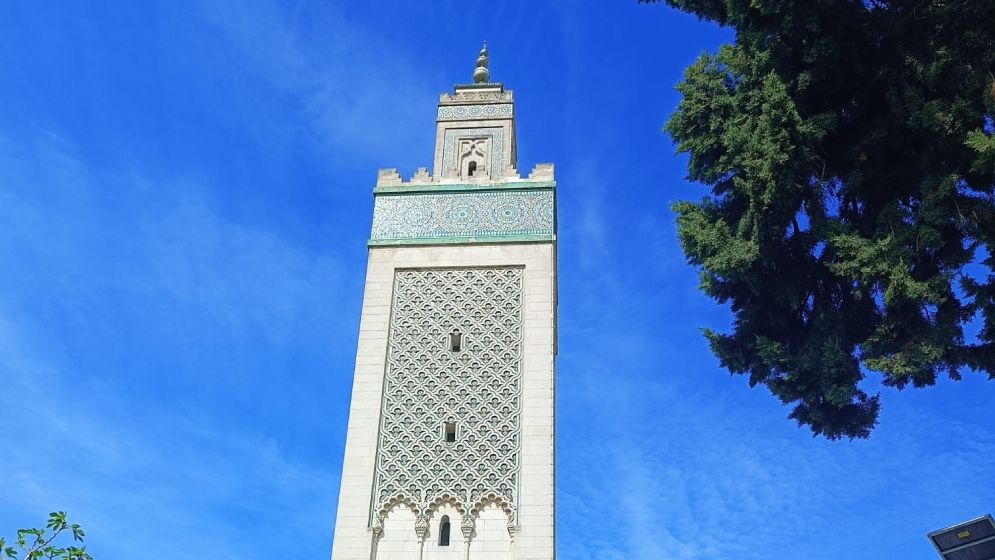
The Grand Mosque of Paris, standing in the historic Latin Quarter as a living record of Muslims’ contribution to French history, marks its centenary in 2026. Over 100 years it has become known not just as a religious building but as an important symbol of Muslims’ contribution to France, of the memory of World War I, of cultural diversity and of social ties.
The move to build the Grand Mosque came after World War I (1914-1918), in which Muslim soldiers from various regions fought for France. Coming from North Africa, West Africa and various French-controlled areas, they took part in Europe’s battlefields, and many died. To recognise and preserve the memory of their sacrifice, a large mosque was planned in Paris. The French parliament approved its construction in 1920, and after several years of building, the Grand Mosque of Paris was formally inaugurated on 15 July 1926 by the then French president, Gaston Doumergue. Si Kaddour Benghabrit became its first rector.
From its founding, the Grand Mosque became an important centre for France’s Muslim community, hosting education, culture and social activity alongside religious functions, and over time becoming a familiar symbol of Muslim heritage and presence in France. Its architecture is notable too, influenced by Andalusian and Moorish styles, with a 33-metre minaret, arched entrances, Arabic calligraphy, mosaic designs and gardens making it one of Paris’s historic landmarks.
A century on, the Grand Mosque’s core activities continue, with regular prayers, Arabic-language teaching, Islamic education, religious discussions, cultural events and social work; attendance rises for Friday prayers, Ramadan and Eid. The mosque is run in line with France’s secular state system — the French government does not appoint the head of any religious institution, and the Grand Mosque is not under direct state control but run through an independent religious structure, currently headed by rector Chems-Eddine Hafiz. For the 2026 centenary, various programmes have been arranged, including historical exhibitions, displays of old photos and documents, Islamic art and culture, and discussions, presenting 100 years of history to a new generation.
Government representatives, public officials, diplomats, religious leaders and civil-society figures took part in the centenary, including Interior Minister Laurent Nuñez, Minister Aurore Bergé, Paris police prefect Patrice Faure, Paris mayor Emmanuel Grégoire and Île-de-France region president Valérie Pécresse. A humanitarian chapter of the mosque’s history during World War II is also discussed: various studies note that under then rector Si Kaddour Benghabrit, people linked to the mosque helped some persecuted people during the Nazi occupation, though historians differ on the specific numbers and details. French historian Benjamin Stora sees the Grand Mosque as an important symbol of Muslims’ contribution to French history and of relations between communities. What began 100 years ago to preserve the memory of war is today an important part of France’s history — a historical record preserving a long story of sacrifice, culture, religious freedom and coexistence.
বাংলায় মূল প্রতিবেদন পড়ুন · Read the original Bengali report