‘Algorithm’ is a word woven deeply into modern life. To many people it now carries a negative or unsettling meaning. This algorithm helps decide what we watch, read or hear on social media. As a result, people’s own tastes and biases are reinforced, creating an ideological monotony, or ‘echo chamber’.
How important the word is can be gauged from a move by the Vatican. Pope Leo XIV discussed the possible dangers of artificial intelligence (AI) in his first encyclical, in which the word ‘algorithm’ appeared 19 times.
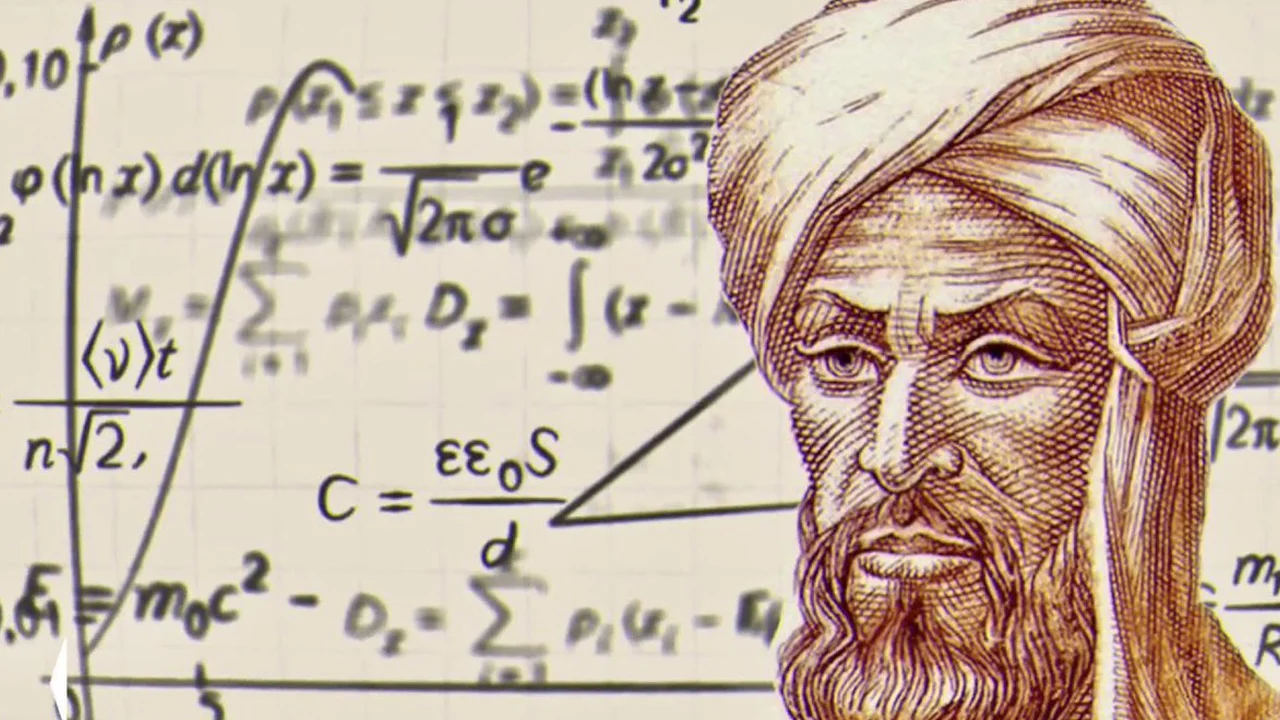
But how did this widely used word originate? Rob Watts, host of the popular YouTube channel ‘RobWords’, which examines the origins and use of words, said the word algorithm originates mainly from the name of a ninth-century Persian mathematician. His name was Muhammad ibn Musa al-Khwarizmi.
Watts said, ‘When we use the word algorithm, we are essentially pronouncing the Latinized form of the name al-Khwarizmi.’ But the path from the 12th century to the word’s present form was quite winding. The modern word ‘algorithm’ came down from the Latin ‘algorismus’ through the French algorisme (algorisme) and the English algorism. Before reaching its current form, it had also become somewhat mixed with the word ‘arithmetic’.
Who was Muhammad ibn Musa al-Khwarizmi?
Al-Khwarizmi was not only a mathematician; he was also an astronomer and a geographer. He was born in the southern region of the Aral Sea in present-day Uzbekistan. That region was named Khwarazm, from which this part of his name derives.
But it was in mathematics that he left his most important contribution. Through his famous book ‘The Compendious Book on Calculation by Completion and Balancing’, he introduced methods of solving mathematical problems, or algorithmic procedures. He also laid the foundations of algebra and helped spread the Hindu-Arabic number system (including the concept of zero) in the West.
Judith Grabiner, emeritus professor of the history of science at Pitzer College, said, ‘When ancient learning was revived in Europe in the 12th century, this book was translated into Latin several times.’
In the eighth century, during the golden age of Islamic science and mathematics, many other words beginning with ‘al’ (the Arabic definite article) also entered English. Examples include alcohol, alkali and alchemy, as well as star names in astronomy such as Altair, Alkaid and Aldebaran.
A mathematical recipe
By way of astronomy and chemistry, the word algorithm entered modern computing. Bill Westrick, a software engineer in Indiana in the United States, said, ‘An algorithm is really a specific set of instructions or rules for getting a task done.’
Comparing it to a recipe for making a cake, he said, ‘In a recipe, the ingredients are to be mixed in a particular order or stirred for a set time. Even if you do not understand why it is being done, following the instructions makes it possible to bake a good cake.’
Susan McRoy, head of the computer science department at the University of Wisconsin–Milwaukee, said that long before modern computers, algorithms had proved highly effective in fields such as business, surveying and navigation. Towards the end of the 1700s, algorithms were used to determine position at sea using a sextant (an instrument for measuring the angular distance between the horizon and a star), which is the basic foundation of today’s digital mapping or GPS (GPS satellite) technology. Algorithms even helped send people to the Moon. In the 1950s, Dutch computer scientist Edsger Dijkstra created ‘Dijkstra’s algorithm’, which finds the shortest distance between two places.
The Pope’s concern about this ‘inhuman’ algorithm, which pushes people on social media towards a single, biased point of view, may be justified. But it is also true that for hundreds of years this same algorithm has been helping people find their way.
Source: NPR
বাংলায় মূল প্রতিবেদন পড়ুন · Read the original Bengali report