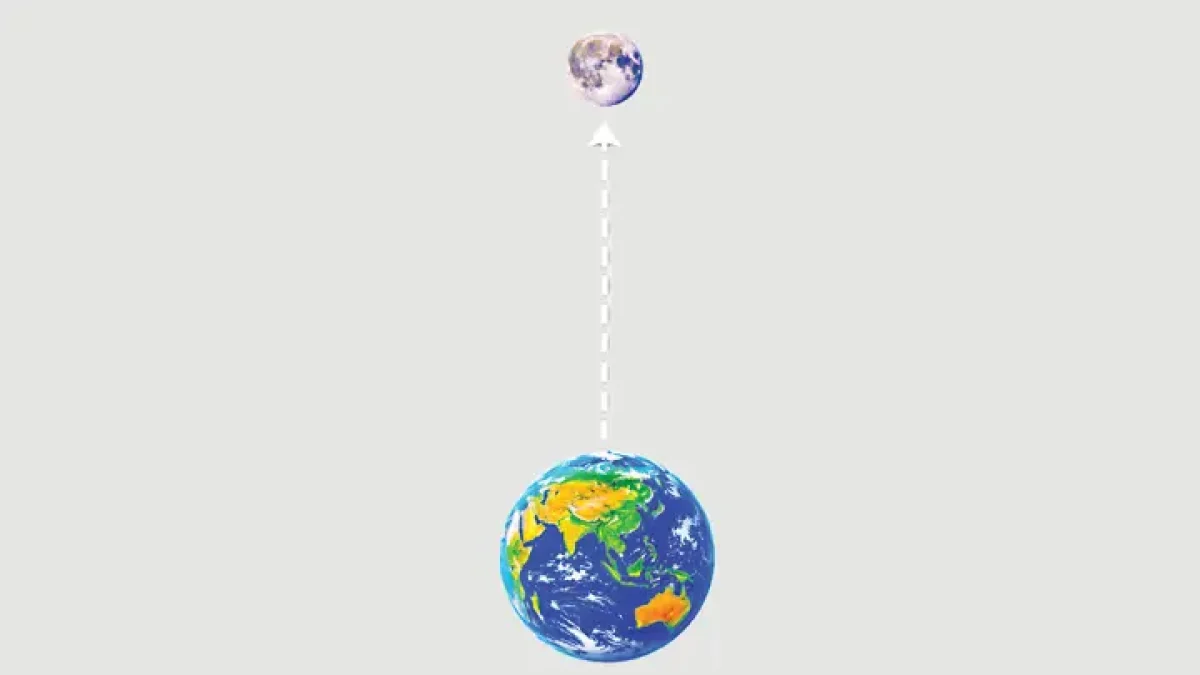
The moon is Earth’s most familiar companion in the night sky. Sometimes a bright full moon, sometimes a half moon, sometimes a thin sliver: from Earth we see it in a different form every day. The moon is Earth’s only natural satellite. But this familiar satellite is slowly moving away from Earth. According to scientists’ measurements, the moon is currently drifting away from Earth by about 3.8 centimetres a year on average. The distance grows by only a few centimetres each year, but over hundreds of millions of years the change is an important part of how the Earth-moon system evolves.
More remarkable still, the moon’s retreat is closely linked to the length of Earth’s day and to solar eclipses. Scientists calculate that, many millions of years from now, a time may come when a total solar eclipse can never again be seen from Earth. Why is this happening? How have scientists measured the moon’s distance? And what force is pushing the moon away? This article explains.
The moon’s average distance from Earth is about 384,400 kilometres. But the distance is not always the same. The moon’s orbit is not a perfect circle but slightly elliptical, so as it circles Earth it sometimes comes closer and sometimes moves farther away. Over the long term, though, the average distance of the moon’s orbit is steadily increasing. According to NASA, the current average rate of increase is about 3.8 centimetres, or an inch and a half, a year. The number seems tiny, but over the long timescales of space it is an important change. Scientists say this change in the moon’s distance has been measured using laser beams sent from Earth, and by calculation.
One of the most accurate ways of measuring the moon’s distance is Lunar Laser Ranging. In 1969, the astronauts of the Apollo 11 mission placed special laser reflectors on the moon’s surface. Similar reflectors were later placed by the Apollo 14 and Apollo 15 missions, and reflectors were also fitted to the former Soviet Union’s Lunokhod rovers. In this method, short pulses of a powerful laser beam are fired from particular observatories on Earth at the reflectors on the moon. By detecting the light that returns from the reflectors, scientists calculate how long it took to travel from Earth to the moon and back.
Light travels at about 300,000 kilometres a second, so the round-trip time gives the distance between Earth and the moon very precisely. By taking these measurements over many years, scientists have established that the moon is slowly moving away from Earth. The experiment has also yielded important information about the dynamics of the Earth-moon system, Earth’s rotation and gravitational interaction, as well as the moon’s distance. The main cause of the moon’s retreat is a complex process involving the gravitational pull between Earth and the moon and the ocean tides.
The moon’s gravity raises tides in Earth’s oceans. On the side of Earth facing the moon, the water tends to rise, and a second tidal bulge forms on the opposite side of the planet. This is why many coastal areas usually see two high tides and two low tides a day. So what do tides have to do with the moon’s distance?
Earth spins on its axis faster than the moon travels around its orbit. As a result, the tidal bulge in Earth’s oceans does not sit directly beneath the moon but runs slightly ahead of it. The gravity of this bulge of water exerts a pull on the moon. This gives the moon energy and angular momentum in its orbit, and it slowly moves out to a more distant orbit. At the same time, the same process takes away part of Earth’s rotational energy, so Earth’s rotation slows slightly and the day grows longer. Put simply, some angular momentum is transferred from Earth’s spin to the moon’s orbit. That is why Earth’s rotation is slowing and the moon is moving away.
Even when the moon has moved much farther from Earth, it will still pass between the sun and Earth. But its apparent size in the sky will then be smaller than the sun’s. So even when the centre of the sun is covered, a bright ring will remain visible around it. This is called an annular solar eclipse. During such an eclipse the sun looks like a ring of fire, because the moon cannot cover the sun’s whole visible disc, leaving a bright ring of sunlight around the moon.
This already happens today. Because the moon’s orbit is elliptical, it is sometimes relatively close to Earth and sometimes farther away. When the moon is farther away, its apparent size is smaller, so even when the sun and moon line up, the sun is not completely covered, and an annular eclipse is seen instead. In other words, even if total solar eclipses come to an end in the future, annular eclipses can still happen.
Hearing that the moon is moving away, one might think it will one day escape Earth’s gravity and be lost in space. But that is not the case. The moon’s future cannot be worked out by assuming its current rate of retreat stays the same for hundreds of millions of years. The depth of Earth’s oceans, the positions of the continents, the shape of the sea floor, Earth’s rotation and the sun’s gravity all play a part in the exchange of tidal energy, so the rate at which the moon moves away can also change over time.
বাংলায় মূল প্রতিবেদন পড়ুন · Read the original Bengali report