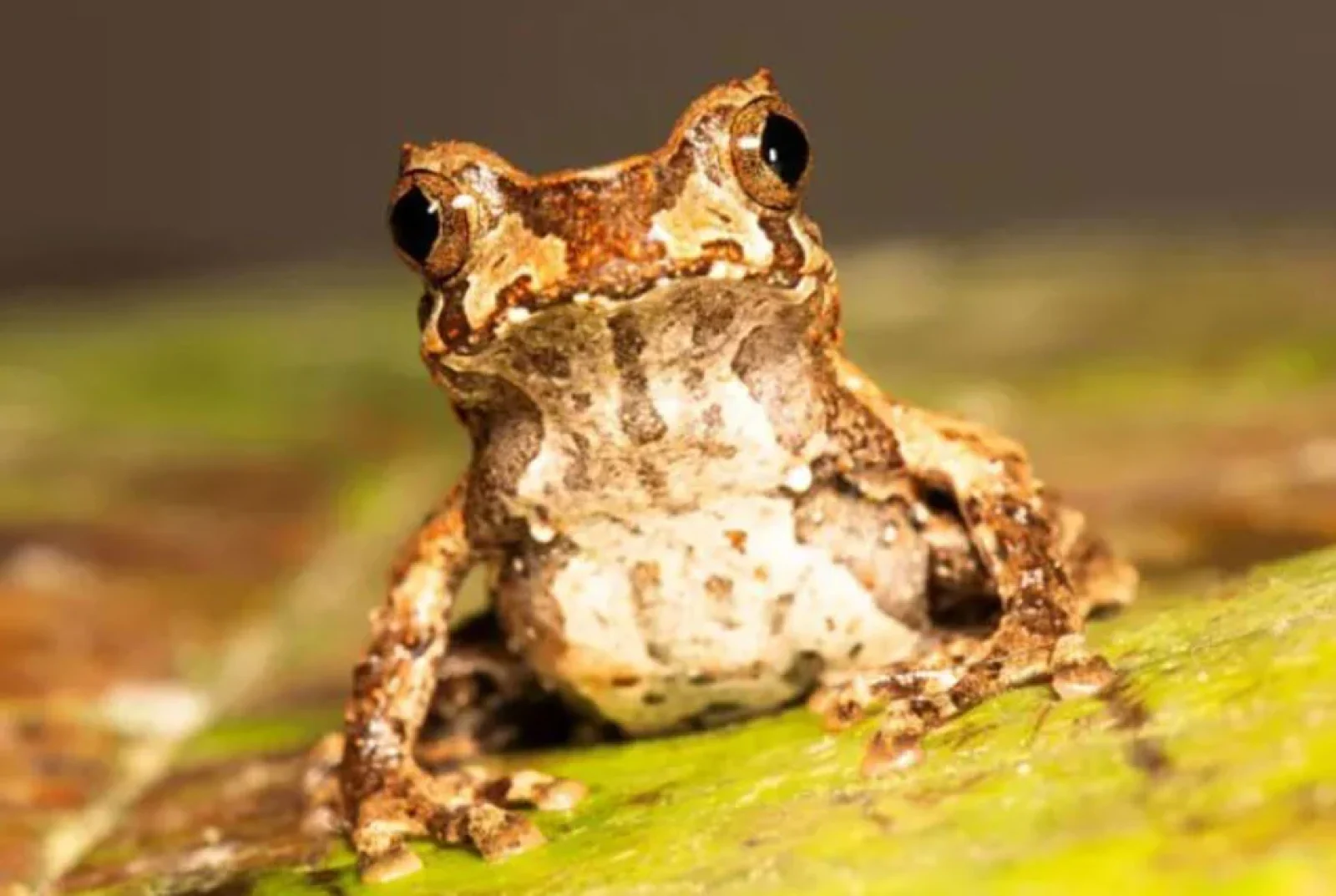
A team of scientists from India and the United States has discovered five new species of miniature horned frogs in the eastern Himalayan region of India’s Arunachal Pradesh, including one that feeds on land snails.
The finding marks the first documented record of a snail-eating frog in India as well as the first evidence of such a diet within the Megophryidae frog family.
All five species belong to the genus Jingophrys and are small frogs with horn-like folds of skin over their eyes. Researchers from the University of Delhi and Harvard University identified the species after five years of fieldwork in remote forests of the eastern Himalayas, publishing their findings on 11 November in the international journal Royal Society Open Science.
The study was led by Sonali Garg of Harvard University’s Museum of Comparative Zoology alongside James Hanken and University of Delhi researchers S. D. Biju, Tage Tajo and Radhakrishna Upadhyaya K. The team analysed external morphology, genetic traits and behaviour to confirm the new species.
The most unusual of the five is Jingophrys tanogogo, or the snail-eating horned frog. Using three-dimensional micro-computed tomography (micro-CT) scanning, researchers detected intact land-snail shells inside the frog’s stomach. Its species name comes from the word for snail in the local Apatani language of Arunachal Pradesh.
Several of the species were named to honour local communities, languages and regions. Jingophrys taniitatii, or the Tani horned frog, is named after the Tani people of Arunachal Pradesh and the Apatani word ‘tatii’ for frogs and toads. Jingophrys siangensis takes its name from the Siang region of Arunachal Pradesh, while Jingophrys. hardyi and Jingophrys wollastoni honour long-time contributors to research and conservation at Harvard University. The researchers also highlighted the role of local communities in guiding fieldwork across remote forests.
Because the frogs are nocturnal, shy and emerge briefly during breeding seasons in remote mountains where temperatures dropped to minus 4 degrees Celsius, researchers often worked through the night without shelter, team member S. D. Biju said.
Beyond identifying the five species, genetic analysis linked the diversification of horned frogs in the region to the uplift of the Himalayas and the development of the Asian monsoon. The study increased the known diversity of the genus Jingophrys sevenfold in India and more than doubled its recognised species globally, while uncovering additional unidentified lineages.
Scientists said the eastern Himalayas should be re-examined as a major centre of amphibian evolution and biodiversity, noting that further research is needed to understand the life cycles, habitats and conservation needs of the newly discovered frogs.
বাংলায় মূল প্রতিবেদন পড়ুন · Read the original Bengali report