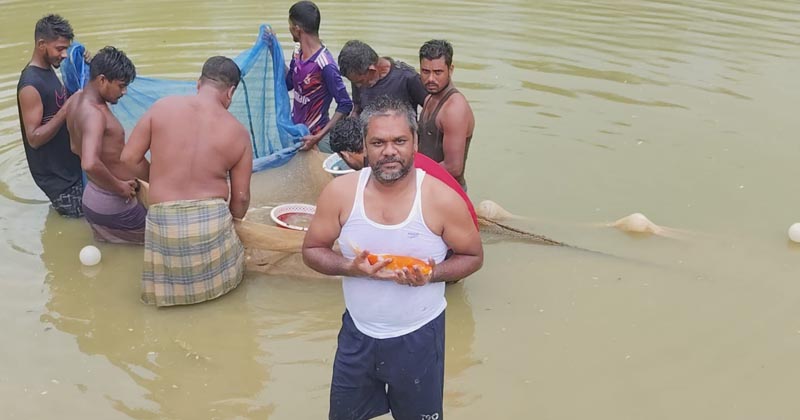
Mohammad Babor Ali Raihan, 42, starts each morning at the edge of his ponds in Kipaitnagar village, Nanupur union, Fatikchari upazila, Chattogram. He moves from one pond to the next, closely monitoring water quality, fingerling growth, and feed levels.
A commerce graduate, Raihan spent nearly nine years working abroad in the scrap metal trade. But the pull of home never left him. After returning, he chose fish fingerling production as his new livelihood.
He started about 12 years ago with an investment of 50,000 to 60,000 taka and a few ponds. Through hard work, experience, and careful planning, the small venture has grown into a sizable operation. He now manages eight ponds — three of his own and five leased — with a total investment of approximately 20 lakh taka.
His farm produces fingerlings of rohu, catla, mrigel, kali baush, grass carp, silver carp, and tilapia. For the past three years, he has also been collecting natural fry from the Halda River with support from the Integrated Development Foundation (IDF), whose officers regularly test water quality and provide technical advice.
Raihan said he emphasizes organic methods and natural feed, which reduces disease and produces healthier fingerlings. His farm yields two to three tons of fingerlings annually, supplying local demand and buyers from other areas. His annual income from the operation is approximately five lakh taka.
“After coming back from abroad, I wanted to do something that would benefit others as well as myself. Fish fingerling production gave me that opportunity,” he said.
Upazila fisheries officer Md. Azizul Islam said Raihan has been using natural fry from the Halda River for the past two years and maintains regular contact with the upazila fisheries office for technical guidance. “His initiative is making a positive contribution to local fisheries development and the sustainable use of Halda’s natural resources,” he said.
বাংলায় মূল প্রতিবেদন পড়ুন · Read the original Bengali report