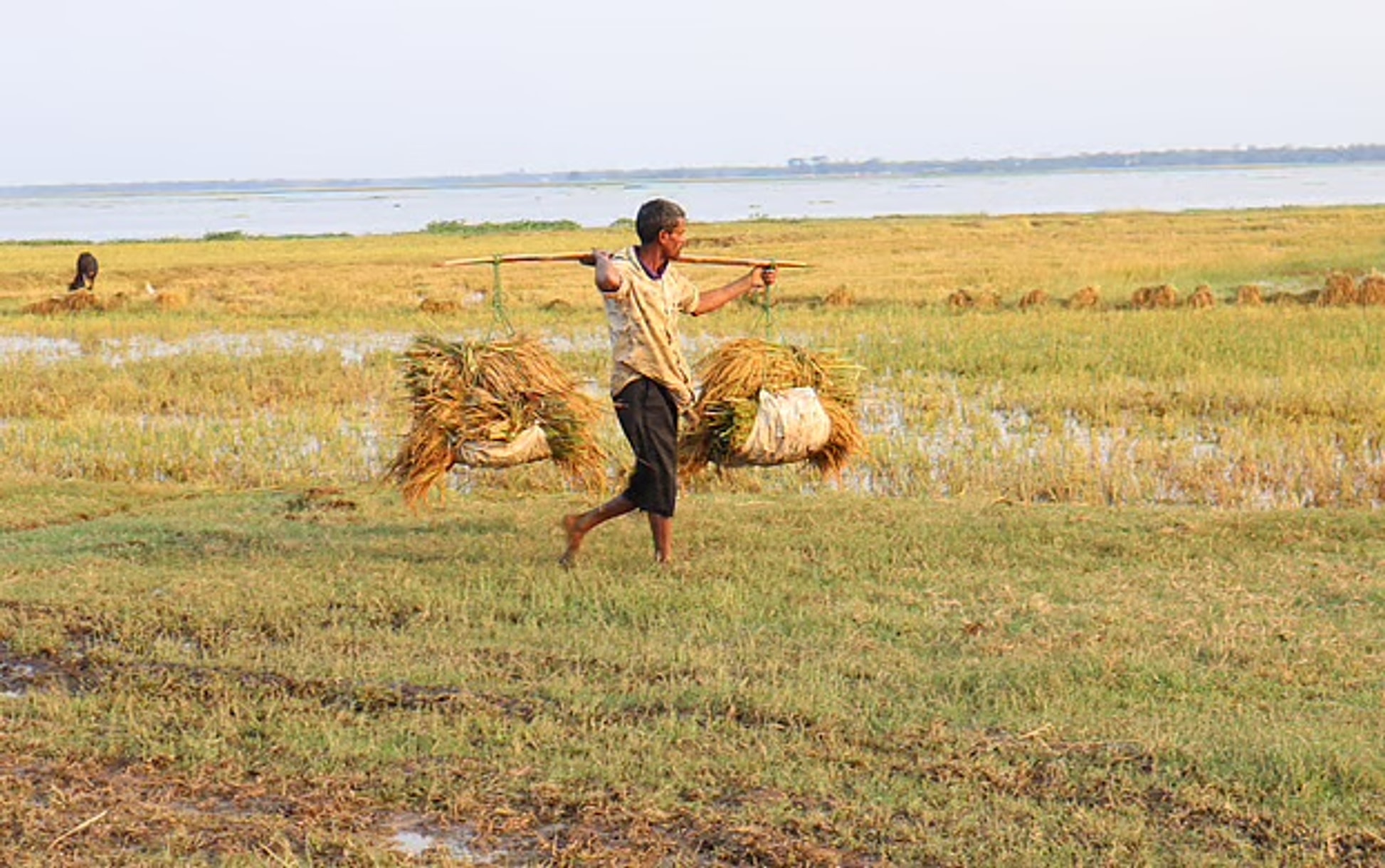
MOULVIBAZAR, Bangladesh — When the sun broke through on Monday afternoon, villages along the haor wetlands stirred to life. Wherever space allowed — paved and unpaved village roads, raised open patches — farmers rushed to spread paddy out to dry. Some laid it on the road, others on polythene or jute mats, still others in threshing yards. But none of them looked relieved.
Farmers said the rice they had managed to recover from the inundated fields was very little, and much of even that had spoiled because there had been no sun to dry it. The sight of the grain weighs on their hearts, they said. Where they had expected 300 to 400 maunds of paddy, only 10 to 20 maunds now sit in their yards. Many had taken advance loans on the condition that they would repay in paddy. That debt now sits heavier on them. Repaying it is out of the question, they said; even the year’s food supply is in doubt.
The worst-hit area is Antehari village along the Kawadighi haor in Moulvibazar’s Rajnagar upazila. Ripe paddy fields lie under water, and the rice that was cut could not be dried in the absence of sun. Some has rotted; some has sprouted. A visit to Antehari on Monday afternoon found paddy and straw spread along the road from Jumapur to Antehari market. Open ground was nowhere to be seen — wet paddy and straw covered every patch. Machines were threshing in some places. Men and women worked across the haor, all of them busy trying to dry the grain.
Standing beside a threshing yard, Sumi Rani Das said, “This time of year, paddy stacks fill the yard on every side. Now there’s no paddy at all.” Beside her, Tapan Das said, “There are 20 to 25 maunds in the yard now. The paddy came up in the fields this year. Twenty to 22 maunds an acre. I sowed 22 acres. If the weather holds, I might recover seven. I built a big yard, big enough for 70 maunds. We were supposed to get 400 to 450 maunds. I doubt we’ll get 100.”
Local people said the worry is not just the lost harvest but the debt. Many farmers had taken cash advances on the condition that they would deliver paddy at 800 taka a maund. Poor and marginal farmers have almost no access to credit other than usury or dadon — interest-bearing advances — leaving them little choice but to borrow on such terms. Sukhen Das of Antehari said, “I’d have been better off as a day laborer. The day I planned to harvest, I lined up the workers. That very night the water came in waist-deep.” One woman said, “Around here, nobody lends without interest.”
Roni Chakraborty said, “We haven’t even managed to cut a quarter of the paddy. Almost everyone will have to leave their homes because of debt. We haven’t seen losses this big in 15 years.” Sumon Das, balancing a bundle of half-rotted paddy on his head as he piled it up, was singing as he worked. “I’m not singing out of joy, brother, but out of pain,” he said. “I have a hundred thousand taka in debt. I thought I’d get 200 maunds of paddy. I’d have paid off the loan with 100 and kept 100. Now the paddy and the straw are both gone. Now the question is whether the cows survive, or whether we do.”
Md. Jalal Uddin, deputy director of the Department of Agricultural Extension in Moulvibazar, said on Tuesday that 3,638 hectares of paddy in the district’s haor region had been completely destroyed. About 400 hectares were lost in the Kawadighi haor alone. Water levels in the haor are still rising slightly, he said. “One round of losses to the farmers is already done.”
বাংলায় মূল প্রতিবেদন পড়ুন · Read the original Bengali report