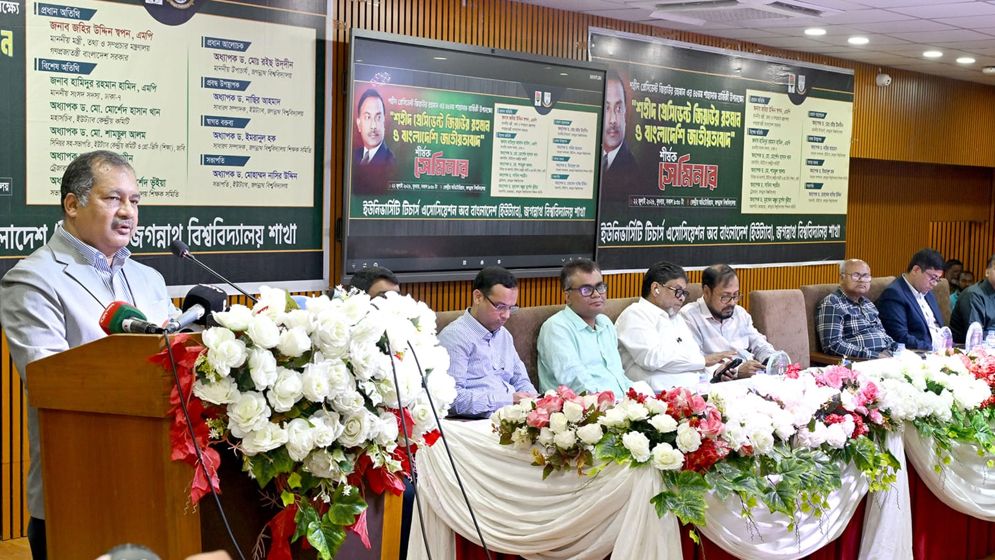
Information and Broadcasting Minister Zahir Uddin Swapan has said the philosophy of Bangladeshi nationalism is an inclusive national identity built to embrace all of Bangladesh’s languages, religions, cultures, ethnic groups and communities. The philosophy recognises every citizen living within Bangladesh’s geographical boundaries equally as part of the national identity, he said.
He was speaking as chief guest on Wednesday, July 22, at a seminar titled “Martyred President Ziaur Rahman and Bangladeshi nationalism,” organised by the Jagannath University branch of the University Teachers’ Association of Bangladesh (UTAB).
The minister said that although Pakistan was established in the Indian subcontinent on the basis of religion, a plural state cannot be held together in the long run on religion alone. From the language movement of 1952 to the great liberation war of 1971, he said, that historical reality has expressed itself continuously.
The information minister recalled what he described as the outstanding role of martyred President Ziaur Rahman in the liberation war, saying his courageous decisions and leadership played an important part in organising the war at its outset. He described Ziaur Rahman’s declaration of independence and his leadership in the liberation war as proven elements of history.
Even after independence, he said, new debate arose over the question of national identity, and an identity based on language alone did not become equally acceptable to all communities. Against that reality, he said, martyred President Ziaur Rahman put forward the citizen-based philosophy of “Bangladeshi nationalism,” which bound every citizen of Bangladesh into a shared national identity with equal dignity.
Zahir Uddin Swapan said that every citizen of Bangladesh — whatever language they speak, whatever religion they follow and whatever ethnic group they belong to — has their dignity and equal rights secured within the Bangladeshi identity. This inclusive nationalism has strengthened the country’s territorial integrity, national cohesion and pluralist social order, he said.
In the modern world, he added, nationalism is defined not merely by language, religion or race, but on the shared interests, territory, constitutional commitments and aspiration for a common future of a state’s citizens. The philosophy of Bangladeshi nationalism reflects that modern conception of the state.
There is no scope for denying one language or culture in order to establish another, the information minister said. Bangladeshi nationalism has developed by respecting and embracing the identity of all of Bangladesh’s languages, cultures, religious beliefs and ethnic groups, he said, and through this philosophy every citizen can feel equally a part of Bangladesh. He said Bangladeshi nationalism remains relevant today as the basis of national unity and cohesion and will guide the country’s progress in future.
The seminar was chaired by Professor Mohammad Nasir Uddin, president of the UTAB Jagannath University branch. Hamidur Rahman Hamid, member of parliament for Dhaka-7, attended as special guest, and Jagannath University Vice-Chancellor Professor Md Rais Uddin was the chief discussant. The keynote paper was presented by Professor Nasir Ahmad, general secretary of the UTAB Jagannath University branch.
বাংলায় মূল প্রতিবেদন পড়ুন · Read the original Bengali report