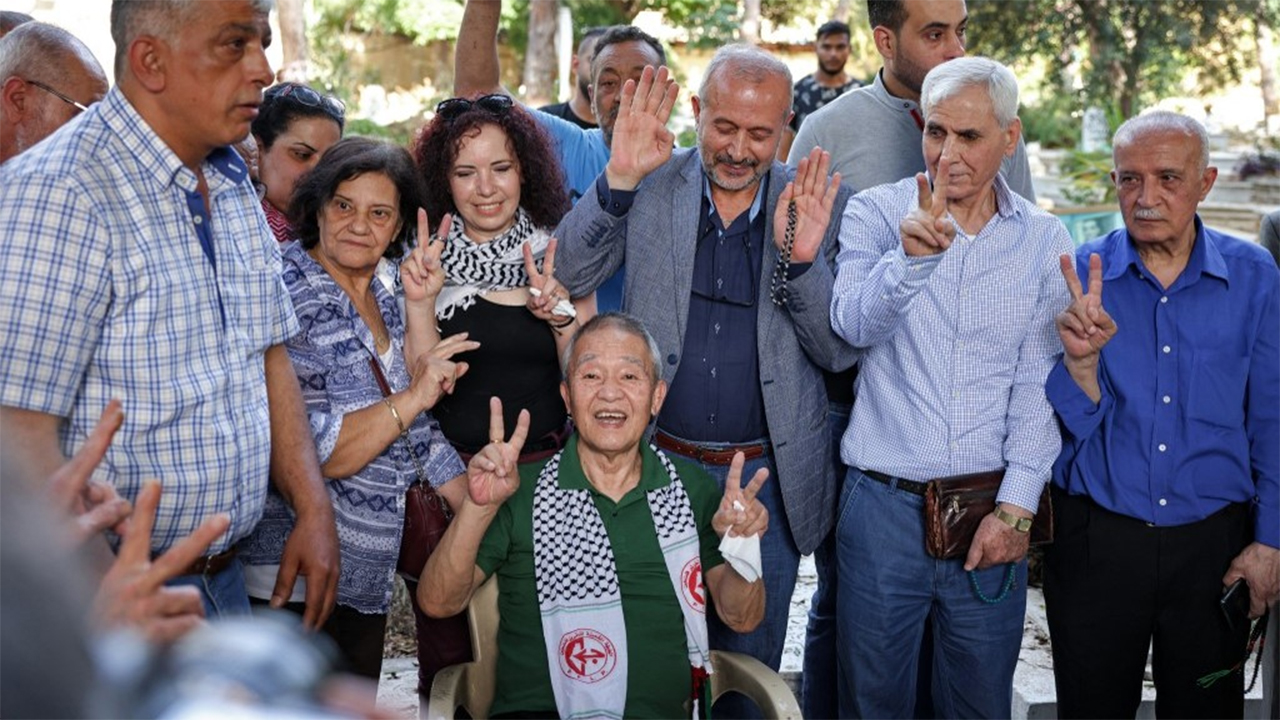
The death of Kozo Okamoto at the age of 78 has closed a turbulent chapter of international militancy. The Japanese revolutionary, who came to attention for leading the attack at Israel's Lod airport in 1972, spent most of his life in Lebanon.
He died in Beirut on Thursday after a long illness. The Popular Front for the Liberation of Palestine (PFLP) confirmed the news in a message. For many years it had provided Okamoto with protection and security in Lebanon.
Middle East Eye reported on Friday, July 24, that the fighter — known to Palestinians as “Ahmad al-Yabani,” or “Ahmad the Japanese” — rarely appeared in public after settling in Lebanon. He remained, however, a singular symbol of international solidarity with the Palestinian liberation struggle. Paying tribute to him, the PFLP said he was an uncompromising fighter for the rights of Palestinians who never retreated from his core principles.
On 30 May 1972, Okamoto, a member of the Japanese Red Army, and two comrades flew from Europe and landed at Israel's then Lod airport (now Ben Gurion airport). When they began their attack with the rifles and grenades they were carrying, 26 people were killed.
Okamoto's two comrades were killed in return fire, and Okamoto was captured, wounded, by Israeli forces. The PFLP said the operation was carried out in response to an Israeli attack on Beirut airport in 1968.
An Israeli court sentenced him to life imprisonment. During 12 years in prison he was subjected to severe torture and held in solitary confinement. He was even made to eat food off the floor like a dog with his hands tied behind his back. He was later released in 1985 under a prisoner-exchange agreement and took political asylum in Lebanon.
In 1997 the Lebanese government arrested Okamoto and four other Japanese nationals for illegal entry. Although the others were handed over to Tokyo in 2000, Beirut refused to hand over Okamoto and gave him permission to stay permanently. At his trial he identified himself as “an Arab resistance fighter.”
The leftist Japanese Red Army, formed in 1971, was closely linked with the Palestinian struggle. Okamoto remained in Lebanon until his last day. People of the resistance movement in the Middle East are remembering with respect this figure who left his own country to stand beside the Palestinians.