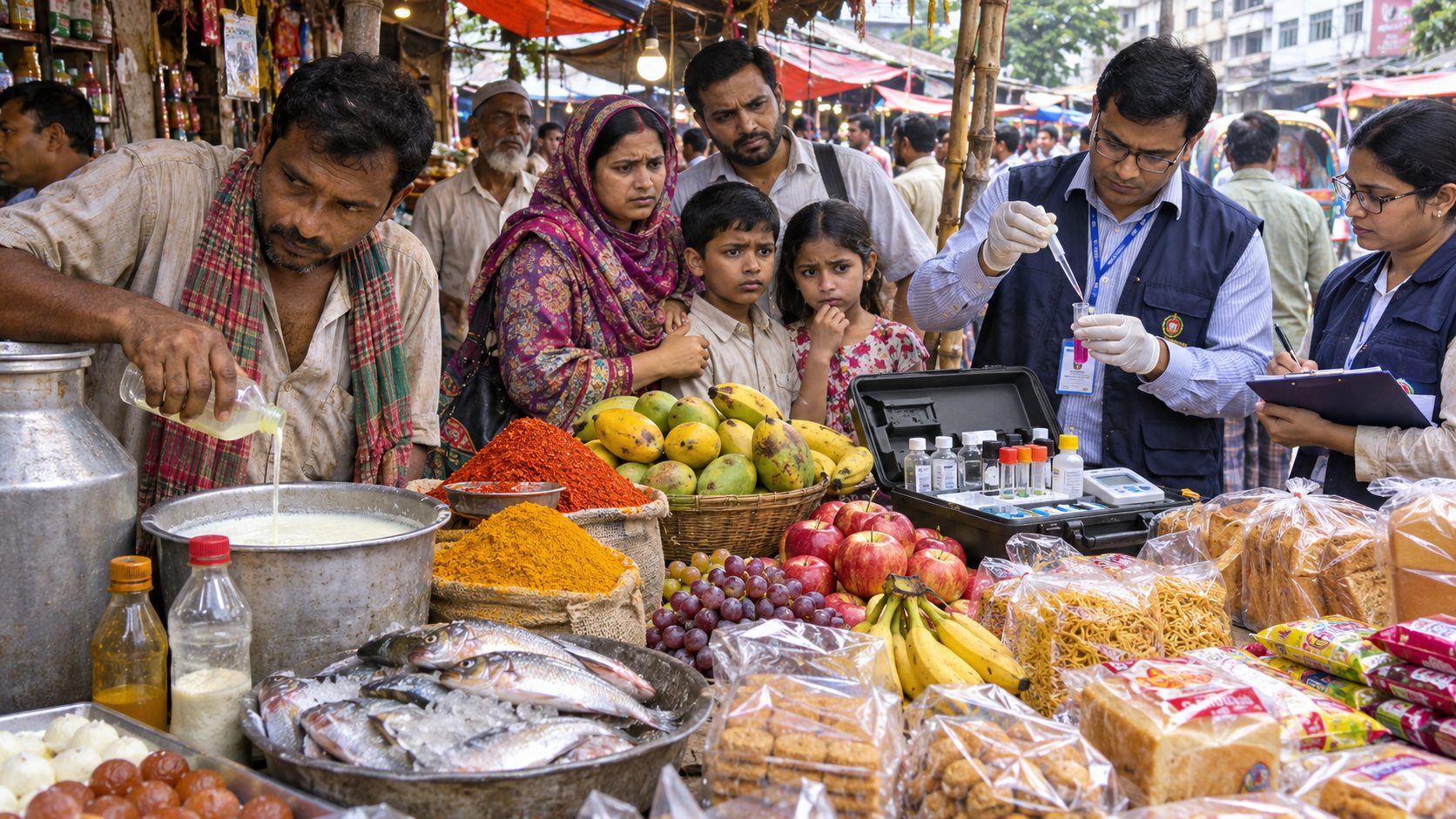
If everyday food becomes a source of illness, where is the guarantee of a safe life? A glass of milk in the morning, rice and fish at lunch, or fruit in the afternoon — when the very foods people eat to stay healthy contain harmful chemicals, substandard ingredients, or toxic substances, public health faces a serious threat. Allegations of food adulteration are not new in Bangladesh. From milk, fish, fruit, and spices to baby food, little appears spared from this risk. Profiteering by unscrupulous traders, weak oversight, and lack of public awareness continue to worsen the situation. This raises urgent questions: how widespread is food adulteration, what steps is the government taking, and what role must ordinary citizens play in ensuring safe food?
Food Adulteration: Compromising Quality for Profit
Food adulteration refers to mixing substandard, harmful, or unauthorized substances into food in ways that degrade its natural quality and purity. Dishonest traders do this to increase weight, make color and flavor more appealing, or extend shelf life artificially.
Reports of adulteration span a wide range of food items in Bangladesh. Common examples include adding water or unauthorized chemicals to milk, using harmful ripening agents on fruit, preserving fish and other foods with banned substances, and mixing artificial dyes or inferior fillers into turmeric and chili powders. Repackaging expired food, mislabeling products, and manufacturing food in unhygienic conditions also pose major food safety hazards.
Consuming adulterated or contaminated food can trigger diarrhea, vomiting, food poisoning, and infections. Prolonged exposure to harmful chemicals can damage the liver and kidneys and, in some cases, increase the risk of cancer. Children face heightened danger because their bodies and immune systems are still developing.
How Many Tested Samples Show Problems?
Measuring the exact scale of food adulteration nationwide is difficult because staffing and laboratory capacity remain insufficient to test every food item on the market regularly. Still, test results from the Bangladesh Food Safety Authority (BFSA) offer a troubling snapshot.
According to published data, in fiscal year 2024–25, BFSA tested 1,713 food samples and found adulteration, contamination, or nutritional quality defects in 571 of them — roughly 33.3 percent of tested samples. In the previous fiscal year, 2023–24, defects were detected in 216 of 1,381 tested samples, or about 15 percent.
However, these figures should not be read as meaning one-third of all food across Bangladesh is adulterated, since they reflect only the samples selected for testing. Even so, the findings underscore the need for much stronger monitoring of food quality.
Government Measures Against Adulteration
The government is deploying laws, agencies, and monitoring drives to combat food adulteration. Key bodies involved include the Bangladesh Food Safety Authority (BFSA), the Directorate of National Consumer Rights Protection, the Bangladesh Standards and Testing Institution (BSTI), the agriculture department, and local administrations.
Under the Food Safety Act 2013, regulations govern safety across production, import, processing, storage, transport, and marketing. Violations can also be prosecuted under the Consumers’ Right Protection Act 2009 and the BSTI Act 2018.
Mobile courts remain one of the government’s primary enforcement tools, conducting raids across markets, restaurants, food factories, and warehouses to detect irregularities. Authorities have also launched divisional mobile laboratories and moved to expand testing facilities to district level so food samples can be screened more rapidly.
Steps are also underway to strengthen testing of imported foods, as ensuring the safety of foreign food products is just as critical as monitoring domestic output.
Yet enforcement still faces bottlenecks, including manpower shortages, too few laboratories, and gaps in routine supervision. Experts stress that raids alone are not enough; consistent punishment for offenders and effective oversight from production to retail are essential.
Consumers’ Role in Ensuring Safe Food
Preventing food adulteration is not the government’s responsibility alone. Consumers also have vital responsibilities:
- Check labels and expiry dates: When buying food, check manufacturing and expiration dates, ingredient lists, and regulatory approvals. For packaged goods, look for the BSTI certification mark and relevant labeling details.
- Avoid unusual colors and unhygienic street food: Stay away from foods with unnatural color, odor, or taste, and exercise caution with uncovered street food or items prepared in unsanitary conditions. Because many adulterants cannot be spotted by sight or smell alone, sourcing from reliable sellers and storing food properly is crucial.
- Report suspected violations: Whenever adulteration or food-safety irregularities are suspected, notify the authorities. Complaints can be filed through the Bangladesh Food Safety Authority hotline at 16155, or with the Directorate of National Consumer Rights Protection.
Families and communities must also build awareness around food safety. Verifying claims before circulating accusations on social media and reporting evidence directly to proper authorities are also part of civic responsibility.
Social Awareness Must Pair with Law Enforcement
Food adulteration is no longer merely a market-management issue; it is directly tied to public health, the economy, and the well-being of future generations. While the government is expanding legal enforcement, inspections, and lab capacity, their impact depends on regular monitoring, skilled staffing, and sustained penalties for violators.
At the same time, producers, traders, and consumers all share responsibility. Traders must stop adding harmful substances in pursuit of excess profit, while shoppers must choose food products carefully.
Safe food is not a luxury — it is a basic human right. Government, businesses, and citizens must work together so the food meant to sustain life never becomes a cause of disease, protecting both the present generation and a healthier future.
বাংলায় মূল প্রতিবেদন পড়ুন · Read the original Bengali report