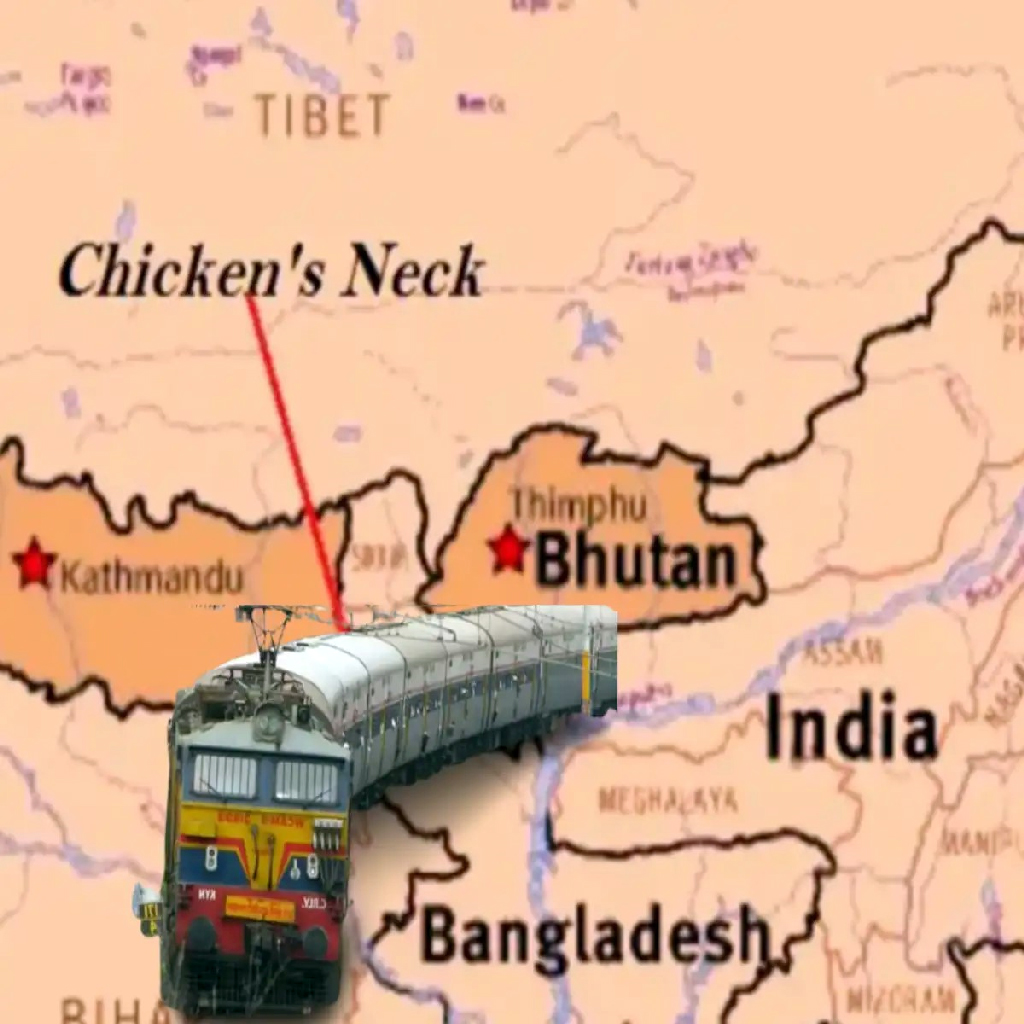
The language of billboards changes with every political shift, so it is natural that billboards and posters of Suvendu Adhikari now dominate West Bengal’s public spaces. But this time a deeper, strategically significant change is under way: strengthening the Siliguri Corridor and giving top priority to land acquisition for the construction of border roads and border fencing.
Suvendu Adhikari’s West Bengal government has taken several steps to strengthen the Siliguri Corridor, which is 60 kilometers long and 22 kilometers wide, the report said. The corridor connects India’s eight northeastern states with the rest of the country and is commonly known as the “Chicken’s Neck.” This narrow strip has always been a major strategic challenge for India.
To the south and west of the Chicken’s Neck lies Bangladesh, and to the north, China’s Tibet. The Siliguri Corridor in the middle also connects India with its neighbors Nepal, Bangladesh and Bhutan. It is linked at the same time to the Chumbi Valley, a highly strategic and disputed area near the tri-junction of India (Sikkim), China (Tibet) and Bhutan. The corridor borders Nepal, Bhutan and Bangladesh and is only 130 kilometers from the Chumbi Valley.
Highways, high-speed rail and an underground rail link to Assam
Three important decisions have been taken concerning the corridor in recent weeks, the report said. Last month, the West Bengal government gave in-principle approval to hand over parts of seven national highways to the National Highways Authority of India (NHAI) and the National Highways and Infrastructure Development Corporation Limited (NHIDCL). This has cleared the way for work to proceed on important infrastructure projects that had been pending for a long time.
These road sections were previously under the national highway wing of the state Public Works Department (PWD). Despite several requests from the central Ministry of Road Transport and Highways, the transfer proposals had been stalled for about a year. Among them is the 329.6-kilometer NH-312, which runs along India’s border with Bangladesh through Jangipur, Umarpur, Krishnanagar, Bongaon and Basirhat to Ghojadanga. Also included are NH-31 from the Bihar-West Bengal border to Gazole and NH-33 to Farakka.
In addition, four more sections, including the Sevoke Army Cantonment-Coronation Bridge-Kalimpong-West Bengal-Sikkim border road under the new NH-10, have been handed over to NHIDCL, a public-sector entity of the central government.
The Hasimara-Jaigaon section up to the India-Bhutan border, the Baradighi-Mainaguri-Changrabandha route up to the Bangladesh border and the Siliguri-Kurseong-Darjeeling hill road will now also come directly under central government supervision. A West Bengal government press note said infrastructure development on these seven sections would further strengthen connectivity with Sikkim, Bhutan and Bangladesh and improve transport in the North Bengal and Dooars region.
Railways Minister Ashwini Vaishnaw has also announced a bullet train from New Delhi to New Jalpaiguri (Siliguri). It would cut travel time from 20 hours to just six hours, reducing both geographical and psychological distance. The minister also said work on a proposed underground railway from Teen Mile Hat to Rangpani, and from there to Bagdogra, in North Dinajpur district along the strategically important Chicken’s Neck would be pushed ahead quickly.
The project falls under the Katihar division of the Northeast Frontier Railway. It spans parts of Darjeeling and North Dinajpur in West Bengal and Kishanganj district in Bihar. The aim of the project is to ensure safe, reliable and uninterrupted rail communication in this strategically sensitive corridor.
Assam Chief Minister Himanta Biswa Sarma described the underground rail link as a major strategic advance. In his view, it would create a safe and seamless transport corridor between the northeastern region and the rest of India.
A different reality: the Nepal, Bhutan and Bangladesh borders
Where do the strengths and challenges of India’s relations with its neighbors lie in this border region? India’s relations with Bhutan and Nepal are of a different kind from those with Bangladesh. Indian citizens can travel to Nepal and Bhutan without a visa, and entry is possible with a valid passport. India offers the same facility to citizens of these two countries.
Travel to Bangladesh, on the other hand, requires a visa. Earlier, residents of West Bengal and the northeastern states could travel using a limited India-Bangladesh passport issued by the district administration, but that arrangement was discontinued in 2013.
What is the Chicken’s Neck, and how important is it in Bangladesh-India-China geopolitics?
The India-Bangladesh border is far more tightly secured than the India-Nepal and India-Bhutan borders. Border fencing has already been completed along 1,647.7 kilometers, and the Adhikari government has sped up the land-transfer process to finish the remaining work quickly. Two more NHAI initiatives will help integrate the Siliguri Corridor into the logistics framework of the central government’s flagship highway program, the Bharatmala Pariyojana.
One is the Gorakhpur-Siliguri Expressway. The 519-kilometer controlled-access greenfield expressway from Gorakhpur in Uttar Pradesh to Siliguri will be built almost parallel to the India-Nepal border.
India is laying an underground railway in the Siliguri Chicken’s Neck, but why?
It will significantly cut travel time between the two ends and boost trade and the movement of people in the India-Nepal border area. Another project is the 506-kilometer Kharagpur-Siliguri economic corridor. It will connect North Bengal with the port city of Kharagpur through Bardhaman, Morgram, Malda and Raiganj.
This corridor will make freight transport faster, increase regional economic connectivity and provide logistics support to the tea, jute and agricultural trade centers along the route.
বাংলায় মূল প্রতিবেদন পড়ুন · Read the original Bengali report