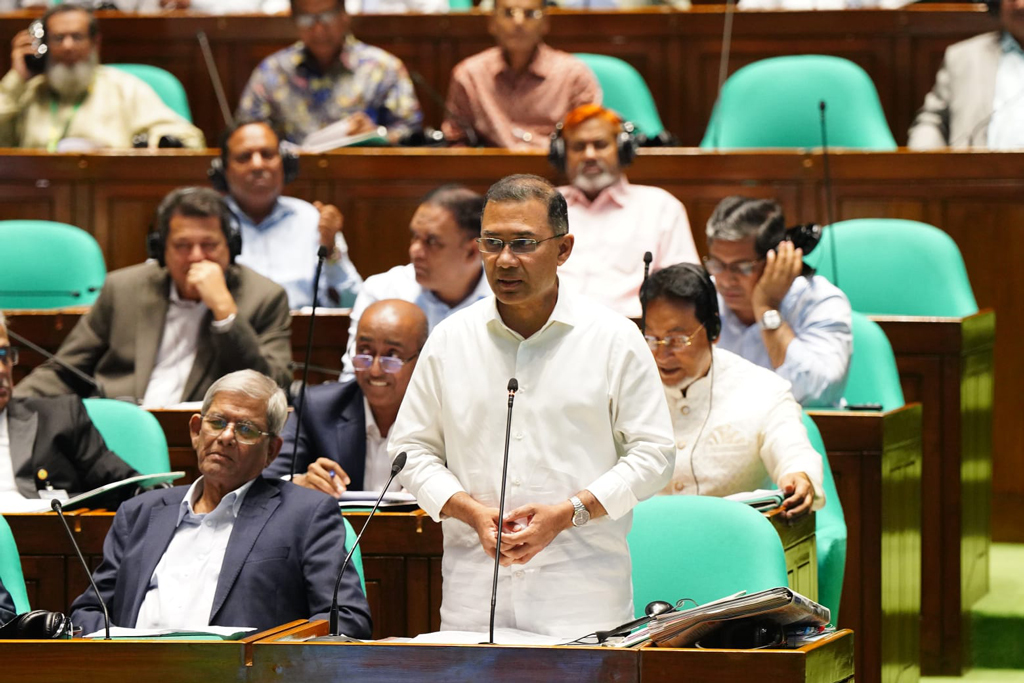
The country’s economy had been reduced entirely to rubble by the past collapse of the health sector, wrong policies and the laundering of thousands of crores of taka, Prime Minister Tarique Rahman has said. Production and investment had nearly stalled, ordinary people had taken their own lives after losing everything in the stock market, and foreign-currency reserves had reached a dire state, he said. At the same time, domestic and foreign loans taken for several “vanity projects” of the previous government had now become a heavy burden on the nation.
The prime minister made the remarks on Monday (29 June) while taking part in the general discussion on the proposed 2026-27 budget in the National Parliament, chaired by Speaker Hafiz Uddin Ahmed.
Agreeing with the remarks of the opposition leader, the prime minister said the government did not want to deny the country’s economic crisis, but nor would the crisis be used as an excuse. With the people’s support, the crisis would be tackled successfully through political goodwill and effective policy.
Noting that from its first days the government had made every effort to keep the prices of essentials within people’s reach during Ramadan, the prime minister said ordinary people had also felt the great pressure created by the oil crisis in the international market. This year’s budget had had to be drawn up against the backdrop of such a fragile economy and multiple crises.
The prime minister said the government was committed to upholding the sacred responsibility the people had given it through a free and fair election on 12 February. The government’s core philosophy, he said, was “Bangladesh First” and “Bangladesh for All.”
The prime minister described this year’s budget, presented under the title “A journey towards a democratic, humane and inclusive economy,” not merely as an annual statement of income and expenditure but as a vision for placing the economy on a new foundation.
Tarique Rahman said one of the main aims of the Tk 9,38,000 crore budget was to bring the economy out of the grip of a privileged few and ensure the participation of ordinary people. Despite the country’s limited resources, development spending had been raised by more than 50 percent to Tk 3,16,000 crore to keep the wheels of investment and production turning.
On public investment, the prime minister said the key consideration was not how much money was spent on a project, but what role that project would play in people’s lives and how much employment it would create.
The prime minister also outlined the government’s three-phase plan for implementing its economic strategy. In the first phase, he said, inflation would be controlled, foreign-currency management strengthened and the protection of marginalised communities ensured. In the second phase, revenue reform, restructuring of the banking sector and export diversification would be carried out. In the final phase, the foundations of a productive, innovation-driven and competitive economy would be cemented.
The prime minister said real development did not come simply from higher GDP growth. Real development came only when ordinary households found relief and young people got work suited to their abilities.
Tarique Rahman said a plan had been taken to build a Bangladesh based not on debt but on production and investment — one where young people would not have to wait year after year for jobs but would create their own employment. He also expressed a resolve to build an export-oriented, innovation-driven economy through the growth of domestic industry, the revival of sick industrial units and the creation of jobs in new industrial zones.
বাংলায় মূল প্রতিবেদন পড়ুন · Read the original Bengali report