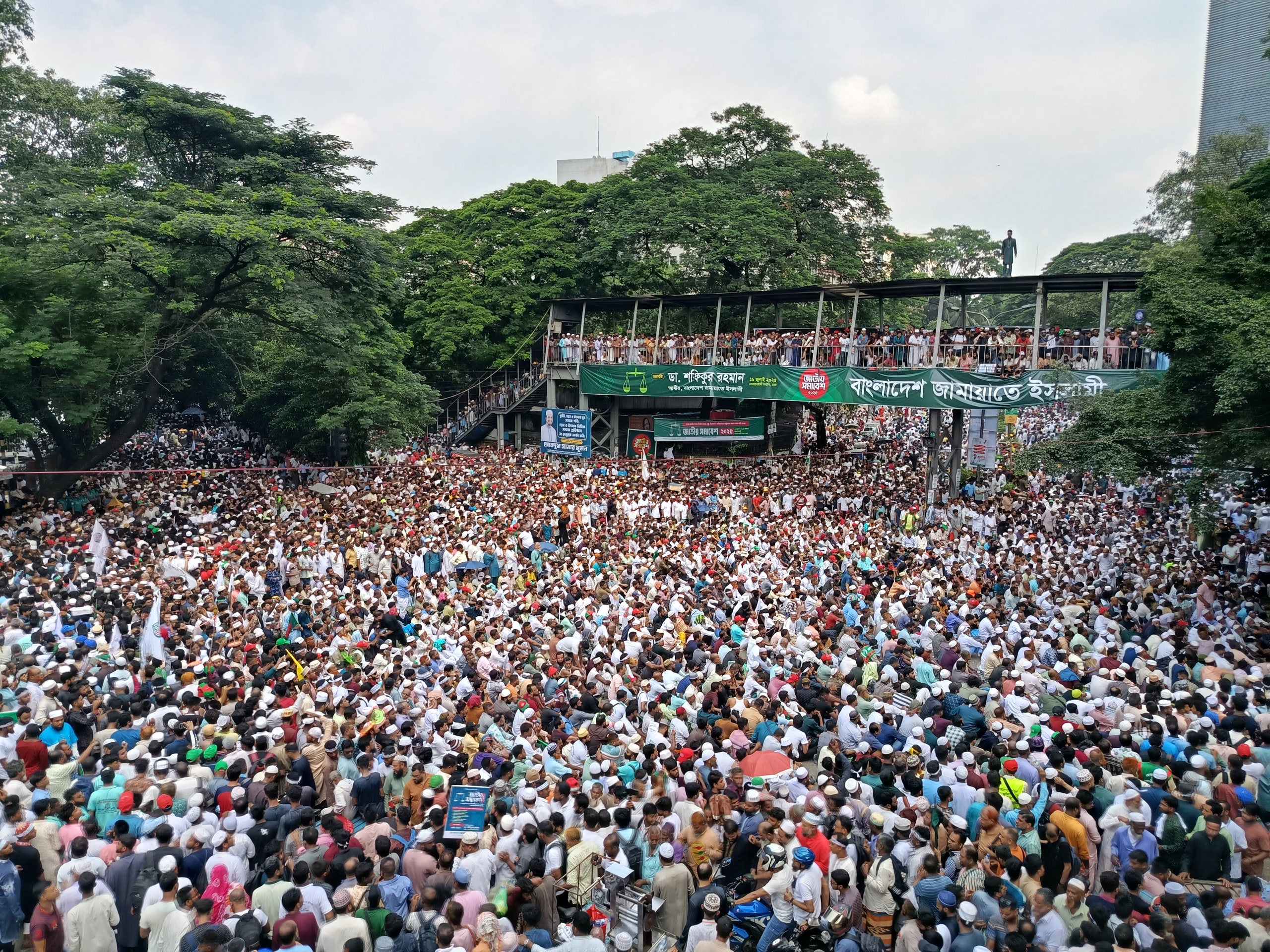
Bangladesh Jamaat-e-Islami, the main opposition party in parliament, is facing questions inside and outside its ranks over controversial remarks and conduct by several of its members of parliament and other leaders, according to a report in local media. Some political analysts believe the incidents are creating a negative reaction even among people who had long looked on the party favourably for ideological reasons.
The party’s policymakers reject that reading. They say the party as a whole should not be judged by a few isolated incidents, and point out that it took swift organisational action when allegations arose.
Jamaat won 68 seats in the 13th parliamentary election and received nine reserved seats for women. The most damaging episode since then involved Gazi Nazrul Islam, the MP for Satkhira-4. A video of him with a young woman at a hotel in Dhaka’s Moghbazar spread online on 21 July. He said she was his second wife. An internal party investigation found him guilty of moral misconduct and he was expelled. The party also wrote to the speaker and the chief election commissioner seeking the cancellation of his seat, which has not yet happened. The woman was found dead in his flat at the MPs’ residential complex on 20 September, and he is now in jail in a case over her death.
Other cases cited include remarks by MP and Islamic speaker Mufti Amir Hamza about women members of parliament, made at a mosque in Kushtia in late March, which led to a defamation case. A second defamation case followed his remarks about the power, energy and mineral resources minister, Iqbal Hasan Mahmud.
Several MPs have also faced allegations over the distribution of government grants and relief. The discretionary fund list of Narail-2 MP Ataur Rahman Bachchu included two allocations of Tk 10,000 in his daughter’s name. He said a personal assistant had prepared the list using his advance signature, and that he has removed the assistant. Allegations of favouring relatives or close associates were raised against two other MPs.
After the allegations emerged, the party sent written instructions to its MPs, signed by secretary general Mia Golam Parwar. They bar MPs from recommending or allocating government grants, relief or financial help to family members, relatives, in-laws, personal assistants and private secretaries or their relatives.
The party also suspended an upazila ameer in Jhenaidah accused of giving a government-allocated bicycle to his granddaughter instead of the intended recipient, cancelled the membership of a Sirajganj leader fined by a mobile court for stockpiling fertiliser, and expelled four activists over an attack on journalists in Dhanmondi.
Most recently, the conduct of Major (retd) Akhtaruzzaman has drawn criticism. He was arrested and sent to jail after a confrontation with officials at Dhaka’s international airport, where he was protesting against the harassment of passengers. Jamaat has stood firmly by him and is holding protests.
Mia Golam Parwar told local media that people’s affection for Jamaat was built on morality, ideals and discipline, and that the steps the party had taken had made it stronger. “On this question Jamaat does not compromise,” he said. Assistant secretary general Maulana ATM Masum said the party acted as soon as questions were raised, and that he knew of no other party that took action so quickly.
Political scientist Professor Dilara Choudhury said people still hold Jamaat in high regard on corruption and ethics, and called the party’s actions commendable. Badiul Alam Majumdar, secretary of the civil society group Shujan, said some of the incidents did not fit the ethics the party speaks of and had dented its image a little among ordinary people, but that it had acted quickly and made its position clear. Dr Abdul Latif Masum, a former vice-chancellor of Patuakhali Science and Technology University, said people do not expect such conduct from Jamaat, but that its quick action had to be taken into account.
বাংলায় মূল প্রতিবেদন পড়ুন · Read the original Bengali report