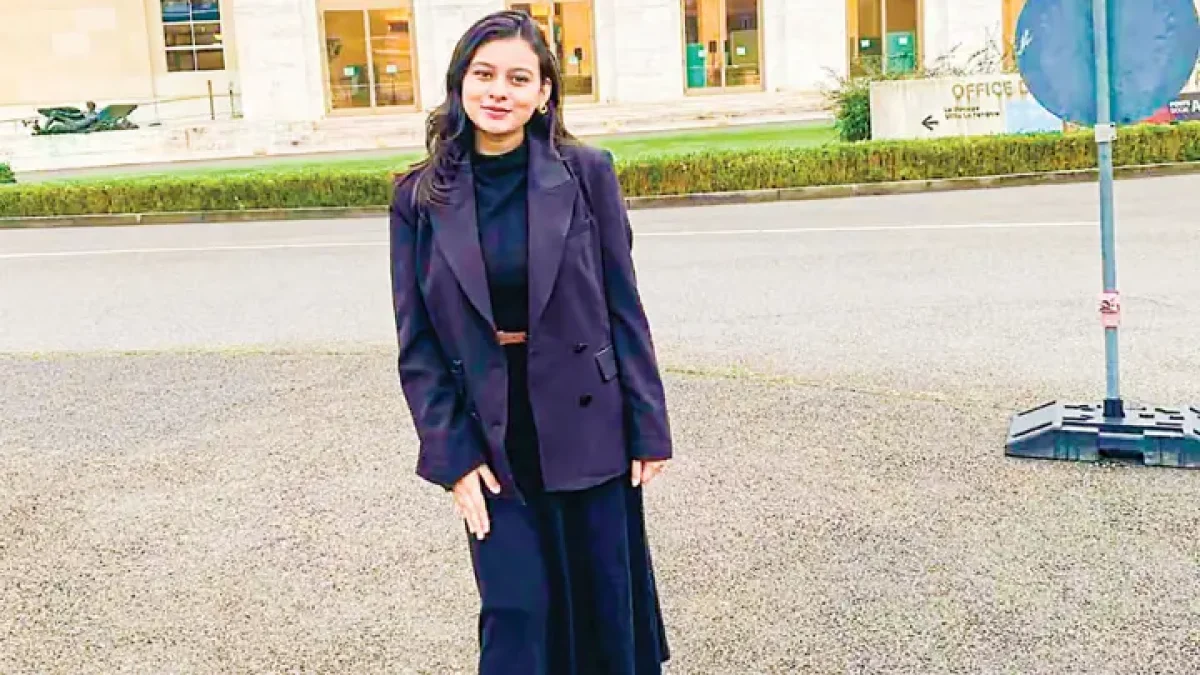
Young Bangladeshi researcher Marzana Akter has won a place in the Asian Scientist 100 list for 2026. For a scientist working on virology, microbiology, infectious disease, biosafety and biosecurity, it is a major recognition in her research career. She had earlier been chosen for the United Nations’ Young Women for Biosecurity Fellowship 2025, the first woman from Bangladesh to be selected. Beyond personal success, her achievement has given Bangladesh’s science a new profile internationally.
More than a personal achievement: Marzana does not see the list only as her own success. To her it is international recognition of science in Bangladesh, and proof that a researcher educated at Bangladeshi universities can take her place among Asia’s best scientists.
The UN fellowship showed her that science is never only a matter for the laboratory. Biosafety taught her ways of keeping laboratories, researchers and the environment safe. Biosecurity taught her how to prevent the misuse of sensitive biological materials, information and technology. Global health security showed her that infectious disease respects no border. And science diplomacy showed that a scientist can at once be a researcher, a partner in policymaking and a bridge for international cooperation. She stepped on to the global stage with the UN fellowship in 2025, and the recognition of the Asian Scientist 100 list for 2026 followed from that experience.
It began with curiosity: Marzana’s science began not in a modern laboratory but in the irrepressible curiosity of childhood. Why do people fall ill, how does a disease spread from one region to another, why is one person infected and another not in the same surroundings: such questions set her thinking. Her family never stifled her curiosity; they encouraged her to ask questions and look for reasons.
As she grew up she came to see that in a country like Bangladesh, health, food security, livestock and infectious disease are not only subjects of research; they are bound up with people’s lives, the economy and national security. From there she learned to see science as a social responsibility more than a profession.
Two universities and a dream: at Shahjalal University of Science and Technology she learned to question, to analyse and to seek the truth on the basis of evidence. It was there she learned that science is not something to be memorised but an unending process of finding answers through understanding and proof. Bangladesh Agricultural University was the turning point of her research life. Working hands-on with microbiology, virology, molecular diagnostics and livestock pathogens, she realised that research findings have a direct effect on agriculture, public health and the economy. There the importance of the One Health idea, which treats the health of people, animals and the environment as one, became clear to her.
In her words, Shahjalal University taught her to dream and the Agricultural University showed her the way to make the dream real.
The goal ahead: she wants to contribute to research whose effect is not confined to scientific journals but brings real change in disease prevention, laboratory biosafety, biosecurity awareness, One Health preparedness and evidence-based policymaking. Her long-term aim is to build a strong culture of biosafety and biosecurity in Bangladesh through research, training and international cooperation.
A message to the young: her first piece of advice is never to belittle your own dream. With a desire to learn, honesty, hard work and persistence it is possible to reach the international stage from any university in Bangladesh. Research is not only for enriching a CV; choose questions whose answers will be of use to society. Good research begins with a good question. To young women she says: “The path may not be easy, but if you make the path, many others will be able to walk behind you.” Her achievement is thus not only one researcher’s success but a new horizon of confidence and possibility for Bangladesh’s young scientists.
বাংলায় মূল প্রতিবেদন পড়ুন · Read the original Bengali report