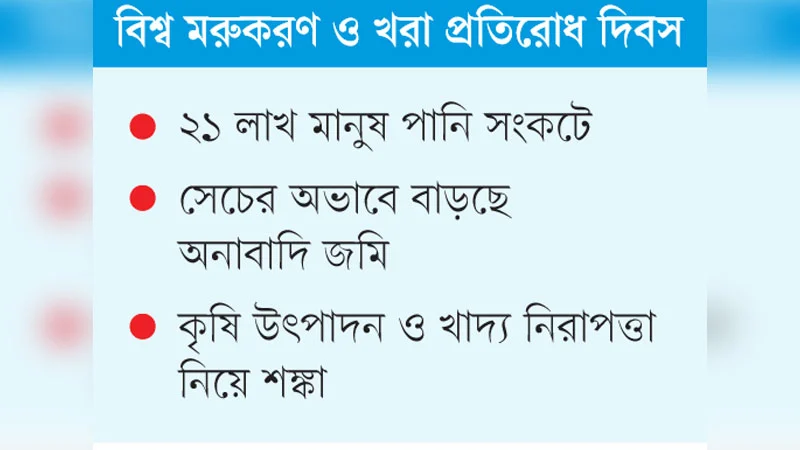
The vast Barind tract of the northwest is slowly heading toward a severe water crisis. The groundwater that sustained farming in the region for several decades is now falling fast. In many areas, deep tube wells no longer draw water as they once did. In some places the water table has dropped to more than 200 feet below the surface.
Villagers must walk hundreds of meters for drinking water. Vast stretches of farmland are going uncultivated for lack of irrigation. It is against this backdrop that World Day to Combat Desertification and Drought is being observed today, Wednesday.
The water table is falling fast
The Barind region has comparatively low and erratic rainfall. Over several decades, a revolution in farm output came on the back of reliance on groundwater. From the 1980s, the Barind Multipurpose Development Authority (BMDA) installed thousands of deep tube wells. As a result, the once drought-prone region began producing boro rice, wheat, maize and various vegetables. But behind that success a big crisis has built up. Excessive water extraction, the effects of climate change and declining rainfall mean groundwater is not being replenished.
According to data from the Water Resources Planning Organisation, between 1985 and 1990 the water table in the Barind region stood at 26 to 30 feet below the surface. By 1994 it had fallen to 35 feet. It reached 51 feet in 2004 and 60 feet in 2013. At present, in many areas the water table is below 80 to 90 feet. In some places, even digging beyond 113 feet brings no water.
Recent research has found that more than 82 percent of the Barind region faces water stress. A joint study by the development organization BRAC, the Global Center on Adaptation and the International Water Management Institute said that if current trends continue, groundwater reserves in the region will reach a critical stage within two decades.
As the situation worsened, the government last year declared 1,469 mauzas across 47 unions in 25 upazilas of Rajshahi, Naogaon and Chapainawabganj as “extremely high water-stress” areas. In addition, 884 mauzas were identified as “high water-stress” and 1,240 mauzas as “medium water-stress” areas. By official estimates these areas cover around 2,787 square kilometers, where some 21 lakh 5 thousand people are facing water stress. Under the Water Act 2013, a decision was taken to restrict the use of groundwater in these areas to drinking water only. Restrictions were also imposed on installing new tube wells. In reality, groundwater extraction continues in many areas.
The water crisis is no longer confined to agriculture. Many villages now face a shortage of safe drinking water. In the village of Uchadanga in Tanore, Rajshahi, hundreds of deep tube wells have stopped working. Even after Dasco Foundation drilled to a depth of 1,400 feet, an adequate water table could not be found in many parts of that village.
Irrigation costs rise, output falls
The water crisis is having a direct impact on farming. Krishani Shabdarani, a farmer in Rajshahi, said that one hour of irrigation used to cost 90 taka but now costs 120 taka. The price of fertilizer has risen, labor wages have risen, yet yields have fallen. Although government guidelines allow a maximum of 11,400 deep tube wells in the area, in reality thousands of shallow and deep tube wells have been installed under private ownership. According to data, 62,000 shallow tube wells and around 4,000 deep tube wells have been installed across the three districts. The water-extraction capacity of these wells is roughly equal to that of 28,000 deep tube wells.
Mohammad Ali, head of BRAC’s Water, Sanitation and Hygiene programme in Bangladesh, said building climate resilience will not be achieved by increasing the availability of safe water alone. To that end, investment is needed in water-efficient irrigation systems, climate-resilient crops, climate-smart agriculture and water management based on local community participation.
Dr. Md. Abul Kasem, additional chief engineer of the Barind Multipurpose Development Authority (BMDA), said the main reason for the steadily mounting pressure on groundwater in the Barind region is the uncontrolled use of privately owned tube wells. According to government guidelines, the area should have a maximum of 11,400 tube wells. Of these, BMDA operates 8,400. But the number of privately operated tube wells has reached around 28,000.
Syeda Rizwana Hasan, adviser to the Water Resources Ministry of the former interim government, said: “To ensure the replenishment of groundwater, we had drawn up an initial action plan. If the current government implements it, the necessary changes can be brought about in the Barind region’s farming system.”
বাংলায় মূল প্রতিবেদন পড়ুন · Read the original Bengali report