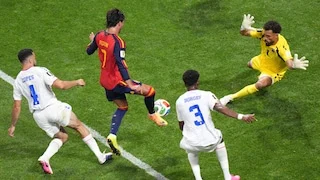
First, a statistic. Spain held 74 percent of possession across the whole match, with 764 successful passes and eight shots at the opponents’ goal. The numbers suggest Spain should have won easily. But the result was Cape Verde 0, Spain 0. Cape Verde’s name comes first on this scoresheet because holding a side as strong as Spain at bay for the entire match was a real achievement — and that honor is theirs.
By dropping points in their first World Cup match, Spain underscored a hard truth once again: football is not only a game of possession, but also of taking up space. And it was on exactly that point that Luis de la Fuente’s side came undone.
Spain dropped points for one reason — excessive possession, but no effective plan to break down the defense. There was tiki-taka, what might be called a game of cat and mouse. But there were no vertical attacks, no changes of pace, no passes capable of slicing through the defense. As a result, the ball circulated at Spain’s feet all match, but no real goal threat was created.
The most striking statistic concerns Spanish striker Mikel Oyarzabal. In the first 30 minutes of the match he did not touch the ball even once. No such thing had happened at a World Cup since 1966. It is not just a personal record, but a symbol of the failure of Spain’s entire attack.
Where was the tactical error?
The problem began with Spain’s attacking plan. Mindful of Spain’s strength, it was clear Cape Verde would set up a low-block defense from the start. There was almost no gap between their two defensive lines. But the kind of quick, direct attacking football needed to break that block was something Spain could not even come close to producing. Instead they played pass after pass, keeping the ball only among themselves. The picture was this: center-back to midfield, midfield to full-back, back to midfield again — the ball going up once and coming back down. But there was hardly any attempt to break the opponents’ last line of defense.
Want proof? The clearest proof is in the record of striker Mikel Oyarzabal not touching the ball. It was as if he had gone off to some remote island. He was on the pitch, but not in the match. Spain’s tactical setup pushed the striker out of the game. Despite all that possession, the whole team could not effectively supply him the ball. Perhaps in the next match he could claim to be played as a midfielder rather than a striker.
Tiki-taka’s old affliction
This is not a new problem. At the 2014 World Cup, despite enjoying more possession against the Netherlands and Chile, Spain went out at the group stage. At the 2018 World Cup, they played more than a thousand passes against hosts Russia in the round of 16 but were knocked out on penalties. At the 2022 World Cup, despite holding 77 percent of possession against Morocco, they failed to create a single effective chance — and again went out on penalties.
This time, the first match of the 2026 World Cup told the same story. There is the ball, there are the passes, there is the control — but no goal. The tiki-taka that once made Spain world champions now seems to be their biggest limitation. In a wider sense, the problem!
— What does it mean?
Tiki-taka not only fails to win the World Cup, it sends you out in the first round!
Not the ball, but the breakthrough
In modern football, possession alone is no guarantee of success. What is needed is pace, changes of direction, passes that break the last line of defense, third-man runs and attacks into the spaces behind the defense. It was precisely these fundamentals that were absent from Spain’s play. A large part of Spain’s 764 passes turned into meaningless statistics.
Cape Verde knew well that Spain would adopt a ball-retention approach. So they patiently held a low block in their own half and waited. They let Spain play their sideways passes, but did not give an inch in front of the box. Spain took shots, but they came back off the wall of Cape Verde’s defense. And the few that reached the posts were kept out by Cape Verde goalkeeper Vozinha, standing like a tireless sentry. He was the hero of the goalless draw.
There is no such thing as a ‘small team’
Disappointed though they were at the final whistle, Spain coach Luis de la Fuente tried to stay positive: “We should have won this match. We created plenty of chances. But in the final moments we lacked sharpness and clinical finishing. We have to improve before the next match.”
The Spanish coach also praised Cape Verde. He said: “They played a very low block. They were also physically very strong. In football there is no longer any such thing as a small team.”
A warning for Spain
In the group stage Spain now face Saudi Arabia and Uruguay. To reach the knockout rounds they must find not only possession but also a way to score. Otherwise the old curse of tiki-taka could once again end Spain’s World Cup dream. Spain came to this World Cup as one of the top favorites. But after a disappointing performance in the very first match, they now face a nightmare scenario.
World football has changed a great deal. In modern football, vertical passing matters more than horizontal passing. Breaking down the opponents’ defense matters more than keeping the ball. If Spain do not walk the path of that reality in their next match, then … “Adios Copa del Mundo.”
That is Spanish. In Bengali: goodbye, World Cup!
বাংলায় মূল প্রতিবেদন পড়ুন · Read the original Bengali report