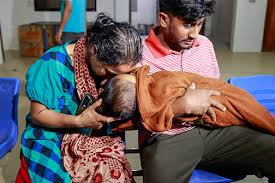
Deaths from measles and measles-like symptoms are rising at an alarming rate in Bangladesh. Three more people died on Friday, taking the toll over roughly the past four months to 750, according to the Directorate General of Health Services (DGHS). Over the same period, 128 new measles cases were confirmed and 901 people were found to have measles symptoms.
The figures were released in a DGHS press statement on Friday (July 10). The three latest victims had been undergoing treatment at hospitals in Dhaka, Sylhet and Barishal, the directorate said.
According to official figures, 93 people have died of confirmed measles in the country since March 15, while another 657 have died with measles symptoms – bringing the total to 750.
By division, the most measles-symptom deaths were recorded in Dhaka, with 285. Rajshahi followed with 89, Sylhet 88, Mymensingh 62, Chattogram 53, Barishal 42, Khulna 29 and Rangpur 9.
In the past 24 hours, 901 people were admitted to hospital with measles or its symptoms – 311 in Dhaka division, 190 in Chattogram, 110 in Barishal, 65 in Sylhet, 52 in Mymensingh, 46 in Khulna, 17 in Rajshahi and 9 in Rangpur.
The DGHS’s latest data show that 92,831 measles patients have been admitted to hospitals across the country so far, of whom 89,234 have been discharged after treatment. The number of patients identified with measles symptoms now stands at 109,899, and confirmed measles patients at 13,326.
Public-health experts have called for swift, effective measures to tackle the situation. Dr. Lelin Chowdhury said stronger steps were urgently needed in health management, including expanding the ambulance network, field hospitals and emergency ICU capacity. He added that genotype testing should be carried out urgently to determine whether a new measles genotype was spreading in the country.
Public-health expert Dr. Mushtaq Hossain called for part of the ICU capacity in government hospitals to be reserved for treating children, and for high-flow oxygen services to be expanded for critically ill patients. High-flow oxygen had saved many lives during the COVID-19 pandemic, he said, and similar preparation was essential for treating children now. If necessary, he added, the NICU capacity of private hospitals and children’s hospitals should also be used.
বাংলায় মূল প্রতিবেদন পড়ুন · Read the original Bengali report