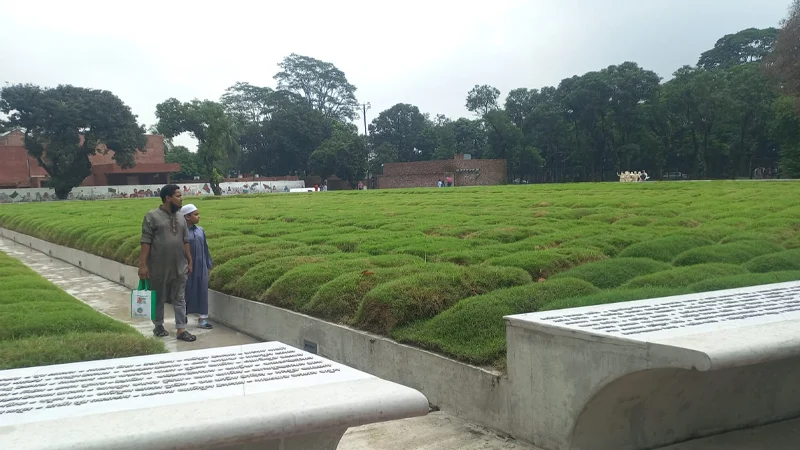
The July 36 Mass Uprising Memory Museum. Even before entering the main building, visitors’ eyes fall on a symbolic graveyard. There, memorial plaques have been built in memory of the students and people martyred in the mass uprising, with plaques all around engraved with the names of victims of extrajudicial killings and enforced disappearances. Visitors halt here.
On Thursday, the first day it opened to the public, this memory museum — at the northern corner of the national parliament in Dhaka’s Sher-e-Bangla Nagar — drew a crowd of visitors. But even amid the crowd, visitors paused longest before that symbolic grave at the entrance. Some read the martyrs’ names, some took photographs, and some stood for a few moments with their eyes closed, saying nothing — as if preparing themselves, before going inside, to stand before a sorrowful yet glorious history.
Visitor Ashikur Rahman said: “In time the rainwater will dry and this plaque will shine again. But the history, sacrifice and memory of struggle written here will never be erased. A nation’s greatest monument is not brick and stone, but memory living in people’s hearts.”
Beside the symbolic grave, Md Hasan — father of Sajol Miya, killed on the Dhaka-Chattogram highway during the July movement — stood for a long time, repeatedly wiping his eyes as he looked at the plaque bearing his son’s name.
Md Hasan said: “My son was martyred by police fire on 19 July 2024. Coming here, I keep remembering my son. I had thought the country would change after the movement. But much of that hope remains unfulfilled.”
Sajol Miya’s younger brother Ibrahim Khalil said: “My brother’s belongings, including his bloodstained shirt and trousers, have been kept here. I came to see them. It feels as if my brother is still among us.”
Ganabhaban, once known as the centre of state power, is now a memory museum. In the face of the mass uprising, the Awami League government fell on 5 August 2024. On the second anniversary of the government’s fall, a day after its inauguration, the museum was opened to the general public for the first time on Thursday.
The ground floor presents various events of ousted prime minister Sheikh Hasina’s long rule — enforced disappearances, killings, repression, political persecution, a list of those martyred in “logi-boitha” attacks, the Shapla Chattar massacre, information on the Awami-era judiciary and the Skype scandal, and documents, photographs and documentaries of various notable events. At the very entrance, the real scene of Ganabhaban after 5 August is presented through 3D projection, alongside artworks from the days of the movement, documents of various events and visual presentations.
The second floor holds the personal mementos of those martyred in the July mass uprising — identity cards, bloodstained clothes, documents of women’s participation, photographs of the movement, video-based 3D exhibits and various digital installations. On the walls are the movement’s slogans, symbolic sculptures of torture at the “Aynaghar,” and photographs of the families of the disappeared. The bed and chair used by the ousted Sheikh Hasina have also found a place in the museum.
Touring the galleries, one saw young men and women who had come to learn history, as well as parents who had lost children, injured protesters and ordinary people from far away, matching every displayed photo and artefact with their own memories.
July Mass Uprising Memory Museum director-general Tanzim Ibne Wahab said the museum was not merely an exhibition centre but could become an important archive of state, society and civic memory. The first day’s experience showed that people were coming here not just to see but to feel, he said — and that feeling began with standing for a few moments before the symbolic grave at the entrance.
From Ganabhaban to the July Mass Uprising Memory Museum
After winning the 1996 election and becoming prime minister, Sheikh Hasina began living at Ganabhaban. By a cabinet decision at the time, Ganabhaban was leased in her name for a token price of one taka. In 2001, the caretaker government led by Latifur Rahman cancelled the lease, and after Sheikh Hasina left Ganabhaban it was not seen in use for several years.
After the Awami League came to power in 2009, Sheikh Hasina first stayed at the state guesthouse Jamuna. After Ganabhaban’s renovation, she began living there in March 2010, and most of the work of her rule was run from Ganabhaban.
After the ousted Sheikh Hasina fled to India on 5 August 2024, thousands of people entered the house and carried out vandalism and looting. That day, the walls and floors of the residence were torn apart in the public’s fury. When converting it into a museum, the language of the public’s anger on the walls was left unchanged. Considering visitors’ health risks, debris was removed from the floors of all rooms except one. The ground floor displays the history of Sheikh Hasina’s 16 years of rule; the second floor displays the history of the July mass uprising.
বাংলায় মূল প্রতিবেদন পড়ুন · Read the original Bengali report