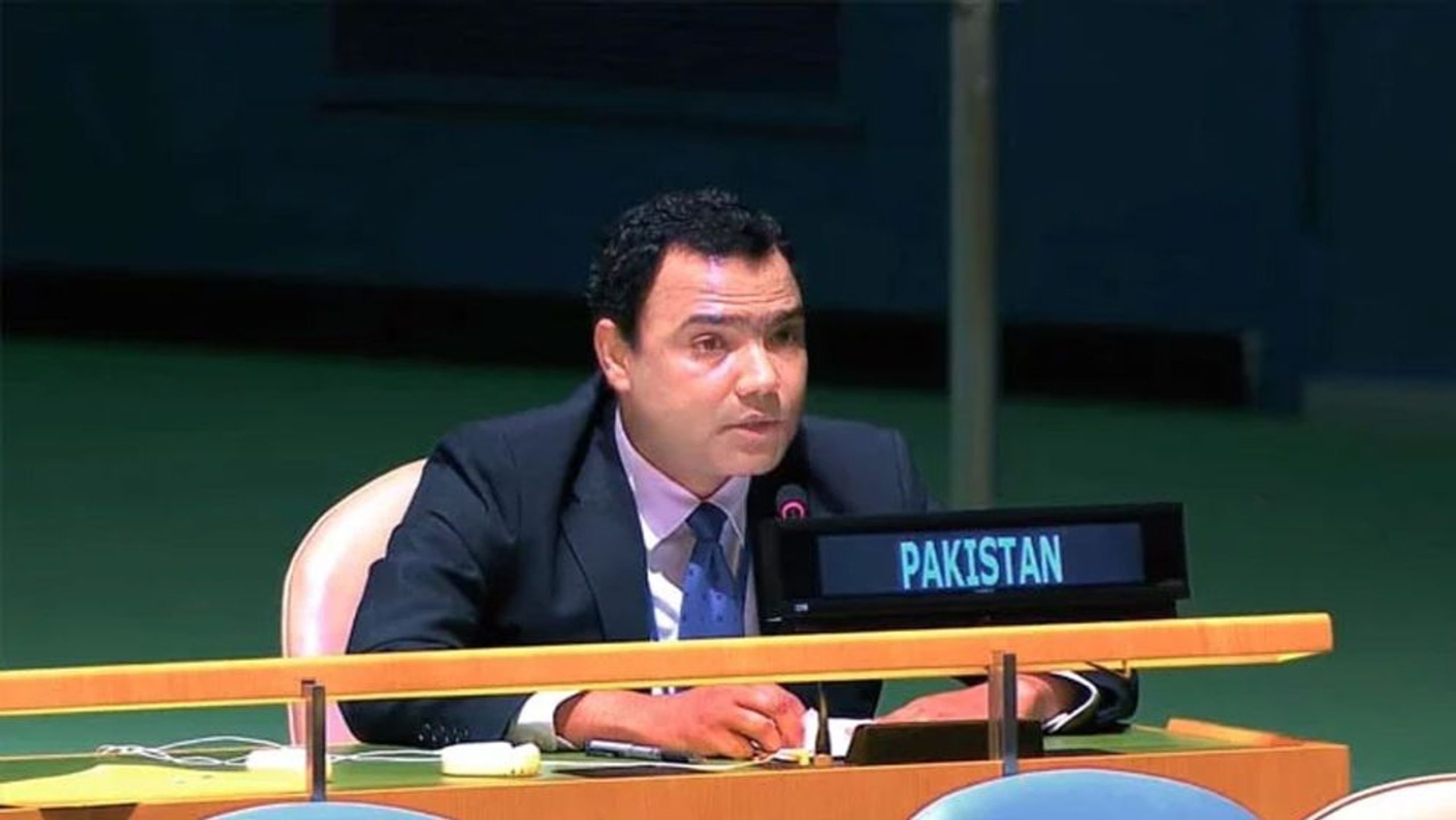
Pakistan has bluntly told the UN General Assembly that Jammu and Kashmir “never was, is not, and never will be” an integral part of India. Islamabad made the remark rejecting New Delhi’s claim in a fresh diplomatic clash over the disputed region on the world stage. After India’s permanent representative to the UN, Parvathaneni Harish, claimed Kashmir as an integral part of India, Pakistani diplomat Gul Qaiser Sarwani exercised the right of reply to make the remark.
Reminding the 193-member General Assembly, Sarwani said India-occupied Jammu and Kashmir is an internationally recognised disputed territory that remains on the UN Security Council’s agenda, and that the historical, legal and international character of the dispute cannot be changed by spreading any confusion. He stressed that Jammu and Kashmir never was, is not, and never will be an integral part of India. Earlier, Pakistan’s permanent representative to the UN, Asim Iftikhar Ahmed, said the Security Council’s annual report reflected the continuing relevance of both the Jammu and Kashmir and Palestine crises, which need resolution under the relevant UN resolutions; the diplomatic war of words began after his remarks.
In his address, Ambassador Asim noted that more than 20 letters or communications on the “India-Pakistan question” had been brought to the Security Council’s attention from January to December 2025, and that the Council held a closed-door meeting on the issue in May 2025 — proof, he said, that the Kashmir dispute remains a focus of the Council’s attention more than seven decades after being placed on its agenda. Pakistan believes a just settlement of the Kashmir dispute, in line with the relevant Security Council resolutions and the aspirations of the Kashmiri people, is needed for lasting peace in South Asia, and that the Kashmiri people must be given the chance to exercise their right to self-determination.
On Palestine, the Pakistani representative said the ongoing tragedy, especially the situation in Gaza, was a top priority on the Security Council’s agenda; after repeated failures to stop the bloodshed, the Council had finally adopted resolution 2803 backing the Gaza peace plan, and full and faithful implementation of that resolution was essential. He reaffirmed Pakistan’s support for an independent, sovereign and contiguous Palestinian state on pre-1967 borders with Jerusalem (Al-Quds Al-Sharif) as its capital, and the Palestinian people’s right to self-determination. He also said the report highlighted the essential role of UN peacekeeping and special political missions, that Pakistan is committed to strengthening peacekeeping, and that the use of the “veto” remains a major concern.
বাংলায় মূল প্রতিবেদন পড়ুন · Read the original Bengali report